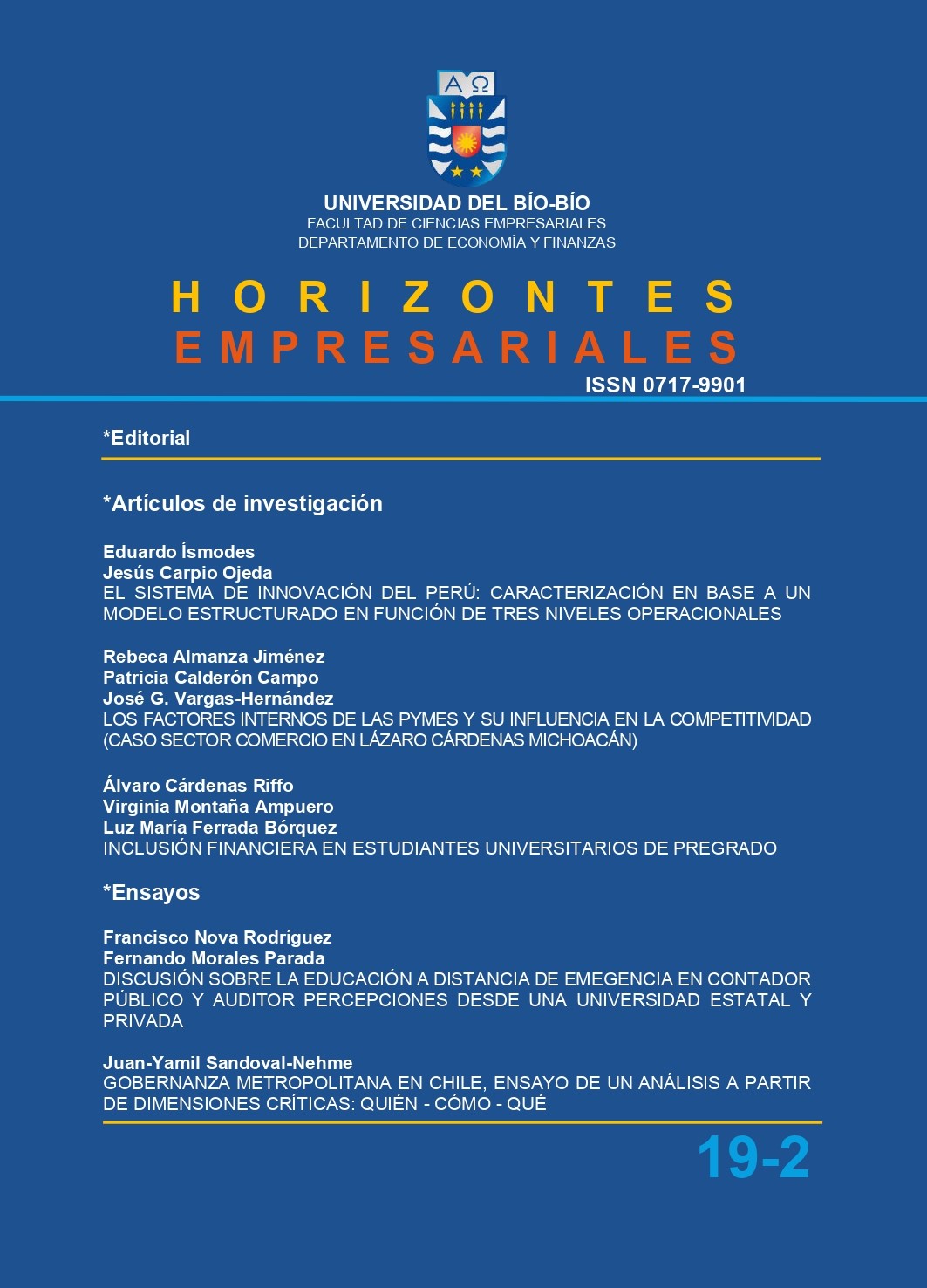
A discussion on emergency distance education in public accountant and auditor program, perceptions from a state and private university
DOI:
https://doi.org/10.22320/hem.v19i2.4537Keywords:
Chile, Covid-19, Higher education, Public accountantsAbstract
Like all sectors of society, the pandemic has strongly impacted Higher Education Institutions (IES). Distance education has been implemented in an accelerated and absent way of planning in response to the urgent need not to gather students and teachers, but at the same time, to be able to continue the training process. This work reflects on this, based on the perception of managers and teachers of Public Accountant and Auditor comparatively on offer of private and public IES, also territorially differentiated between the capital and regional. Among the results we see more coincidences than differences in the perception of teachers and managers, such as increased teaching effort, problems in evaluation mechanisms and achievement of new learnings.
References
Abreu, J. (2020). Tiempos de Coronavirus: La Educación en Línea como Respuesta a la Crisis (Times of Coronavirus: Online Education in Response to the Crisis). Daena: International Journal of Good Conscience, 15(1), 1-15.
ACCA Global. (17 de Junio de 2020). ACCA Global. https://www.accaglobal.com/gb/en/cam/coronavirus/covid-impact-education.html
Álvarez, M., Gardyn, N., Iardelevsky, A., y Rebello, G. (2020). Segregación Educativa en Tiempos de Pandemia: Balance de las Acciones Iniciales durante el Aislamiento Social por el Covid-19 en Argentina. Revista Internacional de Educación para la Justicia Social, 9(3).
Astudillo, M., García, J., Jiménez, V. y Parra, C. [CEFECH] (2020). Estudio y propuestas de alivio económico para la educación superior chilena por la crisis del COVID-19.
Cao, W., Fang, Z., Hou, G., Han, M., Xu, X., Dong, J., & Zheng, J. (2020). The psychological impact of the COVID-19 epidemic on college students in China. Psychiatry research, 112934.
Camacho, A., Fuly, P., Dos Santos, M., y De Menezes, H. (2020). Students in social vulnerability in distance education disciplines in times of COVID-19. Research, Society and Development, 9(7).
CEPAL (2020a). Las oportunidades de la digitalización en América Latina frente al Covid-19. https://scioteca.caf.com/bitstream/handle/123456789/1541/Las_oportunidades_de_la_digitalizacion_en_America_Latina_frente_al_Covid-19.pdf?sequence=5&isAllowed=y
Consejo de Rectores de Universidades Chilenas (CRUCH). (2020). DECLARACIÓN PÚBLICA CONSEJO DE RECTORES DE LAS UNIVERSIDADES CHILENAS: CONTRIBUCIÓN Y CONTINUIDAD DE LA EDUCACIÓN SUPERIOR. Consejo de rectores.https://www.consejoderectores.cl/noticia/867/declaracion-publica-consejo-de-rectores-de-las-universidades-chilenas:-contribucion-y-continuidad-de-la-educacion-superior.html
Educación 2020. (Abril de 2020). Educación 2020. educacion2020.cl/encuestas/estamosconectados/Policy_Brief_EstamosConectados%20_E2020.pdf
Espinosa, A. (2020). Desafíos de la educación superior en tiempos de pandemia: la contingencia inesperada. LA HUMANIDAD A PRUEBA, 25.
Harari, Y. (2018). 21 lecciones para el siglo XXI. Editorial Debate.
Harari, Y. N. (Abril de 2020). National Business Advisors. Obtenido de https://nbanet.co.za/wp-content/uploads/2020/04/60-MA-NEWS-NBA.pdf
Himmel, E. (2002). Modelos de análisis de la deserción estudiantil en la Educación superior. Revista Calidad en la Educación, 17, 91–108.
Hodges, C., Moore, S., Lockee, B., Trust, T., & Bond, A. (2020). The difference between emergency remote teaching and online learning. Educause Review, 27.
IESALC (2020) “COVID-19 y educación superior: De los efectos inmediatos al día después. Análisis de impactos, respuestas políticas y recomendaciones”. Recursos disponible http://www.iesalc.unesco.org/wp-content/uploads/2020/04/COVID-19.pdf en línea [24.05.2020]
IFAC (2018a) “Information and Communications Technology Skills IAESB Task force research Online Survey Analysis”. Version 1.2
https://www.ifac.org/system/files/meetings/files/6-4-Agenda-6-4-Updated-IAESB-Survey-Report-IAESB-Nov-2017-mtg.pdf en línea [23.06.2020]
IFAC (2018b) Information and communications technology literature review https://www.iaesb.org/publications/information-and-communications-technology-literature-review-0 en línea [23.06.2020]
Lee, K. (9 de Marzo de 2020). The Conversation. Obtenido de https://theconversation.com/coronavirus-universities-are-shifting-classes-online-but-its-not-as-easy-as-it-sounds-133030
Ministerio de Salud. (15 de marzo de 2020). MINSAL. Obtenido de https://www.minsal.cl/ministerio-de-salud-confirma-primer-caso-de-coronavirus-en-chile/
Navarro, R. (2020). Reflexiones sobre el modelo universitario visto desde la crisis del coronavirus. Revista Reflexiones, 99(2).
Pardo, H. y Cobo, C. (2020). “Expandir la Universidad más allá de la enseñanza remota de emergencia. Ideas hacia un modelo híbrido post-pandemia”. Edita Outliers
School. Barcelona. http://outliersschool.net/project/Universidadpostpandemia/
Tinto, V. (1975). Dropout from higher education: A theoretical synthesis of recent research. Review of Educational Research, 45, 89–125.
SIES (2020) Informe 2020: Matricula en educación superior. Julio de 2020 https://www.mifuturo.cl/wp-content/uploads/2020/07/Informe-matricula_2020_SIES.pdf en línea [16.08.2020]
Sahu, P. (2020). Closure of universities due to Coronavirus Disease 2019 (COVID-19): impact on education and mental health of students and academic staff. Cureus, 12(4).
Saxena, K. (2020). Coronavirus Accelerates Pace of Digital Education in India.