
X-ray densitometry and colorimetry for the characterization of ten native Brazilian timber species
DOI:
https://doi.org/10.22320/s0718221x/2025.34Keywords:
Brazilian native species, CIELAB color system, tropical timber, wood colorimetry, wood densityAbstract
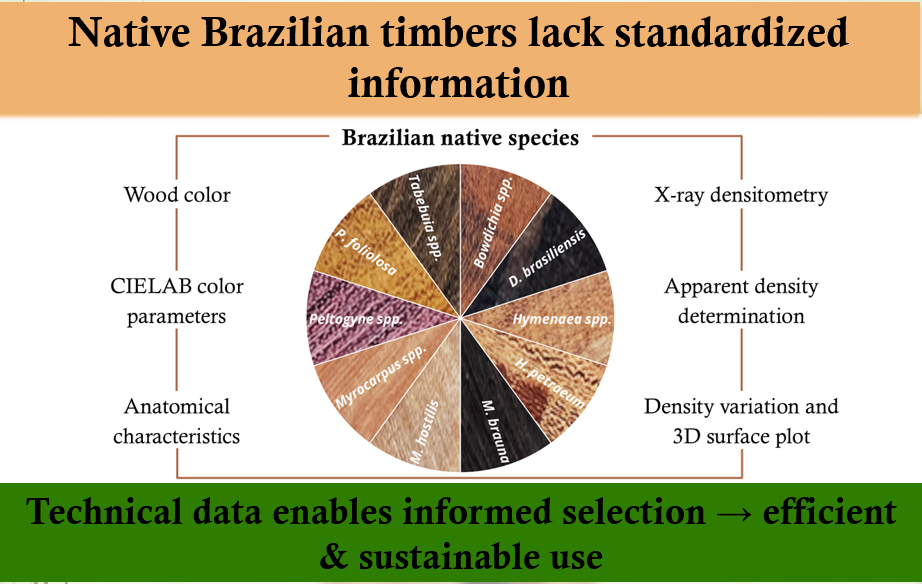
The research responds to the limited availability of technical data on native Brazilian woods, which constrains their industrial application and sustainable management. The commercial use of timber from native Brazilian species is hindered by a scarcity of data on fundamental properties related to wood quality, limiting its use in the wood industry. This study sought to characterize the timber of ten native Brazilian species using X-ray densitometry and colorimetric analysis. Timber samples of various ages and 2 mm thickness were evaluated. The X-ray images enabled the identification of anatomical characteristics such as wood porosity and parenchyma. Densitometric profiles showed woods with high densities (ranging between 550 kg/m³ and 1000 kg/m³). Variations were identified in each sample due to transitions between earlywood and latewood, with latewood presenting higher density, and parenchyma and pore areas showing lower density values. Standard deviation values ranging from 84,6 (Tabebuia) to 162,8 (Bowdichia) indicated differing homogeneity in wood density across the samples. Colorimetric characterization using the CIELAB system allowed the identification of desirable visual characteristics, with species ranging from lighter (L*46,7) to darker (L*25,7) tones and significantly different colors from yellow to purple. Thus, the techniques used in this study proved effective in characterizing native timber through novel analytical methods, contributing to their better utilization.
Downloads
References
Albuquerque, A.R.; Castro, V.R.; Lobão, M.S.; Sarto, C.; Tomazello Filho, M.; Guedes, F.T.P. 2016. Comparative analysis of anatomy and micro-densitometry of the growth rings of hardwoods and conifers, with emphasis on dendrochronology. Scientia Forestalis 44: 595-640. http://dx.doi.org/10.18671/scifor.v44n111.06
Almeida, T.H.; Almeida, D.H.; Gonçalves, D.; Lahr, F.A. 2021. Color variations in CIELAB coordinates for softwoods and hardwoods under the influence of artificial and natural weathering. Journal of Building Engineering 35: e101965. https://doi.org/10.1016/j.jobe.2020.101965
Amorim, P.G.R.; Gonçalez, J.C.; Camargos, J.A.A. 2013. Propriedades da madeira de Pinus caribaea e Eucalyptus grandis estimadas por colorimetria. Cerne 19: 461-466. https://doi.org/10.1590/S0104-77602013000300013
Blanco-Flórez, J.; Silva, J.R.M.D.; Braga, P.P.D.C.; Lima, J.T.; Trugilho, P.F. 2015. Simulação em serviço de pisos de madeira jovem de Tectona grandis. Matéria (Rio de Janeiro) 20: 1048-1060. https://doi.org/10.1590/S1517-707620150004.0107
Boddy, L.; Wood, J.; Redman, E.; Hynes, J.; Fricker, M.D. 2010. Fungal network responses to grazing. Fungal Genetics and Biology 47: 522-530. https://doi.org/10.1016/j.fgb.2010.01.006
Castro, V.R.; Surdi, P.G.; Sette Junior, C.R.; Tomazello-Filho, M.; Chaix, G.; Laclau, J.P. 2017. Efeito da aplicação do potássio, do sódio e da disponibilidade hídrica na densidade aparente a 12 % de umidade do lenho juvenil de árvores de Eucalyptus grandis. Ciência Florestal 27: 1017-1027. https://doi.org/10.5902/1980509828675
Castro, V.R.; Surdi, P.G.; Fernandes, S.A.; Berger, M.S.; Zanuncio, A.J.V.; Zanuncio, J.C.; Araujo, S.O. 2022. Chemical composition of heartwood and sapwood of Tectona grandis characterized by CG/MS-PY. Scienti ic Reports 12: e18441. https://doi.org/10.1038/s41598-022-22800-1
Costa, J.D.A.; Gonçalez, J.C.; Camargos, J.A.A.; Gomes, I.A.S. 2011. Fotodegradação de duas espécies de madeiras tropicais: jatobá (Hymenaea courbaril) e tauari (Couratari oblongifolia) submetidas à radiação ultravioleta. Cerne 17: 133-139. https://doi.org/10.1590/S0104-77602011000100016
Duarte, P.J.; Borges, C.C.; Ferreira, C.A.; Cruz, T.M.; Souza, W.R.Q.; Mori, F.A. 2021. Anatomical identification of tropical woods traded in Lavras, Brazil. Journal of Tropical Forest Science 33: 95-104. https://doi.org/10.26525/jtfs2020.32.4.95
Farias, D.T.; Melo, R.R. 2020. Propriedades físicas da madeira de cinco espécies nativas da Caatinga. Advances in Forestry Science 7: 1147-1152. https://doi.org/10.34062/afs.v7i3.10333
Faxitron. 2009. User Manual Faxitron D X Radiography System. Faxitron: Lincolnshire, UK.
Ferreira, G.C.; Gomes, J.I.; Hopkins, M.J.G. 2004. Estudo anatômico das espécies de Leguminosae comercializadas no estado do Pará como “angelim”. Acta Amazonica 34: 387-398. https://doi.org/10.1590/S0044-59672004000300005
Flora do Brasil. 2020. Jardim Botânico do Rio de Janeiro. Jardim Botânico do Rio de Janeiro: Rio de Janeiro, Brasil. https://dspace.jbrj.gov.br/jspui/bitstream/doc/118/5/Flora%202020%20digital.pdf
Gao, S.; Wang, X.; Wiemann, M.C.; Brashaw, B.K.; Ross, R.J.; Wang, L. 2017. A critical analysis of methods for rapid and nondestructive determination of wood density in standing trees. Annals of Forest Science 74: 1-13. https://doi.org/10.1007/s13595-017-0623-4
Lima, N.N.; Castro, V.R.; Lopes, N.F.; Nunes, Í.L.; Andrade, F.A.; Zanuncio, A.J.V.; Carneiro, A.O.C.; Araujo, S.O. 2023. Tannin extracts as a preservative for Pine thermomechanically densified wood. BioResources 18: 641-652. https://doi.org/10.15376/biores.18.1.641-652
Romagnoli, M.; Segoloni, E.; Luna, M.; Margaritelli, A.; Gatti, M.; Santamaria, U.; Vinciguerra, V. 2013. Wood colour in Lapacho (Tabebuia serratifolia): chemical composition and industrial implications. Wood Science and Technology 47: 701-716. https://doi.org/10.1007/s00226-013-0534-y
Santos, G.M.; Rodriguez, D.R.O.; Barreto, N.D.O.; Assis-Pereira, G.; Barbosa, A.C.; Roig, F.A.; Tomazello-Filho, M. 2021. Growth assessment of native tree species from the Southwestern Brazilian Amazonia by Post-AD 1950 14C analysis: Implications for tropical dendroclimatology studies and atmospheric 14C reconstructions. Forests 12: e1177. https://doi.org/10.3390/f12091177
Santos, L.D.J.; Souza, L.V.; Andrade, G.M.; Matos, T.S.; Braga Júnior, Marcelo Mendes.; Manaças, M.E.A.; Gontijo, A.; Melo Junior, J.C.; Motta, J.; Lima-Melo, L.E. 2022. Use of wood by indigenous peoples of the Eastern Amazon, Brazil. IAWA Journal 43: 448-468.https://doi.org/10.1163/22941932-bja10091
Sedliačiková, M.; Moresová, M.; Kocianová, A. 2021. Mapping the supply of colour tones of wood and furniture products in Slovakian small and medium-sized enterprises. Forests 12: e1775. https://doi.org/10.3390/f12121775
Silva, L.B.D.; Santos, F.D.A.R.D.; Gasson, P.; Cutler, D. 2011. Estudo comparativo da madeira de Mimosa ophthalmocentra Mart. ex Benth e Mimosa tenuiflora (Willd.) Poir (Fabaceae-Mimosoideae) na caatinga nordestina. Acta Botanica Brasilica 25: 301-314. https://doi.org/10.1590/S0102-33062011000200006
Silva, E.S.; Stangerlin, D.M.; Gatto, D.A.; Calegari, L.; Pariz, E. 2015. Colorimetria da madeira de oito espécies nativas do estado do Rio Grande do Sul, Brasil. Revista Ciência da Madeira 6: 31-37.
Soares, W.F.; Melo, L.E.L.; Lisboa, P.L.B. 2014. Anatomia do lenho de cinco espécies comercializadas como ‘Sucupira’. Floresta e Ambiente 21: 114-125. https://doi.org/10.4322/floram.2013.042
Sousa, W.C.S.; Barbosa, L.D.J.; Soares, A.A.V.; Goulart, S.L.; Protásio, T.D.P. 2020. Wood colorimetry for the characterization of Amazonian tree species: a subsidy for a more efficient classification. Cerne 25: 451-462. https://doi.org/10.1590/01047760201925042650
Silveira, L.H.C.; Rezende, A.V.; Vale, A.T.D. 2013. Teor de umidade e densidade básica da madeira de nove espécies comerciais amazônicas. Acta Amazonica 43: 179-184. https://doi.org/10.1590/S0044-59672013000200007
Surdi, P.; Bortoletto, G.; Castro, V.R.; Ferreira, N.; Farinassi, R.; Chaix, G.; Tomazello-Filho, M. 2014. Perfil de densidade do lenho utilizando métodos radiográficos. Scientia Forestalis 42: 229-236. https://repositorio.usp.br/directbitstream/3552c1c5-48b5-4cf2-8008-acc667c5dc89/2504697-Perfil_de_densida.
Valverde, J.C.; Moya, R. 2014. Correlation and modeling between color variation and quality of the surface between accelerated and natural tropical weathering in Acacia mangium, Cedrela odorata and Tectona grandis wood with two coating. Color Research Application 39: 519-529. https://doi.org/10.1002/col.21826
Veloso, H.P.; Rangel-Filho, A.L.R.; Lima, J.C.A. 1991. Classificação da vegetação brasileira, adaptada a um sistema universal. IBGE: Rio de Janeiro, Brasil. https://jbb.ibict.br/bitstream/1/397/1/1991_classificacaovegetal_Velloso1991.pdf
Wu, Y.; Zhou, J.; Huang, Q.; Yang, F.; Wang, Y.; Liang, X.; Li, J. 2020. Study on the colorimetry properties of transparent wood prepared from six wood species. ACS Omega 5: 1782-1788. https://doi.org/10.1021/acsomega.9b02498
Downloads
Published
Issue
Section
License

This work is licensed under a Creative Commons Attribution 4.0 International License.
Los autores/as conservarán sus derechos de autor y garantizarán a la revista el derecho de primera publicación de su obra, el cuál estará simultáneamente sujeto a la Licencia de Reconocimiento de Creative Commons CC-BY que permite a terceros compartir la obra siempre que se indique su autor y su primera publicación esta revista.