
Effects of design configuration on decay initiation and progression in non-durable wood
DOI:
https://doi.org/10.22320/s0718221x/2026.01Keywords:
Aboveground exposure, field testing, moisture content, design configuration, service life, Tsuga heterophylla, western hemlock, wood decayAbstract
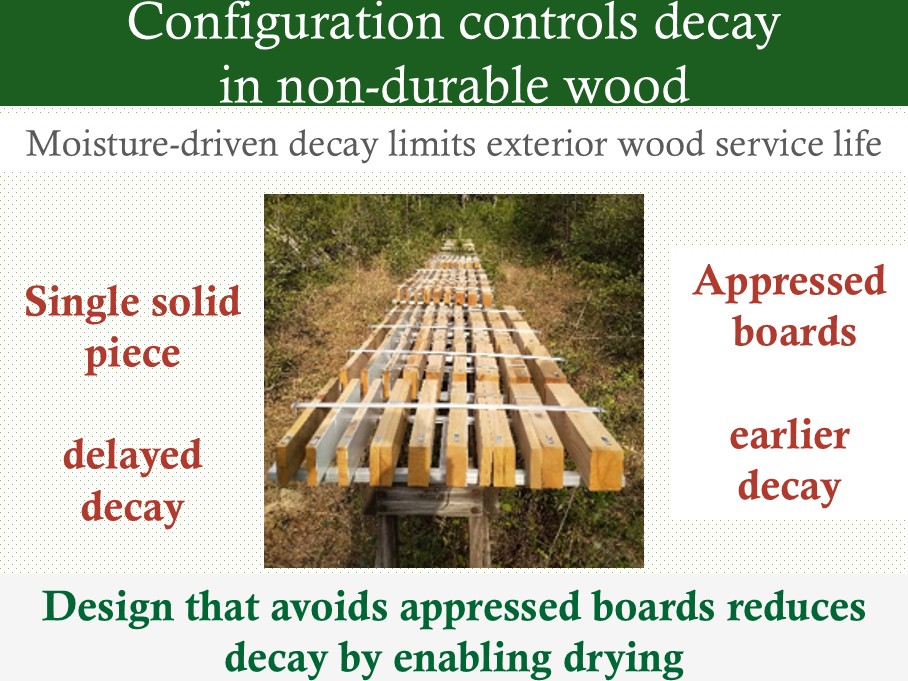
Wood used above ground and exposed to moisture may be vulnerable to decay. The initiation and rate of decay are influenced by several factors, including substrate type, moisture and temperature. The design and geometry of wood components affect moisture dynamics and may therefore influence both the initiation and progression of decay. This study evaluated the impact of nine different design configurations on the durability of wood components in a field experiment conducted at three North America sites with distinct climates. The tested variables included specimen volume, the presence of impermeable surface coatings, and the arrangement of appressed boards. Significant effects on both decay initiation and severity were observed, with water-trapping features such as appressed boards and sealed surfaces associated with earlier onset and more extensive decay over a fixed period. The results suggest that longer service life may be achieved by avoiding design features that retain moisture or inhibit drying.
Downloads
References
American Wood Protection Association. 2021. Standard E7-21. Standard field test for evaluation of wood preservatives to be used in ground contact (UC4A, UC4B, UC4C); Stake test. AWPA: Birmingham, AL. 8p.
American Wood Protection Association. 2023. Standard E25-21. Standard field test for evaluation of wood preservatives to be used above ground (UC3B): Decking test. AWPA: Birmingham, AL. 4p.
Bari, E.; Daniel, G.; Yilgor, N.; Kim, J.S.; Tajick-Ghanbary, M.A.; Singh, A.P.; Ribera, J. 2020. Comparison of the Decay Behavior of Two White-Rot Fungi in Relation to Wood Type and Exposure Conditions. Microorganisms 8(12):1931. https://doi.org/10.3390/microorganisms8121931
Brischke, C.; Alfredsen, G.; Emmerich, L.; Humar, M.; Meyer-Veltrup, L. 2023. Durability of Wood Exposed above Ground-Experience with the Bundle Test Method. Forests 14(7). e1460. https://doi.org/10.3390/f14071460
Brischke, C.; Bayerbach, R.; Rapp, A.O. 2006. Decay-influencing factors: A basis for service life prediction of wood and wood-based products. Wood Material Science and Engineering 1(3-4):91-107. https://doi.org/10.1080/17480270601019658
Brischke, C.; Meyer-Veltrup, L. 2015. Moisture content and decay of differently sized wooden components during 5 years of outdoor exposure. European Journal of Wood and Wood Products 73:719-728. https://doi.org/10.1007/s00107-015-0960-7
Brischke, C.; Rapp, A.O. 2008. Influence of wood moisture content and wood temperature on fungal decay in the field: observations in different micro-climates. Wood Science and Technology 42(8):663-677. https://doi.org/10.1007/s00226-008-0190-9
Brischke, C.; Thelandersson, S. 2014. Modelling the outdoor performance of wood products-A review on existing approaches. Construction and Building Materials 66:384-397. https://doi.org/10.1016/j.conbuildmat.2014.05.087
Carll, C.G.; Highley, T.L. 1999. Decay of wood and wood-based products above ground in buildings. Journal of Testing and Evaluation 27(2):150-158. https://doi.org/10.1520/JTE12054J
Clark, J.W. 1957. Comparative decay resistance of some common Pines, Hemlock, Spruce and True Fir. Forest Science 3:314-320. https://doi.org/10.1093/forestscience/3.4.314
Clausen, C.A.; Lindner, D.L. 2011. Shading aboveground L-joint and lap-joint tests: comparison of white pine and sugar maple test assemblies. Forest Products Journal 61(3):265-269. https://doi.org/10.13073/0015-7473-61.3.265
Cookson, L.J.; Page, D.; Singh, T. 2014. Accelerated above-ground decay testing in Australia and New Zealand. International Biodeterioration & Biodegradation 86:210-217. https://doi.org/10.1016/j.ibiod.2013.09.021
DeGroot, R.C. 1992. Test assemblies for monitoring decay in wood exposed above ground. International Biodeterioration & Biodegradation 29(2):151-175. https://doi.org/10.1016/0964-8305(92)90014-F
Fougerousse, M. 1976. Wood Preservatives: Field Tests Out of Ground Contact - Brief Survey of Principles and Methodology. Proceedings IRG Annual Meeting. Document No. IRG/WP 76-269.
Grüll, G.; Truskaller, M.; Podgorski, L.; Bollmus, S.; Tscherne, F. 2010. Maintenance procedures and definition of limit states for exterior wood coatings. European Journal of Wood and Wood Products 69:443-450. https://dx.doi.org/10.1007/s00107-010-0469-z
Hiscox, J.; Savoury, M.; Johnston, S.R.; Parfitt, D.; Müller, C.T.; Rogers, H.J.; Boddy, L. 2016. Location, location, location: priority effects in wood decay communities may vary between sites. Environmental Microbiology 18(6):1954-1969. https://doi.org/10.1111/1462-2920.13141
Isaksson, T.; Thelandersson, S. 2013. Experimental investigation on the effect of detail design on wood moisture content in outdoor above ground applications. Building and Environment 59:239-249. https://doi.org/10.1016/j.buildenv.2012.08.023
Kirker, G.T.; Bishell, A.; Cappellazzi, J.; Palmer, J.; Bechle, N.; Lebow, P.; Lebow, S. 2020. Role of leaf litter in above-ground wood decay. Microorganisms 8(5). 696. https://doi.org/10.3390/microorganisms8050696
Meyer, L.; Brischke, C. 2015. Fungal decay at different moisture levels of selected European-grown wood species. International Biodeterioration & Biodegradation 103:23-29. https://doi.org/10.1016/j.ibiod.2015.04.009
Meyer, L.; Brischke, C.; Preston, A. 2014. Testing the durability of timber above ground: A review on methodology. Wood Material Science & Engineering 11(5):283-304. https://doi.org/10.1080/17480272.2014.983163
Miklečić, J.; Jirouš-Rajković, V. 2021. Effectiveness of finishes in protecting wood from liquid water and water vapor. Journal of Building Engineering 43. e102621. https://doi.org/10.1016/j.jobe.2021.102621
Morris, P.I.; Laks, P.; Larkin, G.; Ingram, J.K.; Stirling, R. 2016. Aboveground decay resistance of selected Canadian softwoods at four test sites after 10 years of exposure. Forest Products Journal 66(5-6):268-273. https://doi.org/10.13073/FPJ-D-15-00052
Morris, P.I.; Stirling, R. 2016. Modeling the effect of climate on decay rate. Proceedings American Wood Protection Association 112:227-235.
Morris, P.I.; Wang, J. 2008. A new decay hazard map for North America using the Scheffer Index. Proceedings IRG Annual Meeting. Document No. IRG/WP/08-10672.
Norton, J.; Francis, L.P. 2008. Effect of surface-applied treatments on the above-ground performance of simulated timber joinery. Australian Forestry 71(2):100-106. https://doi.org/10.1080/00049158.2008.10676276
Råberg, U.; Edlund, M.L.; Terziev, N.; Land, C.J. 2005. Testing and evaluation of natural durability of wood in above ground conditions in Europe-an overview. Journal of Wood Science 51:429-440. https://doi.org/10.1007/s10086-005-0717-8
Scheffer, T.C. 1971. A climate index for estimating potential for decay in wood structures above ground. Forest Products Journal 21(10):25-31.
Setliff, E.C. 1986. Wood decay hazard in Canada based on Scheffer's climate index formula. The Forestry Chronicle 62(5):456-459. https://doi.org/10.5558/tfc62456-5
Schauwecker, C.F.; Zahora, A.; Preston, A.F. 2010. The relative performance of an organic preservative system under UC3A and UC3B conditions using two test methods. Proceedings IRG Annual Meeting. Document No. IRG/WP/10-20429.
Social Science Statistics. 2025. Z-Score Calculator for Two Population Proportions. Social Science Statistics. https://www.socscistatistics.com/tests/ztest/default2.aspx
Stirling, R.; Brischke, C.; Meyer-Veltrup, L.; Morris, P.I. 2017. Prediction of decay rate in above-ground field tests from physical configurations. IUFRO Division 5 Conference, Vancouver, BC.
Van Niekerk, P.B.; Brischke, C.; Niklewski, J. 2021. Estimating the service life of timber structures concerning risk and influence of fungal decay-A review of existing theory and modelling approaches. Forests 12(5). e588. https://doi.org/10.3390/f12050588
Zahora, A. 2008. Above ground field testing – influence of test method and location on the relative performance of various preservative systems. In: Proceedings of the IRG Annual Meeting, Document No. IRG/WP/08-20393. The International Research Group on Wood Protection: Flamingo Beach, Costa Rica.
Downloads
Published
Issue
Section
License

This work is licensed under a Creative Commons Attribution 4.0 International License.
Los autores/as conservarán sus derechos de autor y garantizarán a la revista el derecho de primera publicación de su obra, el cuál estará simultáneamente sujeto a la Licencia de Reconocimiento de Creative Commons CC-BY que permite a terceros compartir la obra siempre que se indique su autor y su primera publicación esta revista.