Decay and leaching resistance of spruce and larch woods treated with preservatives following different incising pretreatments
DOI:
https://doi.org/10.22320/s0718221x/2026.04Keywords:
Biological incising, decay resistance, laser incising, leaching, mechanical incising, preservativeAbstract
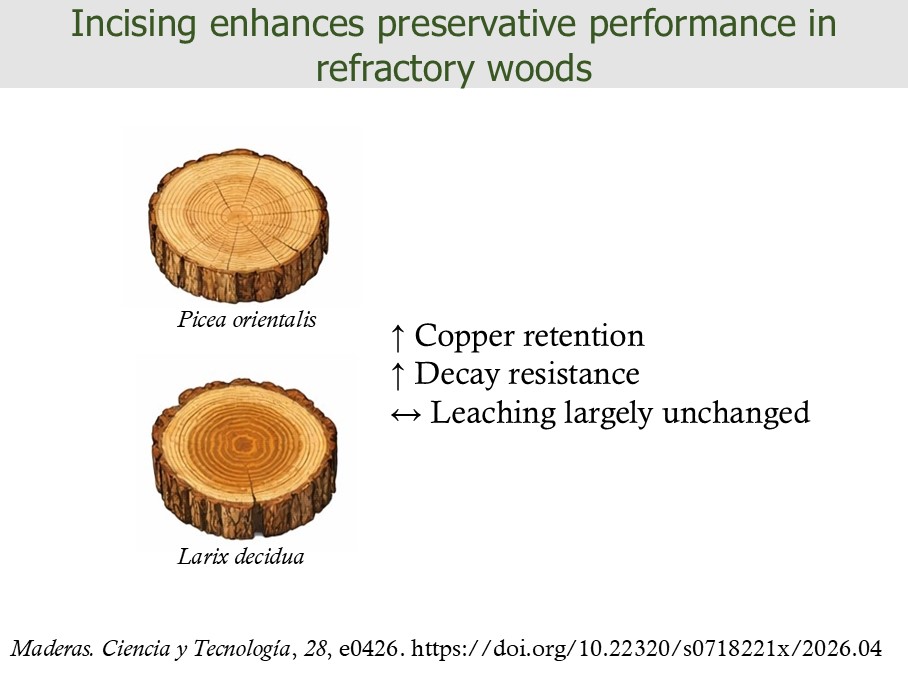
The objective of this study was to determine the extent to which different incising pretreatments can increase decay and leaching resistance of Picea orientalis (oriental spruce) and Larix decidua (european larch) woods. To this purpose, mechanical, biological, and laser incision treatments were applied to sapwood samples of these refractory wood species to enhance permeability. After the incision treatments, cross sections of the samples were sealed with a polyurethane-based paint commonly used in marine applications to minimize excessive uptake of impregnation chemicals. Subsequently, the treated samples were impregnated using a vacuum method with an alkaline copper quat (ACQ) solution (Celcure C4), a copper (Cu)-based preservative. The impregnated spruce and larch samples with and without different incision treatments were then subjected to leaching. Non-pretreated and non-impregnated samples, pretreated and non-impregnated samples, non-pretreated and impregnated samples (leached and non-leached), and pretreated and impregnated samples (leached and non-leached) spruce and larch were exposed to brown rot (Tyromyces palustris) and white rot (Trametes versicolor) fungi for 16 weeks. The highest Cu content (ppm) in spruce before and after leaching was generally observed in samples treated with laser incision; in larch, the highest values were obtained with biological incision. Moreover, incising treatments did not increase Cu leaching in larch, while only biological incision increased leaching in spruce. Decay resistance against both fungal species generally improved in blocks impregnated with Cu compounds following mechanical and laser incising treatments, both before and after leaching. In addition, leaching reduced decay resistance in the control and in laser incised samples exposed to brown rot fungus.
Downloads
References
AWPA International. AWPA. 2022. Standard Method for Accelerated Evaluation of Preservative Leaching. AWPA E11-16 (R2022). AWPA International: Birmingham, Alabama, USA.
AWPA International. AWPA. 2022. Standard Wet Ashing Procedures for Preparing Wood for Chemical Analysis. AWPA A7-22. AWPA International: Birmingham, Alabama, USA.
Bakir, D.; Kartal, S.N.; Terzi, E.; Dogu, D. 2022. The effects of bioincising by Physisporinus vitreus on CuO retention and copper element leaching in oriental spruce wood. Maderas. Ciencia y Tecnología 24. e27. https://doi.org/10.4067/s0718-221x2022000100427
Bakir, D. 2022. Changes in some physical properties and compressive strength of European larch and oriental spruce woods after different incising pretreatments. Artvin Çoruh University Journal of Forestry Faculty 23(2): 175-183. https://doi.org/10.17474/artvinofd.1179285
Bakir, D. 2023. Anatomical structure and copper microdistribution in mechanical, biological, and laser incised spruce and larch refractory woods. BioResources 18(1): 1368-1383. https://doi.org/10.15376/biores.18.1.1368-1383
Bakir, D.; Dogu, D.; Kartal, S.N.; Terzi, E. 2023. Evaluation of pit dimensions and uptake of preservative solutions in wood after permeability improvement by bioincising. Wood Material Science and Engineering 18(1): 233-243. https://doi.org/10.1080/17480272.2021.2014956
Bazyar, B. 2012. Decay resistance and physical properties of oil heat treated aspen wood. BioResources 7(1): 696-705. https://doi.org/10.15376/biores.7.1.696-705
Bozkurt, A.Y.; Göker, Y.; Erdin, N. 1993. Physical and mechanical properties of oriental spruce (Picea orientalis (L.) Link.) grown in a plantation site in Belgrad forest near Istanbul. Forestist 43(2): 33-56. https://www.forestist.org/index.php/pub/issue/view/156
Brischke, C.; Alfredsen, G. 2023. Biological durability of pine wood. Wood Material Science and Engineering 18(3): 1050-1064. https://doi.org/10.1080/17480272.2022.2104134
Cantera, L.; Alonso, R.; Lupo, S.; Bettucci, L.; Amilivia, A.; Martínez, J.; Dieste, A. 2022. Decay resistance of thermally modified Eucalyptus grandis wood against wild strains of Trametes versicolor and Pycnoporus sanguineus. Wood Material Science and Engineering 17(6): 478-487. https://doi.org/10.1080/17480272.2021.1892185
Celimene, C.C.; Micales, J.A.; Ferge, L.; Young, R.A. 1999. Efficacy of pinosylvins against white-rot and brown-rot fungi. Holzforschung 53: 491-497. https://doi.org/10.1515/HF.1999.081
Chang, L.; Rong, B.; Xu, G.; Meng, Q.; Wang, L. 2020. Mechanical properties, components and decay resistance of Populus davidiana bioincised by Coriolus versicolor. Journal of Forestry Research 31(5): 2023-2029. https://doi.org/10.1007/s11676-019-00972-3
EN. 2013. Durability of wood and wood-based products. Use classes: definitions, application to solid wood and wood-based products. EN 335. European Committee for Standardization: Ann Arbor, MI, USA. https://www.en-standard.eu/store/
EN. 2020. Durability of wood and wood-based products. Test method against wood destroying basidiomycetes. EN 113-1. European Committee for Standardization: Ann Arbor, MI, USA. https://www.en-standard.eu/store/
Fuhr, M.J.; Schubert, M.; Stührk, C.; Schwarze, F.W.M.R.; Herrmann, H.J. 2013. Penetration capacity of the wood-decay fungus Physisporinus vitreus. Complex Adaptive Systems Modeling 1. e6. https://doi.org/10.1186/2194-3206-1-6
Fukuta, S.; Nomura, M.; Ikeda, T.; Yoshizawa, M.; Yamasaki, M.; Sasaki, Y. 2016. Wavelength dependence of machining performance in UV-, VIS- and NIR-laser cutting of wood. Journal of Wood Science 62(4): 316-323. https://doi.org/10.1007/s10086-016-1553-8
Gilani, M.S.; Schwarze, F.W.M.R. 2014. Hygric properties of Norway spruce and sycamore after incubation with two white rot fungi. Holzforschung 69(1): 77-86. https://doi.org/10.1515/hf-2013-0247
Goodell, B.; Kamke, F.A.; Liu, J. 1991. Laser incising of spruce lumber for improved preservative penetration. Forest Products Journal 41: 48-52.
Islam, N.; Ando, K.; Yamauchi, H.; Kobayashi, Y.; Hattori, N. 2008. Comparative study between full cell and passive impregnation method of wood preservation for laser incised Douglas fir lumber. Wood Science and Technology 42(4): 343-350. https://doi.org/10.1007/s00226-007-0168-z
JMP Statistical Software. 2020. JMP: Statistical discovery software. SAS Institute Inc.: Cary, NC, USA. https://www.capterra.com/p/151815/JMP-Statistical-Software/
Kamke, F.A.; Peralta, P.N. 1990. Laser incising for lumber drying. Forest Products Journal 40(4): 48-54.
Karlman, L.; Mörling, T.; Martinsson, O. 2005. Wood density, annual ring width and latewood content in larch and Scots pine. Eurasian Journal of Forest Research 8(2): 91-96. https://res.slu.se/id/publ/16254
Lehringer, C.; Hillebrand, K.; Richter, K.; Arnold, M.; Schwarze, F.W.M.R.; Militz, H. 2010. Anatomy of bioincised Norway spruce wood. International Biodeterioration and Biodegradation 64(5): 346-355. https://doi.org/10.1016/j.ibiod.2010.03.005
Lekounougou, S.; Kocaefe, D. 2012. Comparative study on the durability of heat-treated white birch (Betula papyrifera) subjected to the attack of brown and white rot fungi. Wood Material Science and Engineering 7(2): 101-106. https://doi.org/10.1080/17480272.2012.663407
Lekounougou, S.; Kocaefe, D. 2014a. Effect of thermal modification temperature on the mechanical properties, dimensional stability, and biological durability of black spruce (Picea mariana). Wood Material Science and Engineering 9(2): 59-66. https://doi.org/10.1080/17480272.2013.869256
Lekounougou, S.; Kocaefe, D.. 2014b. Impact of thermal modification on bioresistance of North American wood species Pinus banksiana, Populus tremuloides, and Betula papyrifera, against wood-rotting basidiomycete fungi. Wood Material Science and Engineering 9(2): 67-75. https://doi.org/10.1080/17480272.2013.875062
Liang, G.; Meng, D.; Gao, X.; Zhu, Y.; Li, X. 2024. Effectiveness of organic biocide in long-term protection of bamboo against mold fungi with Trametes versicolor pre-treatment. International Biodeterioration and Biodegradation 188. e105749. https://doi.org/10.1016/j.ibiod.2024.105749
Lüxford, R.F. 1953. Use of Engelmann spruce for house construction. U.S. Forest Products Laboratory Report No. 1944-1. 3p. http://hdl.handle.net/1957/2386
Metsä-Kortelainen, S.; Viitanen, H. 2009. Decay resistance of sapwood and heartwood of untreated and thermally modified Scots pine and Norway spruce compared with some other wood species. Wood Material Science and Engineering 4(3-4): 105-114. https://doi.org/10.1080/17480270903326140
Metsä-Kortelainen, S.; Viitanen, H. 2010. Effect of fungal exposure on the strength of thermally modified Norway spruce and Scots pine. Wood Material Science and Engineering 5(1): 13-23. https://doi.org/10.1080/17480271003786738
Metsä-Kortelainen, S.; Viitanen, H. 2017. Durability of thermally modified sapwood and heartwood of Scots pine and Norway spruce in the modified double layer test. Wood Material Science and Engineering 12(3): 129-139. https://doi.org/10.1080/17480272.2015.1061596
Nath, S.; Waugh, D.G.; Ormondroyd, G.A.; Spear, M.J.; Pitman, A.J.; Sahoo, S.; Curling, S.F.; Mason, P. 2020a. CO₂ laser interactions with wood tissues during single pulse laser-incision. Optics and Laser Technology 126. e106069. https://doi.org/10.1016/j.optlastec.2020.106069
Nath, S.; Waugh, D.G.; Ormondroyd, G.A.; Spear, M.J.; Pitman, A.J.; Curling, S.F.; Mason, P. 2020b. Laser incising of wood: A review. Lasers in Engineering 45(4-6): 381-403. https://www.oldcitypublishing.com/journals/lie-home/lie-issue-contents/lie-volume-45-number-4-6-2020/lie-45-4-6-p-381-403/
Nath, S.; Waugh, D.G.; Ormondroyd, G.A.; Spear, M.J.; Curling, S.F.; Pitman, A.J.; Mason, P. 2022. Percussion Nd:YAG laser incision of radiata pine: effects of laser processing parameters and wood anatomy. Lasers in Manufacturing and Materials Processing 9: 173-192. https://doi.org/10.1007/s40516-022-00169-3
Petrič, M.; Murphy, R.J.; Morris, I. 2000. Microdistribution of some copper- and zinc-containing waterborne and organic solvent wood preservatives in spruce wood cell walls. Holzforschung 54(1): 23-26. https://doi.org/10.1515/HF.2000.004
Qi, Y.; Zhou, Z.; Xu, R.; Dong, Y.; Zhang, Z.; Liu, M. 2023. Effect of NaOH pretreatment on permeability and surface properties of three wood species. ACS Omega 8(43): 40362-40374. https://doi.org/10.1021/acsomega.3c04745
Rezaei, F.; Wimmer, R.; Gaff, M.; Gusenbauer, C.; Frömel-Frybort, S.; Sethy, A.K.; Corleto, R.; Ditommaso, G.; Niemz, P. 2022. Anatomical and morphological characteristics of beech wood after CO₂-laser cutting. Wood Material Science and Engineering 17(6): 459-468. https://doi.org/10.1080/17480272.2022.2134820
Schubert, M.; Schwarze, F.W.M.R. 2011. Evaluation of the interspecific competitive ability of the bioincising fungus Physisporinus vitreus. Journal of Basic Microbiology 51(1): 80-88. https://doi.org/10.1002/jobm.201000176
Schubert, M.; Volkmer, T.; Lehringer, C.; Schwarze, F.W.M.R. 2011. Resistance of bioincised wood treated with wood preservatives to blue-stain and wood-decay fungi. International Biodeterioration and Biodegradation 65(1): 108-115. https://doi.org/10.1016/j.ibiod.2010.10.003
Schubert, M.; Stührk, C.; Fuhr, M.J.; Schwarze, F.W.M.R. 2013. Agrobacterium-mediated transformation of the white-rot fungus Physisporinus vitreus. Journal of Microbiological Methods 95(2): 251-252. https://doi.org/10.1016/j.mimet.2013.09.001
Schwarze, F.W.M.R.; Landmesser, H.; Zgraggen, B.; Heeb, M. 2006. Permeability changes in heartwood of Picea abies and Abies alba induced by incubation with Physisporinus vitreus. Holzforschung 60(4): 450-454. https://doi.org/10.1515/HF.2006.071
Stirling, R.; Drummond, J.; Zhang, J.; Ziobro, R.J. 2008. Micro-distribution of micronized copper in southern pine. In: Proceedings IRG 39th Annual Meeting, IRG/WP 08-30479. The International Research Group on Wood Protection: Istanbul, Turkey. 25-29 May 2008, pp. 1-16. https://www.irg-wp.com/meetings/IRG39.html
Tajrishi, I.; Tarmian, A.; Oladi, R.; Humar, M.; Ahmadzadeh, M. 2021. Biodegradation and microscale treatability pattern of loblolly pine heartwood bioincised by Bacillus subtilis and Physisporinus vitreus. Drvna Industrija 72(4): 365-372. https://doi.org/10.5552/drvind.2021.2034
Tajrishi, I.Z.; Oladi, R.; Tarmian, A.; Bari, E.. 2023. A comparative study of structural changes in loblolly pine wood following incubation with the fungus Physisporinus vitreus and the bacterium Bacillus subtilis. Wood Material Science and Engineering 19: 931-943.. https://doi.org/10.1080/17480272.2023.2291539
Terziev, N.; Daniel, G.; Torgovnikov, G.; Vinden, P. 2020. Effect of microwave treatment on the wood structure of Norway spruce and radiata pine. BioResources 15(3): 5616-5626. https://doi.org/10.15376/biores.15.3.5616-5626
Thaler, N.; Lesar, B.; Kariž, M.; Humar, M. 2012. Bioincising of Norway spruce wood using wood inhabiting fungi. International Biodeterioration and Biodegradation 68(1): 51-55. https://doi.org/10.1016/j.ibiod.2011.11.014
Wagner, J.B. 2010. Seasoning of wood: A treatise on the natural and artificial processes employed in the preparation of lumber for manufacture. Kessinger Publishing: United States. ISBN 9781164914815. 26p. https://archive.org/details/cu31924003595794
Wang, L.; Kamdem, P. 2012. Copper leached from micronized copper quaternary (MCQ) treated wood: Influence of the amount of copper in the formulations. In: Proceedings of the 55th International Convention of the Society of Wood Science and Technology. SWST: Beijing, China. 27-31 August 2012, pp. 1-9. https://www.swst.org/wp/meetings/AM12/pdfs/papers/PS-66.pdf
Winandy, J.E.; Hassan, B.; Morrell, J.J. 2023. Review of the effects of incising on treatability and strength of wood. Wood Material Science and Engineering 18(2): 751-762. https://doi.org/10.1080/17480272.2022.2028008
Wu, H.; Hu, Z. 1997. Comparative anatomy of resin ducts of the Pinaceae. Trees 11: 135-143. https://doi.org/10.1007/s004680050069
Downloads
Published
Issue
Section
License

This work is licensed under a Creative Commons Attribution 4.0 International License.
Los autores/as conservarán sus derechos de autor y garantizarán a la revista el derecho de primera publicación de su obra, el cuál estará simultáneamente sujeto a la Licencia de Reconocimiento de Creative Commons CC-BY que permite a terceros compartir la obra siempre que se indique su autor y su primera publicación esta revista.