Eco-friendly protection of pine wood using copper nanoparticles biosynthesized from Cleistocalyx operculatus leaf extracts
DOI:
https://doi.org/10.22320/s0718221x/2026.06Keywords:
Biosynthesis, copper nanoparticles, Pinus kesiya, termites resistance, wood-decaying fungi, wood preservationAbstract
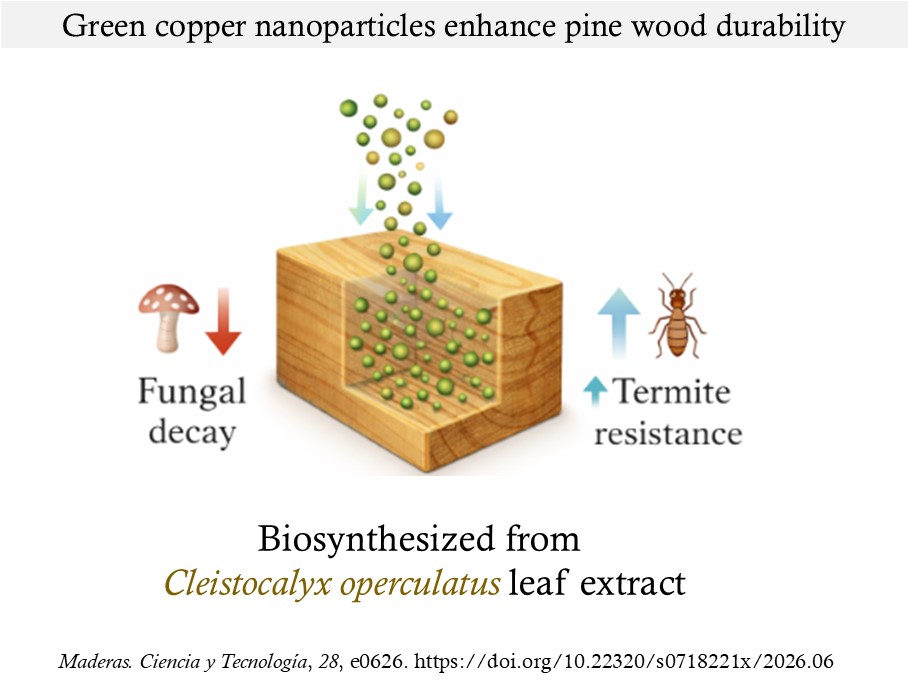
This research investigates the eco-friendly biosynthesis of copper nanoparticles (CuNPs) from Cleistocalyx operculatus (water banyan) leaf extracts for the sustainable preservation of pine wood Pinus kesiya (khasi pine). The study specifically targets protection against common wood-decaying fungi, including Aspergillus flavus ATCC 9643, Fusarium oxysporum ATCC 48112, and Penicillium citrinum ATCC 9849, as well as termites. CuNPs were synthesized under optimized conditions: 80 °C for 30 minutes using a rotary evaporator, at pH 11, with 20 mM copper sulfate, and a 1.5:1 plant extract to precursor ratio. Comprehensive characterization using UV-Vis spectroscopy confirmed a prominent absorption peak at 595 nm. Scanning Electron Microscopy and Transmission Electron Microscopy further validated their spherical morphology, high crystallinity, and an average size of 2 ± 1 nm. Wood durability was evaluated through laboratory tests of fungal and termite resistance To assess the effects of different CuNPs treatments on fungal resistance and termite resistance, a one-way ANOVA was employed. Significant differences were found among the treatment groups (P<0,05). Duncan's multiple range test was performed using SPSS Statistics version 26, with statistical significance set at α = 0,05. The findings demonstrated a clear concentration-dependent efficacy of CuNPs. Treated wood samples exhibited significantly enhanced fungal and termite resistance, displaying notably reduced weight loss (approximately 10-15 %) compared to untreated controls (20-30 %). Furthermore, even at the lowest tested dosage, a substantial termite mortality rate of 43,17 % was observed, highlighting the potent bioactivity of the biosynthesized CuNPs. These results support the potential of Cleistocalyx operculatus-mediated CuNPs as an environmentally sustainable substitute for conventional, often harmful, wood preservatives. This green approach offers a sustainable alternative for wood protection and shows promise for broader applications of eco-friendly nanomaterials.
Downloads
References
Adeleye, A. S.; Conway, J. R.; Garner, K.; Huang, Y.; Su, Y.; Keller, A. A. 2016. Engineered nanomaterials for water treatment and remediation: Costs, benefits, and applicability. Chemical engineering journal 286: 640-662. https://doi.org/10.1016/j.cej.2015.10.105
Aguayo, M.G.; Erazo, O.; Montero, C.; Reyes, L.; Gacitúa, W.; Gómez, L.; Torres, H. 2022. Analyses of impregnation quality and mechanical properties of radiata pine wood treated with copper nanoparticle- and micronized-copper-based wood preservatives. Forests 13. e1636. https://doi.org/10.3390/f13101636
Aguayo, M.G.; Oviedo, C.; Reyes, L.; Navarrete, J.; Gómez, L.; Torres, H.; Gavino, G.; Trollund, E. 2021. Radiata pine wood treated with copper nanoparticles: leaching analysis and fungal degradation. Forests 12. e1606. https://doi.org/10.3390/f12111606
Akhtari, M.; Taghiyari, H.R.; Kokandeh, M.G. 2013. Effect of some metal nanoparticles on the spectroscopy analysis of Paulownia wood exposed to white-rot fungus. European Journal of Wood and Wood Products 71: 283-285. https://doi.org/10.1007/s00107-013-0676-5
Aleksandrowicz-Trzcińska, M.; Szaniawski, A.; Olchowik, J.; Drozdowski, S. 2018. Effects of copper and silver nanoparticles on growth of selected species of pathogenic and wood-decay fungi in vitro. The Forestry Chronicle 94(2): 109-116. https://doi.org/10.5558/tfc2018-017
Baysal, E.; Toker, H.; Türkoğlu, T.; Gündüz, A.; Altay, Ç.; Küçüktüvek, M.; Peker, H. 2021. Weathering characteristics of impregnated and coated Calabrian pine wood. Maderas. Ciencia y Tecnología 23. e31. https://doi.org/10.4067/S0718-221X2021000100431
Borges, C.C.; Tonoli, G.H.D.; Cruz, T.M.; Duarte, P.J.; Junqueira, T.A. 2018. Nanoparticles-based wood preservatives: the next generation of wood protection? Cerne 24(4): 397-407. https://doi.org/10.1590/01047760201824042531
Bridžiuvienė, D.; Raudonienė, V. 2013. Fungi surviving on treated wood and some of their physiological properties. Materials Science 19(1): 43-50. https://doi.org/10.5755/j01.ms.19.1.3824
Caroling, G.; Vinodhini, E.; Ranjitham, A.M.; Shanthi, P. 2015. Biosynthesis of copper nanoparticles using aqueous Phyllanthus embilica extract: characterisation and study of antimicrobial effects. International Journal of Nanomaterials and Chemistry 1(2): 53-63. https://www.naturalspublishing.com/files/published/nc68ux0j612bz8.pdf
Cave, I.D.; Walker, J.C.F. 1994. Stiffness of wood in fast-grown plantation softwoods: the influence of microfibril angle. Forest Products Journal 44(5): 43-48.
Chatterjee, A.K.; Chakraborty, R.; Basu, T. 2014. Mechanism of antibacterial activity of copper nanoparticles. Nanotechnology 25. e135101. https://doi.org/10.1088/0957-4484/25/13/135101
Chung, I.M.; Abdul Rahuman, A.; Marimuthu, S.; Kirthi, A.V.; Anbarasan, K.; Padmini, P.; Rajakumar, G. 2017. Green synthesis of copper nanoparticles using Eclipta prostrata leaves extract and their antioxidant and cytotoxic activities. Experimental and Therapeutic Medicine 14(1): 18-24. https://doi.org/10.3892/etm.2017.4466
Civardi, C.; Schuber, M.; Fey, A.; Wick, P.; Schwarze, F.W.M.R. 2015. Micronized copper wood preservatives: efficacy of ion, nano, and bulk copper against the brown rot fungus Rhodonia placenta. PLOS ONE 10. e0142578. https://doi.org/10.1371/journal.pone.0142578
Civardi, C.; Schlagenhauf, L.; Kaiser, J.P.; Hirsch, C.; Mucchino, C.; Wichser, A.; Wick, P.; Schwarze, F.W.M.R. 2016. Release of copper-amended particles from micronized copper-pressure-treated wood during mechanical abrasion. Journal of Nanobiotechnology 14. e77. https://doi.org/10.1186/s12951-016-0232-7
Clausen, C.A.; Green, F.; Kartal, S.N. 2010. Weatherability and leach resistance of wood impregnated with nano-zinc oxide. Nanoscale Research Letters 5: 1464-1467. https://doi.org/10.1007/s11671-010-9662-6
Corbu, V.M.; Dumbravă, A.Ş.; Marinescu, L.; Motelica, L.I.; Chircov, C.; Surdu, A.V.; Pecete, I.; Balotescu, I.; Popa, M.; Marinas, I.C.; Ianovici, N.; Ciobanu, D.G.; Ditu, L.M.; Ficai, D.; Oprea, O.C.; Ficai, A.; Sesan, T.E.; Chifiriuc, M.C. 2023. Alternative mitigating solutions based on inorganic nanoparticles for the preservation of cultural heritage. Frontiers in Materials 10. e1272869. https://doi.org/10.3389/fmats.2023.1272869
Crisan, M. C.; Teodora, M.; Lucian, M. 2021. Copper nanoparticles: Synthesis and characterization, physiology, toxicity and antimicrobial applications. Applied Sciences 12(1): 141. https://doi.org/10.3390/app12010141
Devipriya, D.; Roopan, S.M. 2017. Cissus quadrangularis mediated ecofriendly synthesis of copper oxide nanoparticles and its antifungal studies against Aspergillus niger and Aspergillus flavus. Materials Science and Engineering: C 80: 38-44. https://doi.org/10.1016/j.msec.2017.05.130
European Standard. 2013. Wood preservatives - Determination of preventive action against Reticulitermes species (European termites) (laboratory method). EN 118:2013. CEN: Brussels, Belgium.
European Standard. 2020. Durability of wood and wood-based products - Test method against wood destroying basidiomycetes - Part 2: Assessment of inherent or enhanced durability. EN 113-2:2020. CEN: Brussels, Belgium.
Freeman, M.H.; McIntyre, C.R. 2008. Comprehensive review of copper-based wood preservatives. Forest Products Journal 58(11): 6-27. https://eurekamag.com/research/029/630/029630941.php
Galan, C.R.; Silva, M.F.; Mantovani, D.; Bergamasco, R.; Vieira, M.F. 2018. Green synthesis of copper oxide nanoparticles impregnated on activated carbon using Moringa oleifera leaves extract for the removal of nitrates from water. The Canadian Journal of Chemical Engineering 96(11): 2378-2386. https://doi.org/10.1002/cjce.23185
Hermida-Montero, L.A.; Pariona, N.; Mtz-Enriquez, A.I.; Carrión, G.; Paraguay-Delgado, F.; Rosas-Saito, G. 2019. Aqueous-phase synthesis of nanoparticles of copper/copper oxides and their antifungal effect against Fusarium oxysporum. Journal of Hazardous Materials 380. e120850. https://doi.org/10.1016/j.jhazmat.2019.120850
Holy, S.; Temiz, A.; Köse Demirel, G.; Aslan, M.; Mohamad Amini, M.H. 2022. Physical properties, thermal and fungal resistance of Scots pine wood treated with nano-clay and several metal-oxides nanoparticles. Wood Material Science & Engineering 17(3): 176-185. https://doi.org/10.1080/17480272.2020.1836023
Jafari, A.; Pourakbar, L.; Farhadi, K.; Gholizad, L.M.; Goosta, Y. 2015. Biological synthesis of silver nanoparticles and evaluation of antibacterial and antifungal properties of silver and copper nanoparticles. Turkish Journal of Biology 39(4): 556-561. https://doi.org/10.3906/biy-1406-81
Kadir, R.; Salmiah, U.; Rahim, S.; Shahlinney, L.; Nor Azried, A.R.; Baharudin, K.; Mohd Adawi, T.O.; Kum, P.S.; Hamidah, A. 2017. Qualitative and quantitative determination of resistance of twenty-two Malaysian commercial timbers through subterranean termite feeding behavior. Forestry Research and Engineering: International Journal 1(2): 52-60. https://doi.org/10.15406/freij.2017.01.00008
Kartal, S.N.; Green, F.; Clausen, C.A. 2009. Do the unique properties of nanometals affect leachability or efficacy against fungi and termites? International Biodeterioration & Biodegradation 63: 490-495. https://doi.org/10.1016/j.ibiod.2009.01.007
Letchumanan, D.; Sok, S.P.; Ibrahim, S.; Nagoor, N.H.; Arshad, N.M. 2021. Plant-based biosynthesis of copper/copper oxide nanoparticles: an update on their applications in biomedicine, mechanisms, and toxicity. Biomolecules 11. e564. https://doi.org/10.3390/biom11040564
Manikandan, A.; Sathiyabama, M. 2015. Green synthesis of copper-chitosan nanoparticles and study of its antibacterial activity. Journal of Nanomedicine & Nanotechnology 6. e1000251.
Maliki, M.; Ifijen, I.H.; Ikhuoria, E.U.; Jonathan, E.M.; Onaiwu, G.E.; Archibong, U.D.; Ighodaro, A. 2022. Copper nanoparticles and their oxides: optical, anticancer and antibacterial properties. International Nano Letters 12(4): 379-398. https://doi.org/10.1007/s40089-022-00380-2
Nasrollahzadeh, M.; Momeni, S.S.; Sajadi, S.M. 2017. Green synthesis of copper nanoparticles using Plantago asiatica leaf extract and their application for the cyanation of aldehydes using K₄Fe(CN)₆. Journal of Colloid and Interface Science 506: 471-477. https://doi.org/10.1016/j.jcis.2017.07.072
Nazar, N.; Bibi, I.; Kamal, S.; Iqbal, M.; Nouren, S.; Jilani, K.; Umair, M.; Ata, S. 2018. Cu nanoparticles synthesis using biological molecule of Punica granatum seeds extract as reducing and capping agent: growth mechanism and photocatalytic activity. International Journal of Biological Macromolecules 106: 1203-1210. https://doi.org/10.1016/j.ijbiomac.2017.08.126
Ouda, S. 2014. Antifungal activity of silver and copper nanoparticles on two plant pathogens Alternaria alternata and Botrytis cinerea. Research Journal of Microbiology 9: 34-42. https://doi.org/10.3923/jm.2014.34.42
Pariona, N.; Mtz-Enriquez, A.I.; Sánchez-Rangel, D.; Carrión, G.; Paraguay-Delgado, F.; Rosas-Saito, G. 2019. Green-synthesized copper nanoparticles as a potential antifungal against plant pathogens. RSC Advances 9(33): 18835-18843. https://doi.org/10.1039/C9RA03110C
Pham, N.D.; Duong, M.M.; Le, M.V.; Hoang, H.A.; Pham, L.K.O. 2019. Preparation and characterization of antifungal colloidal copper nanoparticles and their antifungal activity against Fusarium oxysporum and Phytophthora capsici. Comptes Rendus Chimie 22(11-12): 786-793. https://doi.org/10.1016/j.crci.2019.10.007
Pham, P.A.; Doan, T.H.; Nguyen, T.N.; Nguyen, M.V.; Ngo, Q.A.; Kulikouskaya, V.; Tran, Q.V. 2024. Synthesis and antibacterial activity of metallic copper–chitosan nanomaterial using environmentally friendly Cleistocalyx operculatus leaf extract as a reducing agent. Vietnam Journal of Chemistry 62(S1): 139-146. https://doi.org/10.1002/vjch.202300277
Ping, S.K. 2015. Synthesis and characterization of zinc oxide nanoparticles for wood protection application. PhD Thesis. Universiti Malaysia Sarawak. https://ir.unimas.my/id/eprint/10531/
Pradhan, S. 2018. Green synthesis of copper nanoparticles using Aloe vera and its characterization. International Journal of Information Research and Review 5: 5410-5414. http://ijirr.com/sites/default/files/issues-pdf/2813.pdf
Ramyadevi, J.; Jeyasubramanian, K.; Marikani, A.; Rajakumar, G.; Rahuman, A.A. 2012. Synthesis and antimicrobial activity of copper nanoparticles. Materials Letters 71: 114-116. https://doi.org/10.1016/j.matlet.2011.12.055
Salman, S.; Thévenon, M.F.; Pétrissans, A.; Dumarçay, S.; Candelier, K.; Gérardin, P. 2017. Improvement of the durability of heat-treated wood against termites. Maderas. Ciencia y Tecnología 19(3): 317-328. https://doi.org/10.4067/S0718-221X2017005000027
Sap-Iam, N.; Homklincha, C.; Larpudomle, R.; Warisnoich, W.; Sereemaspu, A.; Dubas, S.T. 2010. UV irradiation-induced silver nanoparticles as mosquito larvicides. Journal of Applied Sciences 10: 3132-3136. https://doi.org/10.3923/jas.2010.3132.3136
Shiny, K.S.; Sundararaj, R.; Mamatha, N.; Lingappa, B. 2019. A new approach to wood protection: preliminary study of biologically synthesized copper oxide nanoparticle formulation as an environmentally friendly wood protectant against decay fungi and termites. Maderas. Ciencia y Tecnología 21(3): 347-356. https://doi.org/10.4067/S0718-221X2019005000307
Sivrikaya, H.; Can, A.; de Troya, T.; Conde, M. 2015. Comparative biological resistance of differently thermally modified wood species against decay fungi, Reticulitermes grassei and Hylotrupes bajulus. Maderas. Ciencia y Tecnología 17(3): 559-570. https://doi.org/10.4067/S0718-221X2015005000050
Subha, V., Kirubanandan, S., & Renganathan, S. 2017. Green synthesis of copper nanoparticles using methanol extract of Passiflora foetida and its drug delivery applications. International Journal of Green Chemistry 3(2): 31–52. https://doi.org/10.22159/ajpcr.2017.v10i4.15744
Suman, T.; Elumalai, D.; Kaleena, P.; Rajasree, S.R. 2013. GC-MS analysis of bioactive components and synthesis of silver nanoparticles using Ammannia baccifera aerial extract and its larvicidal activity. Industrial Crops and Products 47: 239-245. https://doi.org/10.1016/j.indcrop.2013.03.010
Tahir, A.; Quispe, C.; Herrera-Bravo, J.; Iqbal, H.; Anum, F.; Javed, Z.; Sharifi-Rad, J. 2022. Green synthesis, characterization and antibacterial, antifungal, larvicidal and anti-termite activities of copper nanoparticles derived from Grewia asiatica L. Bulletin of the National Research Centre 46.e188. https://doi.org/10.1186/s42269-022-00877-y
Thakur, S.; Rai, R.; Sharma, S. 2014. Study the antibacterial activity of copper nanoparticles synthesized using herbal plants leaf extract. International Journal of Bio-Technology and Research 4(5): 21-34.
Thao, D.; Le, S.; Watanabe, A. 2022. Genetic diversity of Pinus kesiya in the Central Highlands of Vietnam. Research Square Preprint. 1-16. https://doi.org/10.21203/rs.3.rs-2012791/v1
Theivasanthi, T.; Alagar, M. 2011. Studies of copper nanoparticles effects on microorganisms. arXiv Preprint. arXiv:1110.1372. https://arxiv.org/abs/1110.1372
Usman, M.S.; El Zowalaty, M.E.; Shameli, K.; Zainuddin, N.; Salama, M.; Ibrahim, N.A. 2013. Synthesis, characterization, and antimicrobial properties of copper nanoparticles. International Journal of Nanomedicine 8: 4467-4479. https://doi.org/10.2147/IJN.S50837
Usmani, S.M.; Plarre, R.; Hübert, T.; Kemnitz, E. 2020. Termite resistance of pine wood treated with nano metal fluorides. European Journal of Wood and Wood Products 78: 493-499. https://doi.org/10.1007/s00107-020-01522-z
Valodkar, M.; Modi, S.; Pal, A.; Thakore, S. 2011. Synthesis and anti-bacterial activity of Cu, Ag and Cu–Ag alloy nanoparticles: a green approach. Materials Research Bulletin 46(3): 384-389. https://doi.org/10.1016/j.materresbull.2010.12.001
Xu, K.M.; Su, G.M.; Chai, X.; Qin, Y.J.; Chen, T.A.; Du, G.B.; Xie, L.K. 2022. Functional modification of hydrophobicity and oleophobicity for wood surface of Pinus kesiya var. langbianensis. Journal of South China Agricultural University 43(1): 13-19. https://doi.org/10.7671/j.issn.1001-411X.202105036
Yu, L.; Liu, S.; Yang, B.; Wei, J.; Lei, M.; Fan, X. 2015. Sn–Ga co-doped ZnO nanobelts fabricated by thermal evaporation and application to ethanol gas sensors. Materials Letters 141: 79-82. https://doi.org/10.1016/j.matlet.2014.11.049
Yugandhar, P.; Vasavi, T.; Devi, P.U.M.; Savithramma, N. 2017. Bioinspired green synthesis of copper oxide nanoparticles from Syzygium alternifolium: characterization and evaluation of its synergistic antimicrobial and anticancer activity. Applied Nanoscience 7: 417-427. https://doi.org/10.1007/s13204-017-0584-9
Zanatta, P.; Mattoso, T.; Gallio, E.; Lazarotto, M.; Gatto, D.A.; da Cunha, A.B.D.; Beltrame, R. 2022. Exposure of Pinus elliottii wood treated with titanium dioxide to the fungus Postia placenta and photodegradation. Madera y Bosques 28(1). e2811895. https://doi.org/10.21829/myb.2022.2811895
Zhang, S.; Wang, C. 2023. Precise analysis of nanoparticle size distribution in TEM image. Methods and Protocols 6. e63. https://doi.org/10.3390/mps6040063
Zhou, J.; Zhang, Y.; He, B. 2016. Application of preservative-treated pinewood in garden timber architecture and opuscule. Journal of Landscape Research 8(2): 83-85. https://www.proquest.com/docview/1780243363
Downloads
Published
Issue
Section
License

This work is licensed under a Creative Commons Attribution 4.0 International License.
Los autores/as conservarán sus derechos de autor y garantizarán a la revista el derecho de primera publicación de su obra, el cuál estará simultáneamente sujeto a la Licencia de Reconocimiento de Creative Commons CC-BY que permite a terceros compartir la obra siempre que se indique su autor y su primera publicación esta revista.