
Influence of particle size and blending ratio on the physical and mechanical properties of falcata sawdust-recycled LDPE wood-plastic composites
DOI:
https://doi.org/10.22320/s0718221x/2026.12Keywords:
Falcataria moluccana, low-density polyethylene (LDPE), mechanical properties, particle size, recycled plastics, wood plastic composites (WPC)Abstract
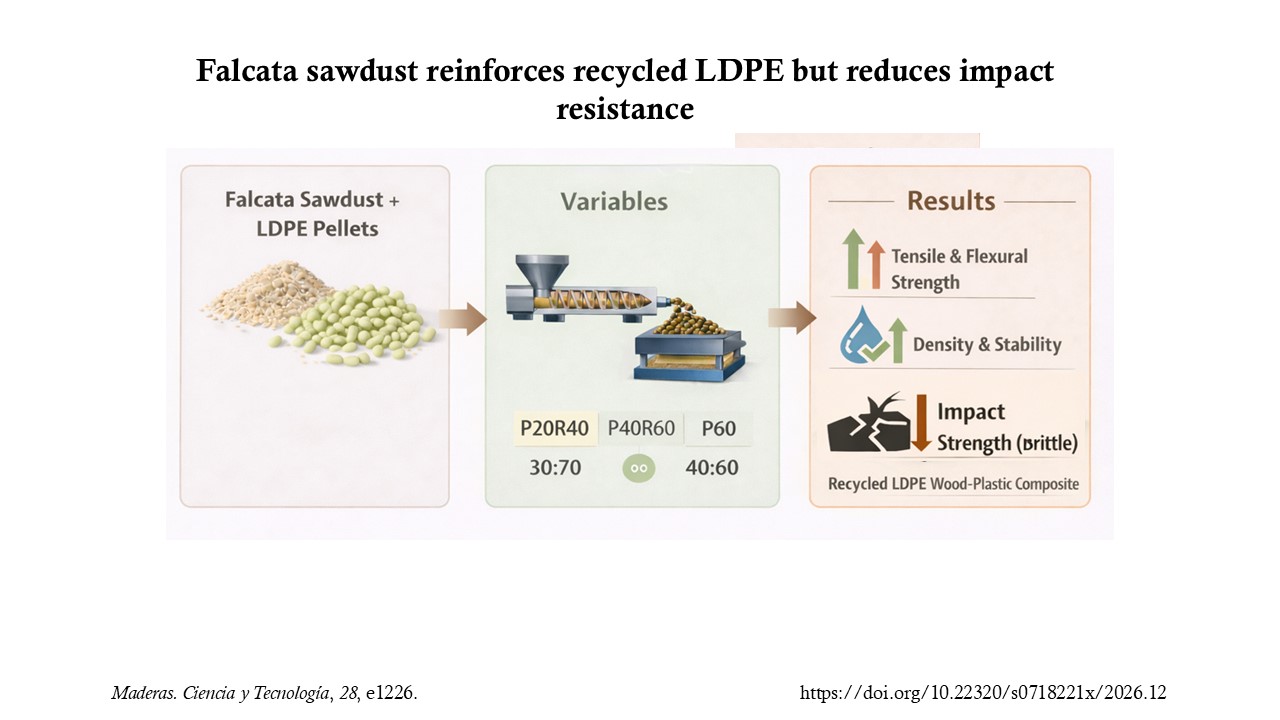
The increasing accumulation of wood and plastic waste necessitates the development of sustainable, value-added materials such as wood-plastic composites (WPCs). This study investigated the feasibility of utilizing Falcataria moluccana (falcata) sawdust as a reinforcing filler in a recycled low-density polyethylene (LDPE) matrix. WPCs were fabricated via twin-screw extrusion using three sawdust particle sizes—P20R40 (0,840 - 0,400 mm), P40R60 (0,400 - 0,250 mm), and P60 (<0,250 mm)—at blending ratios of 30:70 and 40:60 (sawdust:LDPE, by weight). Physical properties, including relative density, moisture content, water absorption, and thickness swelling, were evaluated alongside mechanical performance according to ASTM standards. The results demonstrated that the incorporation of sawdust produced WPCs with physical stability and hygroscopic properties comparable to or superior to those of the pure recycled LDPE control. Mechanical analysis revealed a significant reinforcement effect; the inclusion of sawdust enhanced both the tensile and flexural strength and modulus of the composites. Specifically, finer sawdust particles (<0,250 mm) and a 30:70 sawdust-to-LDPE ratio yielded the optimal overall mechanical performance. However, impact strength tests indicated that the wood filler increased material brittleness, as the neat LDPE significantly outperformed all WPC treatments in energy absorption. Overall, this study concludes that falcata sawdust is a viable natural fiber for reinforcing recycled LDPE, offering a sustainable pathway for upcycling waste into rigid composite materials, provided that applications account for the inherent reduction in impact resistance.
Downloads
References
Alipon, M.A.; Bondad, E.O.; Gilbero, D.M. Jimenez, J.J.P.; Domingo, E.P.; Marasigan, O.S. 2021. Anatomical Properties and Utilization of 3-, 5-, and 7-yr-old Falcata (Falcataria moluccana (Miq.)) Barneby & JW Grimes) from Caraga Region, Mindanao Philippines. Philippine Journal of Science 150(5): 1307-1319. http://dx.doi.org/10.56899/150.05.38
ASTM International. ASTM 2018. Methods for Determining the Izod Pendulum Impact Resistance of Plastics ASTM D256-10e1. 2018. ASTM International. West Conshohocken, USA.
ASTM International. ASTM 2017. Method for Tensile Properties of Plastics. ASTM D638-02a. 2017. ASTM International. West Conshohocken, USA.
ASTM International. ASTM. 2017. Methods for Evaluating Properties of Wood-Base Fiber and Particle Panel Materials. ASTM D1037-99. 2017. ASTM International. West Conshohocken, USA.
ASTM International. ASTM. 2017. Methods for Flexural Properties of Unreinforced and Reinforced Plastics and Electrical Insulating Materials. ASTM D790-15e2. 2017. ASTM International. West Conshohocken, USA.
ASTM International. ASTM. 2019. Guide for Evaluating Mechanical and Physical Properties of Wood-Plastic Composite Products. ASTM D7031-11. 2019. ASTM International. West Conshohocken, USA.
ASTM International. ASTM. 2022. Methods for Density and Specific Gravity (Relative Density) of Wood and Wood-Based Materials. ASTM D2395-17. 2022. ASTM International. West Conshohocken, USA.
Antwi-Boasiako, C.; Ansah, A.O.O.; Glalah, M. 2022. Physico-mechanical properties of wood–plastic composites from Triplochiton scleroxylon K. Schum wood-residue and post-consumer polyethylene waste as construction materials. International Wood Products Journal 13(1): 50-56. https://doi.org/10.1080/20426445.2021.2014026
Ashori, A.; Kiani, H.; Mozaffari, S.A. 2011. Mechanical properties of reinforced polyvinyl chloride composites: Effect of filler form and content. Journal of Applied Polymer Science 120(3): 1788-1793. https://doi.org/10.1002/app.33378
Aumnate, C.; Gamonpilas, C.; Kruenate, J. 2010. Effect of ethylene vinyl acetate on the rheological and mechanical behavior of low-density polyethylene-based greenhouse film. Advanced Materials Research. 93: 475-478. https://doi.org/10.4028/www.scientific.net/AMR.93-94.475
Bello, R.S. 2017. Characterization of sawdust produced from circular, chain and band sawing machines. Bioprocess Engineering 1(1): 21-29. https://www.sciencepublishinggroup.com/article/10.11648/j.be.20170101.14
Berger, M.J.; Stark, N.M. 1997. Investigations of species effects in an injection-molding-grade, wood-filled polypropylene. In Proceedings of the fourth international conference on wood fiber-plastic composites, Madison, WI. USA. 12 -14 May 1997, pp. 19-25. https://docslib.org/doc/11746649/investigations-of-species-effects-in-an-injection-molding-grade-wood-filled-polypropylene
Berzin, F.; Vergnes, B. 2021. Thermoplastic natural fiber-based composites. In: Fiber reinforced composites. Woodhead Publishing, Elsevier, Amsterdam, Netherlands,. pp. 113-139 https://doi.org/10.1016/B978-0-12-821090-1.00015-6. ISBN: 978-0-12-821090-1
Bledzki, A.K.; Gassan, J. 1999. Composites reinforced with cellulose-based fibres. Prog Polym Sci 24(2): 221-274. https://doi.org/10.1016/S0079-6700(98)00018-5
Caulfield, D.F.; Clemons, C.; Jacobson, R.E.; Rowell, R.M. 2005. Wood/Nonwood Thermoplastic Composites. In: Handbook of wood chemistry and wood composites. CRC Press, Boca Raton, Florida, USA, pp. 366-378. https://doi.org/10.1201/b12487. ISBN 0-8493-1588-3.
Chaharmahali, M.; Mirbagheri, J.; Tajvidi, M.; Najafi, S. K.; Mirbagheri, Y. 2010. Mechanical and physical properties of wood-plastic composite panels. Journal of Reinforced Plastics and Composites. 29(2): 310-319. https://doi.org/10.1177/0731684408093877
Chaharmahali, M.; Tajvidi, M.; Najafi, S. K. 2008. Mechanical properties of wood plastic composite panels made from waste fiberboard and particleboard. Polymer composites. 29(6): 606-610. https://doi.org/10.1002/pc.20434
Chaudemanche, S.; Perrot, A.; Pimbert, S.; Lecompte, T.; Faure, F. 2018. Properties of an industrial extruded HDPE-WPC: The effect of the size distribution of wood flour particles. Construction and Building Materials. 162: 543-552. https://doi.org/10.1016/j.conbuildmat.2017.12.061
Clemons, C. 2002. Wood-plastic Composites in the United States: The interfacing of two Industries. Forest Products Journal 52(6): 10-18. https://research.fs.usda.gov/treesearch/8778
Clemons, C. 2010. Wood flour. In: Functional Fillers for Plastics: Second, updated and enlarged edition. John Wiley & Sons. pp. 269 - 290. ISBN: 978-3-527-32361-5.
de Prá Andrade, M.; Poletto, M. 2021. Wood treatments and interfacial bonding in wood-plastic composites. In: Wood Polymer Composites: Recent Advancements and Applications. Springer, Singapore, pp. 43-65. https://doi.org/10.1007/978-981-16-1606-8_3. ISBN978-981-16-1605-1
Delviawan, A.; Kojima, Y.; Kobori, H.; Suzuki, S.; Aoki, K.; Ogoe, S. 2019. The effect of wood particle size distribution on the mechanical properties of wood-plastic composite. Journal of Wood Science 65(1). e67. https://doi.org/10.1186/s10086-019-1846-9
Eduagin, R.T.; Galarrita, R.J.L.; Calixtro, J.F.; Oclaman, F.D.; Namoco, C.S. 2021. Utilization of falcata sawdust briquettes as an alternative solid fuel. Journal of Engineering and Applied Sciences 16(8): 880-884. https://hal.science/hal-04172864/
Espert, A.; Vilaplana, F.; Karlsson, S. 2004. Comparison of water absorption in natural cellulosic fibres from wood and one-year crops in polypropylene composites and its influence on their mechanical properties. Composites Part A: Applied science and manufacturing. 35(11), 1267-1276. https://doi.org/10.1016/j.compositesa.2004.04.004
Faker, M.; Aghjeh, M. R.; Ghaffari, M.; Seyyedi, S.A. 2008. Rheology, morphology and mechanical properties of polyethylene/ethylene vinyl acetate copolymer (PE/EVA) blends. European Polymer Journal. 44(6): 1834-1842. https://doi.org/10.1016/j.eurpolymj.2008.04.002
Flores-Hernandez, M. A.; González, I. R.; Lomeli-Ramirez, M. G.; Fuentes-Talavera, F. J.; Silva-Guzman, J. A.; Cerpa-Gallegos, M. A.; García-Enriquez, S. 2014. Physical and mechanical properties of wood plastic composites polystyrene-white oak wood flour. Journal of composite materials 48(2): 209-217. https://doi.org/10.1177/0021998312470149
Forest Management Bureau - Department of Environment and Natural Resources. 2023. Philippine Forestry Statistics. Quezon City, Philippines.
Gacitúa, W.; Wolcott, M. 2009. Morphology of wood species affecting wood-thermoplastic interaction: Microstructure and mechanical adhesion. Maderas. Ciencia y Tecnología 11(3): 217-231. http://dx.doi.org/10.4067/S0718-221X2009000300005
Gomes, D. A. C.; de Novais Miranda, E. H.; de Araújo Veloso, M. C. R.; da Silva, M. G.; Ferreira, G. C.; Mendes, L. M.; Júnior, J. B. G. 2023. Production and characterization of recycled low-density polyethylene/amazon palm fiber composites. Industrial Crops and Product 201. e116833. https://doi.org/10.1016/j.indcrop.2023.116833
Gozdecki, C; Wilczyński, A. 2015. Effects of wood particle size and test specimen size on mechanical and water resistance properties of injected wood-high density polyethylene composites. Wood and Fiber Science 47(4): 1-10. https://wfs.swst.org/index.php/wfs/article/view/2366/2254
Granada, J.B.R.; Anggut, A.O.; Tama, F.S.I.; Abarca, R.R.; Ogdiman, R.A.; Pahunang, R.R. 2024. Response surface methodology optimization of sodium diclofenac adsorption using activated carbon derived from falcata tree sawdust. Industrial Crops and Products 221. e119272. https://doi.org/10.1016/j.indcrop.2024.119272
Gulitah, V.; Liew, K. C. 2018. Effect of plastic content ratio on the mechanical properties of wood-plastic composite (WPC) made from three different recycled plastic and acacia fibres. Transactions on Science and Technology. 5(2): 184-189. https://tost.unise.org/pdfs/vol5/no2/5x2x184x189.html
Hu, X.; Li, D.; Li, L. 2020. Weathering characteristics of wood-plastic composites compatibilized with ethylene vinyl acetate. BioResources 15(2): 3930-3944. http://dx.doi.org/10.15376/biores.15.2.3930-3944
Israel, D.C.; Bunao, D.F.M. 2017. Value chain analysis of the wood processing industry in the Philippines, PIDS Discussion Paper Series, No. 2017-05, Philippine Institute for Development Studies (PIDS), Quezon City. https://hdl.handle.net/10419/173582
Izekor, D.N.; Amiandamhen, S.O.; Agbarhoaga, O.S. 2013. Effects of geometric particle sizes of wood flour on strength and dimensional properties of wood plastic composites. Journal of Applied and Natural Science 5(1): 194-199. http://dx.doi.org/10.31018/jans.v5i1.305
Jimenez J.J.P.; Escobin, R.P.; Conda, J.M. 2015. Profile of wood species used in local and imported plywood and their bond performance. Philippine Forest Products Journal 6(1): 43-58.
Jimenez J.J.P.; Gilbero, D.M.; Alipon, M.A. 2021. Veneer and plywood properties of yemane (Gmelina arborea Roxb.) from 3-, 5-, and 7-year-old plantation trees. International Wood Products Journal 12(4): 277-286. https://doi.org/10.1080/20426445.2021.1979823
Jimenez J.J.P.; Gilbero, D.M.; Alipon, M.A. 2022. Evaluation of Young Falcata Plus-Trees for Veneer and Plywood Production in the Philippines. Philippine Journal of Science 151(6A): 2081-2092. https://doi.org/10.56899/151.6A.02
Jimenez, J.J.P.; Mari, E.L.; Villena, E.M.; Cabangon, R.J. 2013. Utilization of spent tea leaves and waste plastics for composite boards. Philippine Forest Products Journal 4(1): 29-36.
Kamdem, D.P.; Jiang, H.; Cui, W.; Freed, J.; Matuana, L.M. 2004. Properties of wood plastic composites made of recycled HDPE and wood flour from CCA-treated wood removed from service. Composites Part A: Applied Science and Manufacturing 35(3): 347-355. https://doi.org/10.1016/j.compositesa.2003.09.013
Kellogg, R. M.; Wangaard, F. F. 1969. Variation in the cell-wall density of wood. Wood and Fiber Science 3: 180-204. https://wfs.swst.org/index.php/wfs/article/view/1352
Khonsari, A.; Taghiyari, H.R.; Karimi, A.; Tajvidi, M. 2015. Study on the effects of wood flour geometry on physical and mechanical properties of wood-plastic composites. Maderas Ciencia y Tecnología 17(3): 545-558. http://dx.doi.org/10.4067/S0718-221X2015005000049
Kormin, S.; Kormin, F.; Beg, M.D.H. 2019. Study on the biodegradability and water adsorption of ldpe/sago starch blend. Journal of Physics: Conference Series 1150 (1). 012033. https://iopscience.iop.org/article/10.1088/1742-6596/1150/1/012033/meta
Maharani, R.; Yutaka, T.; Yajima, T.; Minoru, T. 2010. Scrutiny on physical properties of sawdust from tropical commercial wood species: Effects of Different Mills and Sawdust's Particle Size. Indonesian Journal of Forestry Research 7(1): 20-32. https://doi.org/10.20886/ijfr.2010.7.1.20-32
Mračková, E.; Krišťák, Ľ.; Kučerka, M.; Gaff, M.; Gajtanska, M. 2016. Creation of wood dust during wood processing: Size analysis, dust separation, and occupational health. BioResources 11(1): 209-222. https://doi.org/10.15376/biores.11.1.209-222
Najafi, S. K.; Hamidinia, E.; Tajvidi, M. 2006. Mechanical properties of composites from sawdust and recycled plastics. Journal of Applied Polymer Science 100(5): 3641-3645. https://doi.org/10.1002/app.23159
Najafi, S. K.; Sharifnia, H.; Tajvidi, M. 2008. Effects of water absorption on creep behavior of wood-plastic composites. Journal of Composite Materials 42(10): 993-1002. https://doi.org/10.1177/0021998307088608
Paglicawan, M.; Emolaga, C.S.; Jimenez, J.J.P. 2025. Properties of Tobacco Stalks as Reinforcement in Natural Fiber Composites. Philippine Journal of Science 154(4): 967-982. https://doi.org/10.56899/154.04.16.
Paglicawan, M.; Emolaga, C.S.; Jimenez, J.J.P.; Monsada, A.M.; Marasigan, D.D.; Villanueva, N.M.; Co, J.F. 2022. Thermoplastic composite material comprising wood byproducts. PH/ Utility Model Registration No.: 2/2022/050073.
Pham, N.T.H. 2021. Characterization of low-density polyethylene and LDPE-based/ethylene-vinyl acetate with medium content of vinyl acetate. Polymers 13(14). e2352. https://doi.org/10.3390/polym13142352
Posch, W. 2011. Polyolefins. In: Applied Plastics Engineering Handbook. William Andrew Publishing. Elsevier, Amsterdam, Netherlands, pp 23-48. https://www.sciencedirect.com/book/9781437735147/applied-plastics-engineering-handbook ISBN: 978-1-4377-3514-7
Pożoga, M.I.; Szczepanek, M. 2021. Analysis of Particles’ Size and Degree of Distribution of a Wooden Filler in Wood-Polymer Composites. Materials 14(21). e6251. https://doi.org/10.3390/ma14216251
Radoor, S.; Karayil, J.; Shivanna, J.M.; Siengchin, S. 2021. Water Absorption and Swelling Behaviour of Wood Plastic Composites. In: Wood Polym Compos. Springer, Singapore. pp 195–212. http://dx.doi.org/10.1007/978-981-16-1606-8_10. ISBN978-981-16-1605-1
Rahman, K.S.; Islam, M.N.; Rahman, M.M.; Hannan, M.O.; Dungani, R.; Khalil, H.A. 2013. Flat-pressed wood plastic composites from sawdust and recycled polyethylene terephthalate (PET): physical and mechanical properties. SpringerPlus 2. e629. https://doi.org/10.1186/2193-1801-2-629
Rahman, K.S.; Islam, M.N.; Ratul, S.B.; Dana, N.H.; Musa, S.M.; Hannan, M.O. 2018. Properties of flat-pressed wood plastic composites as a function of particle size and mixing ratio. Journal of Wood Science 64: 279-286. https://doi.org/10.1007/s10086-018-1702-3
Ramesh, M.; Rajeshkumar, L. N.; Srinivasan, N.; Kumar, D.V.; Balaji, D. 2022. Influence of filler material on properties of fiber-reinforced polymer composites: A review. e-Polymers 22(1): 898-916. https://doi.org/10.1515/epoly-2022-0080
Ramli, R. A. 2024. A comprehensive review on utilization of waste materials in wood plastic composite. Materials Today Sustainability 27. e100889. https://doi.org/10.1016/j.mtsust.2024.100889
Samyn, P. 2024. Challenges for Wood–Plastic Composites: Increasing Wood Content and Internal Compatibility. Environmental and Earth Sciences Proceedings 31(1): e1. https://doi.org/10.3390/eesp2024031001
Sandquist, D.; Thumm, A.; Dickson, A.R. 2020. The influence of fines material on the mechanical performance of wood fiber polypropylene composites. BioResources 15(1): 457-468. https://doi.org/10.15376/biores.15.1.457-468
Smith, P.M.; Wolcott, M.P. 2006. Opportunities for wood/natural fiber-plastic composites in residential and industrial applications. Forest Products Journal 56(3): 4-11. http://kb.forestprod.org/Main/ind/?id=67931
Spear, M.J.; Eder, A.; Carus, M. 2015. Wood polymer composites. In: Wood Composites. Woodhead Publishing. Elsevier, Amsterdam, Netherlands, pp. 195-249. https://doi.org/10.1016/B978-1-78242-454-3.00010-X. ISBN: 978-1-78242-454-3
Stark, N.M.; Rowlands, R.E. 2003. Effects of wood fiber characteristics on mechanical properties of wood/polypropylene composites. Wood Fiber Sci 35(2): 167-174. https://wfs.swst.org/index.php/wfs/article/view/590
Sun, C. C. 2005. True density of microcrystalline cellulose. Journal of pharmaceutical sciences 94(10): 2132-2134. https://doi.org/10.1002/jps.20459
Tajvidi, M.; Najafi, S. K.; Moteei, N. 2006. Long‐term water uptake behavior of natural fiber/polypropylene composites. Journal of Applied Polymer Science 99(5): 2199-2203. https://doi.org/10.1002/app.21892
Takatani, M.; Ito, H.; Ohsugi, S.; Kitayama, T.; Saegusa, M.; Kawai, S.; Okamoto, T. 2000. Effect of lignocellulosic materials on the properties of thermoplastic polymer/wood composites. Holzforschung 54(2):197-200. https://doi.org/10.1515/HF.2000.033
Vítěz, T.; Trávníček, P. 2010. Particle size distribution of sawdust and wood shavings mixtures. Research in Agricultural Engineering 56(4):154-158. https://rae.agriculturejournals.cz/pdfs/rae/2010/04/05.pdf
Wang, W.; Morell. J.J. 2004. Water sorption characteristics of two wood-plastic composites. Forest Products Journal 54 (12): 209-212. http://hdl.handle.net/1957/26271
Wolcott, M.P.; Englund, K. 1999. A technology review of wood–plastic composites. In Proceedings of the 33rd International Particleboard and Composite Materials Symposium. Pullman WA. 13-15 April 1999. pp. 103-111.
World Bank Group. 2021. Market Study for the Philippines: Plastics Circularity Opportunities and Barriers. Marine Plastics Series, East Asia and Pacific Region. Washington DC., USA. https://doi.org/10.1596/35295
Xu, K.; Du, G.; Wang, S. 2021. Wood plastic composites: their properties and applications. In: Engineered Wood Products for Construction. IntechOpen. 92960, pp. 197-221. https://doi.org/10.5772/intechopen.98918. ISBN: 978-1-83962-771-2.
Yuan, Q.; Wu, D.; Gotama, J.; Bateman, S. 2008. Wood fiber reinforced polyethylene and polypropylene composites with high modulus and impact strength. Journal of Thermoplastic Composite Materials 21(3): 195-208. https://doi.org/10.1177/0892705708089472
Zepeda-Cepeda, C.O.; Goche-Télles, J.R.; Palacios-Mendoza, C.; Moreno-Anguiano, O.; Núñez-Retana, V.D.; Heya, M.N.; Carrillo-Parra, A. 2021. Effect of sawdust particle size on physical, mechanical, and energetic properties of Pinus durangensis briquettes. Applied sciences 11(9). e3805. https://doi.org/10.3390/app11093805
Zimmermann, M.V.; Turella, T.C.; Santana, R.M.; Zattera, A.J. 2014. The influence of wood flour particle size and content on the rheological, physical, mechanical and morphological properties of EVA/wood cellular composites. Materials & Design 57: 660-666. http://dx.doi.org/10.1016/j.matdes.2014.01.010
Downloads
Published
Issue
Section
License

This work is licensed under a Creative Commons Attribution 4.0 International License.
Los autores/as conservarán sus derechos de autor y garantizarán a la revista el derecho de primera publicación de su obra, el cuál estará simultáneamente sujeto a la Licencia de Reconocimiento de Creative Commons CC-BY que permite a terceros compartir la obra siempre que se indique su autor y su primera publicación esta revista.