Influence of wood species on the physical and mechanical performance of Ganoderma lucidum-based mycelium composites for sustainable packaging applications
DOI:
https://doi.org/10.22320/s0718221x/2026.19Keywords:
Bio-based materials, Ganoderma lucidum, lignocellulosic substrate, mechanical properties, mycelium-based composites, wood sawdustAbstract
This study addresses the need for a clearer understanding of how specific lignocellulosic substrates influence the performance of mycelium-based composites. Mycelium-based composites were prepared by combining Ganoderma lucidum (Curtis) mycelium with sawdust from Quercus sp. (oak) and Fagus orientalis (oriental beech) using a molding process. The aim was to evaluate the effects of wood species on the physical, thermal, and mechanical properties of these composites under controlled conditions. Physical properties (density), thermal stability (thermogravimetric analysis, TGA), and mechanical performance (compressive strength) were evaluated, and morphological characteristics were analyzed using scanning electron microscopy (SEM).
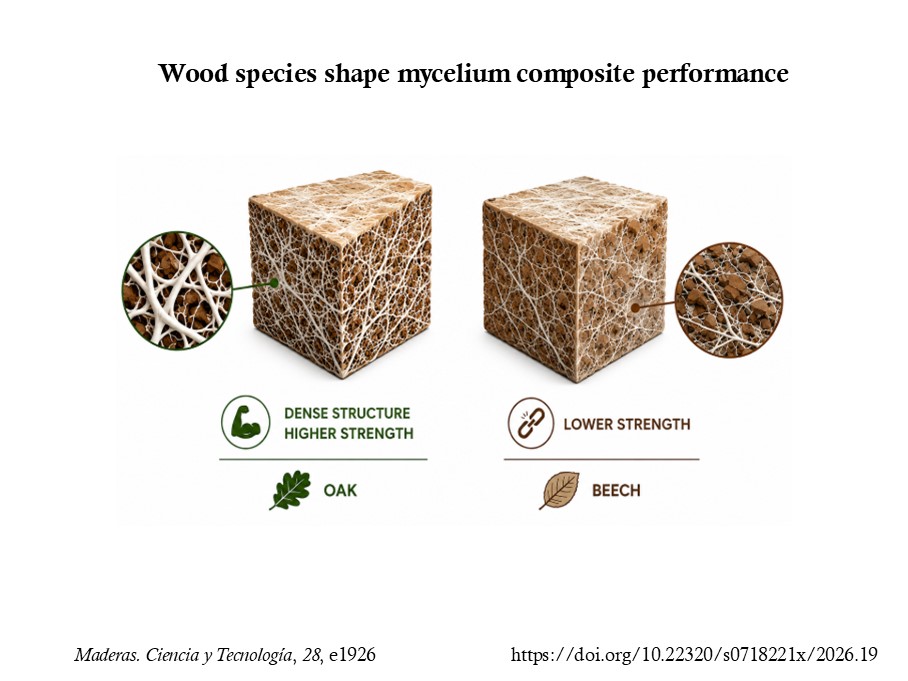
The results showed that substrate type significantly influences composite performance. Oak-Ganoderma lucidum (curtis) composites exhibited superior physical and mechanical properties compared with beech-Ganoderma lucidum (curtis) composites, with a density of 239 kg/m³ and a compressive strength of 0.20 MPa. SEM analysis revealed a filamentous network of tubular hyphae of varying diameters surrounding the wood cell walls, while TGA results indicated similar thermal degradation behavior for both composites.The developed mycelium-based composites exhibited properties comparable to expanded polystyrene (EPS), highlighting their potential as sustainable alternatives for packaging and insulation. Overall, this study demonstrates that substrate composition plays a governing role in determining material performance and informs the design of bio-based composites.
Downloads
References
Abhijith, R.; Ashok, A.; Rejeesh, C.R. 2018. Sustainable packaging applications from mycelium to substitute polystyrene: a review. Materials Today: Proceedings 5(1): 2139–2145. https://doi.org/10.1016/j.matpr.2017.09.211
Alici, N.; Dalkılıç, B. 2022. Usage of bio-based materials in indoor members. GRID 5(2): 325–346. https://doi.org/10.37246/grid.941882
ASTM International. 2016. Standard test method for dimensions and density of preformed block and board-type thermal insulation. ASTM C303-10(2016)e1. ASTM International: West Conshohocken, PA, USA.
ASTM International. 2017. Standard test method for measuring compressive properties of thermal insulations. ASTM C165-07(2017). ASTM International: West Conshohocken, PA, USA.
ASTM International. 2018. Standard specification for rigid, cellular polystyrene thermal insulation. ASTM C578-18. ASTM International: West Conshohocken, PA, USA.
Appels, F.V.W.; Dijksterhuis, J.; Lukasiewicz, C.E.; Jansen, K.M.B.; Wösten, H.A.B.; Krijgsheld, P. 2018. Hydrophobin gene deletion and environmental growth conditions impact mechanical properties of mycelium by affecting the density of the material. Scientific Reports 8. e4703. https://doi.org/10.1038/s41598-018-23171-2
Arora, R.; Mamila, K. 2021. Styrene: risk assessment, environmental, and health hazard. In: Hazardous Gases. Academic Press: Cambridge, MA, USA, pp. 363–374. https://doi.org/10.1016/B978-0-323-89857-7.00015-3
Aquino, M.; Rugolo, M.; Robledo, G.; Kuhar, F. 2022. Evaluation of mycelium composite materials produced by five Patagonian fungal species. Maderas. Ciencia y Tecnología 24. e35. https://doi.org/10.4067/S0718-221X2022000100435
Attias, N.; Danai, O.; Abitbol, T.; Tarazi, E.; Ezov, N.; Pereman, I.; Grobman, Y.J. 2020. Mycelium bio-composites in industrial design and architecture: comparative review and experimental analysis. Journal of Cleaner Production 246. e119037. https://doi.org/10.1016/j.jclepro.2019.119037
Atila, F. 2020. Comparative study on the mycelial growth and yield of Ganoderma lucidum on different lignocellulosic wastes. Acta Ecologica Sinica 40(2): 153–157. https://doi.org/10.1016/j.chnaes.2018.11.007
Beje, G.; Diriba, M.; Dawit, A. 2013. Evaluation of locally available substrates for cultivation of oyster mushroom (Pleurotus ostreatus) in Jimma, Ethiopia. African Journal of Microbiology Research 7(23): 2228–2237. https://doi.org/10.5897/AJMR12.895
Bandyopadhyay, A.; Basak, G.C. 2007. Studies on photocatalytic degradation of polystyrene. Materials Science and Technology 23(3): 307–314. https://doi.org/10.1179/174328407X158640
Biby, S.R.; Surendran, V.; Kundanati, L. 2025. Mycelium biocomposites from agricultural and paper waste: sustainable alternative to plastic foam-based secondary packaging. Bioresource Technology Reports 31. e102177. https://doi.org/10.1016/j.biteb.2025.102177
Bruscato, C.; Malvessi, E.; Brandalise, R.N.; Camassola, M. 2019. High performance of macrofungi in the production of mycelium-based biofoams using sawdust: sustainable technology for waste reduction. Journal of Cleaner Production 234: 225–232. https://doi.org/10.1016/j.jclepro.2019.06.150
Cai, J.; Han, J.; Ge, F.; Lin, Y.; Pan, J.; Ren, A. 2023. Development of impact-resistant mycelium-based composites (MBCs) with agricultural waste straws. Construction and Building Materials 389. e131730. https://doi.org/10.1016/j.conbuildmat.2023.131730
Chan, X.Y.; Saeidi, N.; Javadian, A.; Hebel, D.E.; Gupta, M. 2021. Mechanical properties of dense mycelium-bound composites under accelerated tropical weathering conditions. Scientific Reports 11. e22112. https://doi.org/10.1038/s41598-021-01598-4
Cohen, J.T.; Carlson, G.; Charnley, G.; Coggon, D.; Delzell, E.; Graham, J.D.; Greim, H.; Krewski, D.; Medinsky, M.; Monson, R.; Paustenbach, D.; Petersen, B.; Rappaport, S.; Rhomberg, L.; Ryan, P.R.; Thompson, K. 2002. A comprehensive evaluation of the potential health risks associated with occupational and environmental exposure to styrene. Journal of Toxicology and Environmental Health, Part B 5(1–2): 1–263. https://doi.org/10.1080/1093740025297216
de Lima, G.G.; Schoenherr, Z.C.P.; Magalhães, W.L.E.; Tavares, L.B.B.; Helm, C.V. 2020. Enzymatic activities and analysis of a mycelium-based composite formation using peach palm (Bactris gasipaes) residues on Lentinula edodes. Bioresources and Bioprocessing 7. e58. https://doi.org/10.1186/s40643-020-00346-2
Dias, P.P.; Jayasinghe, L.B.; Waldmann, D. 2021. Investigation of mycelium–Miscanthus composites as building insulation material. Results in Materials 10. e100189. https://doi.org/10.1016/j.rinma.2021.100189
Elsacker, E.; Søndergaard, A.; Van Wylick, A.; Peeters, E.; De Laet, L. 2021. Growing living and multifunctional mycelium composites for large-scale formwork applications using robotic abrasive wire-cutting. Construction and Building Materials 283. e122732. https://doi.org/10.1016/j.conbuildmat.2021.122732
Ergün, M.E.; Kurt, R.; Can, A.; Özlüsoylu, İ.; Ersoy Kalyoncu, E. 2024. Optimized eco-friendly foam materials: a study on the effects of sodium alginate, cellulose, and activated carbon. Polymers 16(17). e2511. https://doi.org/10.3390/polym16172511
Floudas, D.; Binder, M.; Riley, R.; Barry, K.; Blanchette, R.A.; Henrissat, B.; Martínez, A.T.; Otillar, R.; Spatafora, J.W.; Yadav, J.S.; Aerts, A.; Benoit, I.; Boyd, A.; Carlson, A.; Copeland, A.; Coutinho, P.M.; de Vries, R.P.; Ferreira, P.; Findley, K.; Foster, B.; Gaskell, J.; Glotzer, D.; Górecki, P.; Heitman, J.; Hesse, C.; Hori, C.; Igarashi, K.; Jurgens, J.A.; Kallen, N.; Kersten, P.; Kohler, A.; Kües, U.; Kumar, T.K.A.; Kuo, A.; LaButti, K.; Larrondo, L.F.; Lindquist, E.; Ling, A.; Lombard, V.; Lucas, S.; Lundell, T.; Martin, R.; McLaughlin, D.J.; Morgenstern, I.; Morin, E.; Murat, C.; Nagy, L.G.; Nolan, M.; Ohm, R.A.; Patyshakuliyeva, A.; Rokas, A.; Ruiz-Dueñas, F.J.; Sabat, G.; Salamov, A.; Samejima, M.; Schmutz, J.; Slot, J.C.; St. John, F.; Stenlid, J.; Sun, H.; Sun, S.; Syed, K.; Tsang, A.; Wiebenga, A.; Young, D.; Pisabarro, A.; Eastwood, D.C.; Martin, F.; Cullen, D.; Grigoriev, I.V.; Hibbett, D.S. 2012. The Paleozoic origin of enzymatic lignin decomposition reconstructed from 31 fungal genomes. Science 336(6089): 1715–1719. https://doi.org/10.1126/science.1221748
Fricker, M.; Boddy, L.; Bebber, D. 2007. Biology of the fungal cell. Springer: Berlin, Germany.
Hall, I.R.; Stephenson, S.L.; Buchanan, P.K.; Yun, W.; Cole, A.L.J. 2003. Edible and poisonous mushrooms of the world. Timber Press: Portland, OR, USA.
Haisheng, P.; Junshe, S.; Minjing, W.; Teng, Y.; Xiuqing, Z. 2017. Effect of lignin additive amount on growth of Ganoderma lucidum. Transactions of the Chinese Society of Agricultural Engineering 33(6): 309–314. https://doi.org/10.11975/j.issn.1002-6819.2017.06.040
Holt, G.A.; McIntyre, G.; Flagg, D.; Bayer, E.; Wanjura, J.D.; Pelletier, M.G. 2012. Fungal mycelium and cotton plant materials in the manufacture of biodegradable molded packaging material: evaluation study of select blends of cotton byproducts. Journal of Biobased Materials and Bioenergy 6(4): 431–439. https://doi.org/10.1166/jbmb.2012.1241
Islam, M.R.; Tudryn, G.; Bucinell, R.; Schadler, L.; Picu, R.C. 2017. Morphology and mechanics of fungal mycelium. Scientific Reports 7. e13070. https://doi.org/10.1038/s41598-017-13295-2
Jiang, L.; Walczyk, D.; Mooney, L.; Putney, S. 2013. Manufacturing of mycelium-based biocomposites. In: Proceedings of the International SAMPE Technical Conference. SAMPE: Covina, CA, USA.
Jones, M.; Bhat, T.; Huynh, T.; Kandare, E.; Yuen, R.; Wang, C.H.; John, S. 2018. Waste-derived low-cost mycelium composite construction materials with improved fire safety. Fire and Materials 42(7): 816–825. https://doi.org/10.1002/fam.2637
Joshi, K.; Meher, M.K.; Poluri, K.M. 2020. Fabrication and characterization of bioblocks from agricultural waste using fungal mycelium for renewable and sustainable applications. ACS Applied Bio Materials 3(4): 1884–1892. https://doi.org/10.1021/acsabm.9b01047
Kijpornyongpan, T.; Schwartz, A.; Yaguchi, A.; Salvachúa, D. 2022. Systems biology-guided understanding of white-rot fungi for biotechnological applications: a review. iScience 25(7). e104640. https://doi.org/10.1016/j.isci.2022.104640
Kundu, S. 2021. Study of secondary metabolites produced by white rot fungi for knowing their antimicrobial properties. Journal of Emerging Technologies and Innovative Research 8(2). http://www.jetir.org/papers/JETIR2102176.pdf
Li, P.; Zhang, H.; Chen, L. 2025. Dynamic response of EPS foam in packaging: experimental tests and constitutive modeling. Polymers 17(12). e1606. https://doi.org/10.3390/polym17121606
Lingam, D.; Narayan, S.; Mamun, K.; Charan, D. 2023. Engineered mycelium-based composite materials: comprehensive study of various properties and applications. Construction and Building Materials 391. e131841. https://doi.org/10.1016/j.conbuildmat.2023.131841
Llanos-López, N.A.; Ebada, S.S.; Vasco-Palacios, A.M.; Sánchez-Giraldo, L.M.; López, L.; Rojas, L.F.; Mándi, A.; Kurtán, T.; Marin-Felix, Y. 2023. Panapophenanthrin, a rare oligocyclic diterpene from Panus strigellus. Metabolites 13(7). e848. https://doi.org/10.3390/metabo13070848
Manan, S.; Ullah, M.W.; Ul-Islam, M.; Atta, O.M.; Yang, G. 2021. Synthesis and applications of fungal mycelium-based advanced functional materials. Journal of Bioresources and Bioproducts 6(1): 1–10. https://doi.org/10.1016/j.jobab.2021.01.001
Marková, I.; Ladomerský, J.; Hroncová, E.; Mračková, E. 2018. Thermal parameters of beech wood dust. BioResources 13(2): 3098–3109. https://doi.org/10.15376/biores.13.2.3098-3109
Martínez, A.T.; Speranza, M.; Ruiz-Dueñas, F.J.; Ferreira, P.; Camarero, S.; Guillén, F.; Martínez, M.J.; Gutiérrez, A.; del Río, J.C. 2005. Biodegradation of lignocellulosics: microbial, chemical, and enzymatic aspects of the fungal attack of lignin. International Microbiology 8(3): 195–204. https://revistes.iec.cat/index.php/IM/article/view/4c457c7ccd5bc.002/9522
Motamedi, S.; Rousse, D.R.; Promis, G. 2025. Microstructure-driven hygrothermal behavior of mycelium-based composites for bio-based insulation. Energies 18(11). e2864. https://doi.org/10.3390/en18112864
Murata, K.; Araki, S.; Yokoyama, K. 1991. Assessment of the peripheral, central, and autonomic nervous system function in styrene workers. American Journal of Industrial Medicine 20(6): 775–784. https://doi.org/10.1002/ajim.4700200609
Ozen, E.; Yildirim, N.; Dalkilic, B.; Ergun, M.E. 2021. Effects of microcrystalline cellulose on some performance properties of chitosan aerogels. Maderas. Ciencia y Tecnología 23. e26. https://doi.org/10.4067/S0718-221X2021000100426
Pinar, O.; Rodríguez-Couto, S. 2024. Biologically active secondary metabolites from white-rot fungi. Frontiers in Chemistry 12. e1363354. https://doi.org/10.3389/fchem.2024.1363354
Peng, L.; Yi, J.; Yang, X.; Xie, J.; Chen, C. 2023. Development and characterization of mycelium biocomposites by utilization of different agricultural residual byproducts. Journal of Bioresources and Bioproducts 8(1): 78–89. https://doi.org/10.1016/j.jobab.2022.11.005
Phillips, R. 1981. Mushrooms and other fungi of Great Britain and Europe. Derek A. Reid (ed.). Illustrated reprint edition. Pan Books: London, UK. 287 p. ISBN 9780330264419.
Polruang, S.; Asokbunyarat, V.; Bouthong, P.; Rizqa, F.; Somprasong, A. 2025. Simulated environmental weathering of expanded polystyrene foam and polypropylene under UV and wave agitation. Scientific Reports 15(1). e38649. https://doi.org/10.1038/s41598-025-22367-7
Rajendran, R.C. 2022. Packaging applications of fungal mycelium-based biodegradable composites. In: Fungal biopolymers and biocomposites. Springer: Singapore. https://doi.org/10.1007/978-981-19-1000-5_11
Shakir, M.A.; Azahari, B.; Yusup, Y.; Yhaya, M.F.; Salehabadi, A.; Ahmad, M.I. 2020. Preparation and characterization of mycelium as a bio-matrix in fabrication of biocomposite. Journal of Advanced Research in Fluid Mechanics and Thermal Sciences 65(2): 253–263. https://semarakilmu.com.my/journals/index.php/fluid_mechanics_thermal_sciences/article/view/3710
Soh, E.; Chew, Z.Y.; Saeidi, N.; Javadian, A.; Hebel, D.; Le Ferrand, H. 2020. Development of an extrudable paste to build mycelium-bound composites. Materials and Design 195. e109058. https://doi.org/10.1016/j.matdes.2020.109058
Sorrentino, A.; Gorrasi, G.; Vittoria, V. 2007. Potential perspectives of bio-nanocomposites for food packaging applications. Trends in Food Science & Technology 18(2): 84–95. https://doi.org/10.1016/j.tifs.2006.09.004
Sun, W.; Tajvidi, M.; Hunt, C.G.; McIntyre, G.; Gardner, D.J. 2019. Fully bio-based hybrid composites made of wood, fungal mycelium and cellulose nanofibrils. Scientific Reports 9. e3766. https://doi.org/10.1038/s41598-019-40442-8
Sudheer, S.; Alzorqi, I.; Ali, A.; Cheng, P.G.; Siddiqui, Y.; Manickam, S. 2018. Determination of the biological efficiency and antioxidant potential of Ganoderma lucidum cultivated using different agro-wastes in Malaysia. International Journal of Medicinal Mushrooms 20(1): 89–100. https://doi.org/10.1615/IntJMedMushrooms.2017024588
Swan, S.H.; Main, K.M.; Liu, F.; Stewart, S.L.; Kruse, R.L.; Calafat, A.M.; Mao, C.S.; Ternand, C.L.; Sullivan, S.; Teague, J.L. 2005. Decrease in anogenital distance among male infants with prenatal phthalate exposure. Environmental Health Perspectives 113(8): 1056–1061. https://doi.org/10.1289/ehp.8100
Sydor, M.; Cofta, G.; Doczekalska, B.; Bonenberg, A. 2022. Fungi in mycelium-based composites: usage and recommendations. Materials 15(18). e6283. https://doi.org/10.3390/ma15186283
Turkish Standards Institution. 1999. Wood-based panels — determination of moisture content. TS EN 322. Turkish Standards Institution: Ankara, Türkiye.
Vicuña, R. 2000. Ligninolysis. Molecular Biotechnology 14(2): 173–176. https://doi.org/10.1385/MB:14:2:173
Vidholdová, Z.; Kormúthová, D.; Iždinský, J.; Lagaňa, R. 2019. Compressive resistance of the mycelium composite. Annals of Warsaw University of Life Sciences — SGGW Forestry and Wood Technology 107: 31–36. https://doi.org/10.5604/01.3001.0013.7634
Xie, Q.; Li, H.; Li, Z.; Zhang, H.; Yuan, M.; Wu, M.; Li, H.; Xu, X. 2022. Accumulation, chemical speciation and ecological risks of heavy metals on expanded polystyrene microplastics in seawater. Gondwana Research 108: 181–192. https://doi.org/10.1016/j.gr.2022.01.017
Yanagiba, Y.; Ito, Y.; Yamanoshita, O.; Zhang, S.Y.; Watanabe, G.; Taya, K.; Nakajima, T. 2008. Styrene trimer may increase thyroid hormone levels via down-regulation of the aryl hydrocarbon receptor (AhR) target gene UDP-glucuronosyltransferase. Environmental Health Perspectives 116(6): 740–745. https://doi.org/10.1289/ehp.10864
Yang, Z.J.; Zhang, F.; Still, B.; White, M.; Amstislavski, P. 2017. Physical and mechanical properties of fungal mycelium-based biofoam. Journal of Materials in Civil Engineering 29(7). e04017030. https://doi.org/10.1061/(ASCE)MT.1943-5533.0001866
Yildirim, N.; Ozen, E.; Ergun, M.E.; Dalkilic, B. 2022. A study on physical, morphological and antibacterial properties of biopolymers reinforced polyvinyl acetate foams. Materials Research 25. e20210579. https://doi.org/10.1590/1980-5373-MR-2021-0579
Zabel, R.A.; Morrell, J.J. 2020. Wood microbiology. 2nd edition. Academic Press: Cambridge, USA.
Downloads
Published
Issue
Section
License

This work is licensed under a Creative Commons Attribution 4.0 International License.
Los autores/as conservarán sus derechos de autor y garantizarán a la revista el derecho de primera publicación de su obra, el cuál estará simultáneamente sujeto a la Licencia de Reconocimiento de Creative Commons CC-BY que permite a terceros compartir la obra siempre que se indique su autor y su primera publicación esta revista.