
Mechanical, physical, thermal, and biological characterization of recycled polypropylene-based wood–plastic composites reinforced with heterogeneous furniture-factory waste sawdust
DOI:
https://doi.org/10.22320/s0718221x/2026.21Keywords:
Compatibilization, interfacial adhesion, maleated polypropylene (MAPP), lignocellulosic composites, fungal decay resistance, industrial residues, recycled polymersAbstract
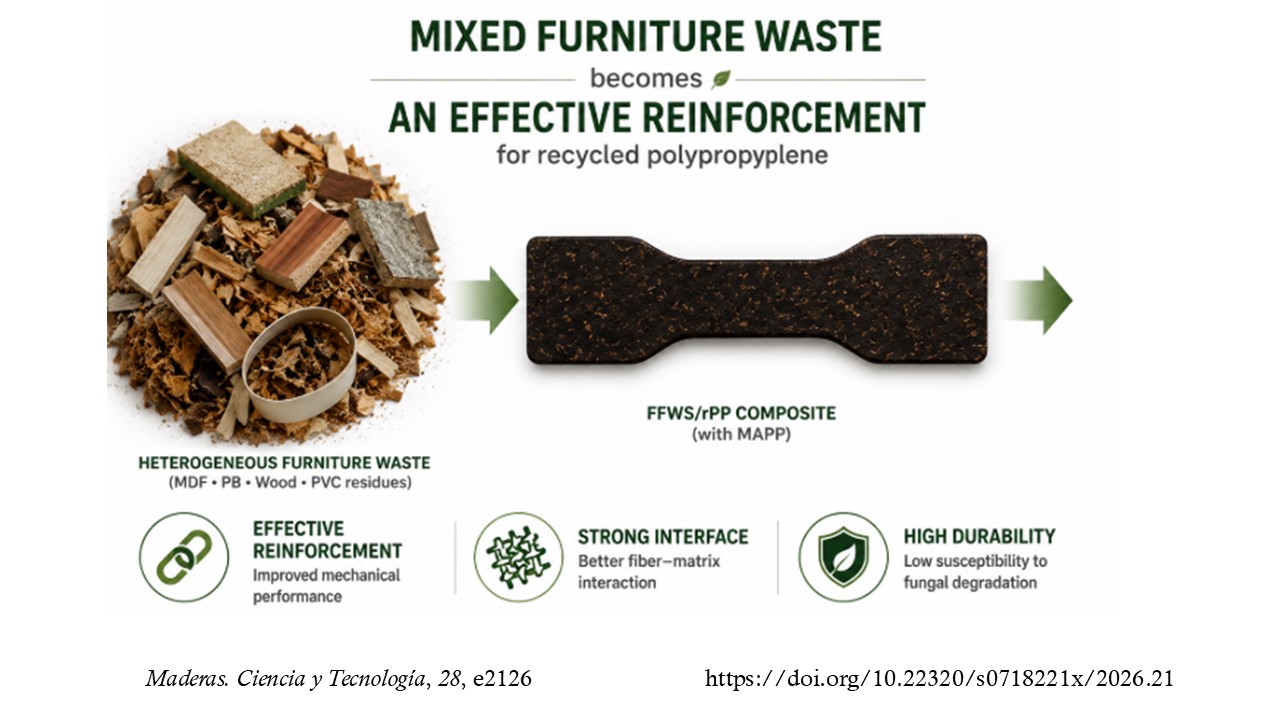
This study investigates sustainable wood-plastic composites produced from heterogeneous furniture-factory waste sawdust and recycled polypropylene, with maleic anhydride-grafted polypropylene as a compatibilizer. Composites containing 0-40 wt% furniture-factory waste sawdust and 0 or 3 wt% maleic anhydride-grafted polypropylene were melt compounded and injection molded. Mechanical, physical, thermal, morphological, and biological performances were systematically evaluated. Increasing furniture-factory waste sawdust content significantly increased tensile and flexural moduli, while tensile strength, elongation at break, and impact strength decreased in the absence of maleic anhydride-grafted polypropylene due to weak interfacial adhesion. The addition of 3 wt% maleic anhydride-grafted polypropylene markedly enhanced mechanical performance, increasing tensile strength to 22,80 MPa and flexural strength to 43,58 MPa at 40 wt% furniture-factory waste sawdust (improvements of up to 42,9 % and 35,7 % respectively, relative to the uncompatibilized counterparts). Scanning electron microscopy analysis confirmed improved fiber encapsulation and reduced interfacial defects. Water absorption increased with furniture-factory waste sawdust content, while fungal mass losses remained below 2 % for all formulations. Thermal analysis revealed reduced initial degradation temperatures with furniture-factory waste sawdust and a broader decomposition range in the presence of maleic anhydride-grafted polypropylene. These results demonstrate that heterogeneous furniture-factory waste sawdust can be successfully incorporated into recycled polypropylene-based wood–plastic composites and that MAPP compatibilization significantly enhances composite performance. The findings provide valuable insights into the mechanical, physical, thermal, morphological, and biological characteristics of FFWS/rPP composites produced from real industrial waste streams.
Downloads
References
Arsad, A.; Suradi, N.L.; Rahmat, A.R.; Danlami, J.M. 2013. The influence of kenaf fiber as reinforcement on recycled polypropylene/recycled polyamide-6 composites. International Journal of Plastics Technology 17(2): 149–162. https://doi.org/10.1007/s12588-013-9055-7
ASTM International. 2024. Standard test methods for determining the Izod pendulum impact resistance of plastics. ASTM D256-24. ASTM International: West Conshohocken, PA, USA.
ASTM International. 2022. Standard test method for tensile properties of plastics. ASTM D638-22. ASTM International: West Conshohocken, PA, USA.
ASTM International. 2017. Standard test methods for flexural properties of unreinforced and reinforced plastics and electrical insulating materials. ASTM D790-17. ASTM International: West Conshohocken, PA, USA.
ASTM International. 2020. Standard test methods for density and specific gravity (relative density) of plastics by displacement. ASTM D792-20. ASTM International: West Conshohocken, PA, USA.
Atar, İ. 2025. Effect of nanoscale carbon black, ammonium polyphosphate, and microcrystalline cellulose on properties of polypropylene composites. BioResources 20(1): 994–1007. https://doi.org/10.15376/biores.20.1.994-1007
Başboğa, H.İ.; Kılıç, İ.; Atar, İ.; Mengeloğlu, F. 2022. The usage of wood of dahoma (Piptadeniastrum africanum), a tropic tree, in the production of wood plastic composite. Ormancılık Araştırma Dergisi 9(Özel Sayı): 271–280. https://doi.org/10.17568/ogmoad.1091247
Başboğa, H.İ. 2023. Polypropylene-based composites reinforced with waste tropic wood flours: Determination of accelerated weathering resistance, tribological, and thermal properties. BioResources 18(4): 7251–7294. https://doi.org/10.15376/biores.18.4.7251-7294
Birinci, E.; Kaymakcı, A. 2023. Effect of processing technology, nanomaterial and coupling agent ratio on some physical, mechanical, and thermal properties of wood polymer nanocomposites. Forests 14(5). e1036. https://doi.org/10.3390/f14051036
Bledzki, A.K.; Faruk, O. 2003. Wood fibre reinforced polypropylene composites: Effect of fibre geometry and coupling agent on physico-mechanical properties. Applied Composite Materials 10(6): 365–379. https://doi.org/10.1023/A:1025741100628
Burgada, F.; Fages, E.; Quiles-Carrillo, L.; Lascano, D.; Ivorra-Martinez, J.; Arrieta, M.P.; Fenollar, O. 2021. Upgrading recycled polypropylene from textile wastes in wood plastic composites with short hemp fiber. Polymers 13(8). e1248. https://doi.org/10.3390/polym13081248
Brachet, P.; Høydal, L.T.; Hinrichsen, E.L.; Melum, F. 2008. Modification of mechanical properties of recycled polypropylene from post-consumer containers. Waste Management 28(12): 2456–2464. https://doi.org/10.1016/j.wasman.2007.10.021
Candelier, K.; Atli, A.; Alteyrac, J. 2019. Termite and decay resistance of bioplast-spruce green wood-plastic composites. European Journal of Wood and Wood Products 77(1): 157–169. https://doi.org/10.1007/s00107-018-1368-y
Cesarino, I.; Dias, O.A.T.; Negrão, D.R.; Rocha, L.L.N.; Leão, A.L. 2019. Deterioration of wood plastics composites by the white-rot fungus Pycnoporus sanguineus. Journal of Composites Science 3(1). e24. https://doi.org/10.3390/jcs3010024
Catto, A.L.; Montagna, L.S.; Almeida, S.H.; Silveira, R.M.B.; Santana, R.M.C. 2016. Wood plastic composites weathering: Effects of compatibilization on biodegradation in soil and fungal decay. International Biodeterioration & Biodegradation 109: 11–22. https://doi.org/10.1016/j.ibiod.2015.12.026
Chen, W.H.; Eng, C.F.; Lin, Y.Y.; Bach, Q.V. 2020. Independent parallel pyrolysis kinetics of cellulose, hemicelluloses and lignin at various heating rates analyzed by evolutionary computation. Energy Conversion and Management 221. e113165. https://doi.org/10.1016/j.enconman.2020.113165
Chiou, A.H.; Lin, C.H. 2023. Material and mechanical characterization of recycled polypropylene reinforced with different weight percentages of short glass fiber developed by injection molding. Heliyon 9(9). e19403. https://doi.org/10.1016/j.heliyon.2023.e19403
Çavdar, A.D.; Kalaycıoğlu, H.; Mengeloğlu, F. 2011. Tea mill waste fibers filled thermoplastic composites: The effects of plastic type and fiber loading. Journal of Reinforced Plastics and Composites 30(10): 833–844. https://doi.org/10.1177/0731684411408752
Çavuş, V. 2020. Selected properties of mahogany wood flour filled polypropylene composites: The effect of maleic anhydride-grafted polypropylene (MAPP). BioResources 15(2): 2227–2236. https://doi.org/10.15376/biores.15.2.2227-2236
Çavuş, V.; Mengeloğlu, F. 2020. Effect of wood particle size on selected properties of neat and recycled wood polypropylene composites. BioResources 15(2): 3427–3442. https://doi.org/10.15376/biores.15.2.3427-3442
Danesh, M.A.; ZiaeiTabari, H.; Hosseinpourpia, R.; Nazarnezhad, N.; Shams, M. 2012. Investigation of the morphological and thermal properties of waste newsprint/recycled polypropylene/nanoclay composite. BioResources 7(1): 936–945. https://doi.org/10.15376/biores.7.1.936-945
Dányádi, L.; Janecska, T.; Szabó, Z.; Nagy, G.; Móczó, J.; Pukánszky, B. 2007. Wood flour filled PP composites: Compatibilization and adhesion. Composites Science and Technology 67(13): 2838–2846. https://doi.org/10.1016/j.compscitech.2007.01.024
Eroğlu, Ö.; Çetin, N.S.; Narlıoğlu, N.; Yan, W. 2023. Plastic/fiber composite using recycled polypropylene and fibers from Sorghum halepense L. BioResources 18(2): 3109–3122. https://doi.org/10.15376/biores.18.2.3109-3122
Fang, C.; Nie, L.; Liu, S.; Yu, R.; An, N.; Li, S. 2013. Characterization of polypropylene–polyethylene blends made of waste materials with compatibilizer and nano-filler. Composites Part B: Engineering 55: 498–505. https://doi.org/10.1016/j.compositesb.2013.06.046
Gulitah, V.; Liew, K.C. 2019. Three different recycle codes of plastic/Acacia fibre composites: Physical and morphological properties. International Journal of Biobased Plastics 1(1): 1–7. https://doi.org/10.1080/24759651.2018.1557585
Hernández-Díaz, D.; Villar-Ribera, R.; Julián, F.; Tarrés, Q.; Espinach, F.X.; Delgado-Aguilar, M. 2020. Topography of the interfacial shear strength and the mean intrinsic tensile strength of hemp fibers as a reinforcement of polypropylene. Materials 13(4). e1012. https://doi.org/10.3390/ma13041012
Islam, M.R.; Beg, M.D.H.; Gupta, A. 2013. Characterization of laccase-treated kenaf fibre reinforced recycled polypropylene composites. BioResources 8(3): 3753–3770. https://doi.org/10.15376/biores.8.3.3753-3770
Japanese Standards Association. 2010. Wood preservatives — Performance requirements and their test methods for determining effectiveness. JIS K 1571:2010. Japanese Standards Association: Tokyo, Japan.
Jeske, H.; Schirp, A.; Cornelius, F. 2012. Development of a thermogravimetric analysis (TGA) method for quantitative analysis of wood flour and polypropylene in wood plastic composites (WPC). Thermochimica Acta 543: 165–171. https://doi.org/10.1016/j.tca.2012.05.016
Jian, B.; Mohrmann, S.; Li, H.; Li, Y.; Ashraf, M.; Zhou, J.; Zheng, X. 2022. A Review on Flexural Properties of Wood-Plastic Composites. Polymers 14(19). e3942. https://doi.org/10.3390/polym14193942
Kartal, S.N.; Aysal, S.; Terzi, E.; Yılgör, N.; Yoshimura, T.; Tsunoda, K. 2013. Wood and Bamboo-PP Composites: Fungal and Termite Resistance, Water Absorption, and FT-IR Analyses. BioResources 8(1): 1222–1244. https://doi.org/10.15376/biores.8.1.1222-1244
Keener, T.J.; Stuart, R.K.; Brown, T.K. 2004. Maleated coupling agents for natural fibre composites. Composites Part A: Applied Science and Manufacturing 35(3): 357–362. https://doi.org/10.1016/j.compositesa.2003.09.014
Klyosov, A.A. 2007. Wood-Plastic Composites. John Wiley & Sons: Hoboken, NJ, USA. 698 p. ISBN 9780470148914. https://doi.org/10.1002/9780470165935
Kılıç, I.; Avcı, B.; Atar, İ.; Korkmaz, N.; Yılmaz, G.; Mengeloğlu, F. 2023. Using Furniture Factory Waste Sawdust in Wood-Plastic Composite Production and Prototype Sample Production. BioResources 18(4): 7212–7229. https://doi.org/10.15376/biores.18.4.7212-7229
Kılıç, I.; Avcı, B.; Atar, İ.; Korkmaz, N.; Yılmaz, G.; Mengeloğlu, F. 2024. Utilization of flours from hemp stalks as reinforcement in polypropylene matrix. BioResources 19(1): 1494–1516. https://doi.org/10.15376/biores.19.1.1494-1516
Kim, H.S.; Yang, H.S.; Kim, H.J.; Park, H.J. 2004. Thermogravimetric Analysis of Husk Flour Filled Thermoplastic Polymer Composites. Journal of Thermal Analysis and Calorimetry 76:395–404. https://doi.org/10.1023/B:JTAN.0000028020.02657.9b
Kim, H.S.; Lee, B.H.; Choi, S.W.; Kim, S.; Kim, H.J. 2007. The effect of types of maleic anhydride-grafted polypropylene (MAPP) on the interfacial adhesion properties of bio-flour-filled polypropylene composites. Composites Part A: Applied Science and Manufacturing 38(6): 1473–1482. https://doi.org/10.1016/j.compositesa.2007.01.004
Kumar, S.; Vedrtnam, A.; Pawar, S.J. 2019. Effect of wood dust type on mechanical properties, wear behavior, biodegradability, and resistance to natural weathering of wood-plastic composites. Frontiers of Structural and Civil Engineering 13(6): 1446–1462. https://doi.org/10.1007/s11709-019-0568-9
La Mantia, F.P.; Morreale, M. 2011. Green composites: A brief review. Composites Part A: Applied Science and Manufacturing 42(6): 579–588. https://doi.org/10.1016/j.compositesa.2011.01.017
Langhorst, A.E.; Burkholder, J.; Long, J.; Thomas, R.; Kiziltas, A.; Mielewski, D. 2018. Blue-agave fiber-reinforced polypropylene composites for automotive applications. BioResources 13(1): 820–835. https://doi.org/10.15376/biores.13.1.820-835
Leu, S-Y.; Yang, T-H.; Lo, S-F.; Yang, T.H. 2012. Optimized material composition to improve the physical and mechanical properties of extruded wood-plastic composites (WPCs). Construction and Building Materials 29: 120–127. https://doi.org/10.1016/j.conbuildmat.2011.09.013
López, J.P.; Gironès, J.; Méndez, J.A.; El Mansouri, N.E.; Llop, M.; Mutjé, P.; Vilaseca, F. 2012. Stone-ground wood pulp-reinforced polypropylene composites: Water uptake and thermal properties. BioResources 7(4): 5478–5487. https://doi.org/10.15376/biores.7.4.5478-5487
Maziero, R.; Soares, K.; Filho, A.I.; Franco Jr., A.R.; Rubio, J.C.C. 2019. Maleated polypropylene as coupling agent for polypropylene composites reinforced with Eucalyptus and Pinus particles. BioResources 14(2): 4774–4791. https://doi.org/10.15376/biores.14.2.4774-4791
Mengeloğlu, F.; Başboğa, H.İ.; Aslan, T. 2015. Selected properties of furniture plant waste filled thermoplastic composites. PRO LIGNO 11(4): 199–206. https://www.proligno.ro/en/articles/2015/201504.htm
Mertens, O.; Krause, K.C.; Weber, M.; Krause, A. 2020. Performance of thermomechanical wood fibers in polypropylene composites. Wood Material Science & Engineering 15(2): 114–122. https://doi.org/10.1080/17480272.2018.1500494
Myers, G.E.; Chahyadi, I.S.; Coberly, C.A.; Ermer, D.S. 1991. Wood flour/polypropylene composites: Influence of maleated polypropylene and process and composition variables on mechanical properties. International Journal of Polymeric Materials and Polymeric Biomaterials 15(1): 21–44. https://doi.org/10.1080/00914039108031519
Momanyi, J.; Herzog, M.; Muchiri, P. 2019. Analysis of thermomechanical properties of selected class of recycled thermoplastic materials based on their applications. Recycling 4(3). e33. https://doi.org/10.3390/recycling4030033
Mankowski, M.; Morrell, J.J. 2000. Patterns of Fungal Attack in Wood-Plastic Composites Following Exposure in a Soil Block Test. Wood and Fiber Science 32(3): 340–345. https://wfs.swst.org/index.php/wfs/article/view/429
Ndiaye, D.; Gueye, M.; Diop, B. 2013. Characterization, physical and mechanical properties of polypropylene/wood-flour composites. Arabian Journal for Science and Engineering 38: 59–68. https://doi.org/10.1007/s13369-012-0407-y
Nukala, S.G.; Kong, I.; Kakarla, A.B.; Tshai, K.Y.; Kong, W. 2022. Preparation and characterisation of wood polymer composites using sustainable raw materials. Polymers 14(15). e3183. https://doi.org/10.3390/polym14153183
Naumann, A.; Stephan, I.; Noll, M. 2012. Material resistance of weathered wood-plastic composites against fungal decay. International Biodeterioration & Biodegradation 75: 28–35. https://doi.org/10.1016/j.ibiod.2012.08.004
Naumann, A.; Seefeldt, H.; Stephan, I.; Braun, U.; Noll, M. 2012. Material resistance of flame retarded wood-plastic composites against fire and fungal decay. Polymer Degradation and Stability 97(7): 1189–1196. https://doi.org/10.1016/j.polymdegradstab.2012.03.031
Özmen, N.; Çetin, N.; Narlıoğlu, N.; Çavuş, V.; Altuntaş, E. 2014. Utilisation of MDF waste for wood plastic composites production. Turkish Journal of Forestry 15(1): 65–71. https://doi.org/10.18182/tjf.64025
Panthapulakkal, S.; Sain, M. 2007. Injection-molded short hemp fiber/glass fiber reinforced polypropylene hybrid composites: Mechanical, water absorption and thermal properties. Journal of Applied Polymer Science 103(4): 2432–2441. https://doi.org/10.1002/app.25486
Pokhrel, S.; Gardner, D.J.; Han, Y. 2021. Mechanical properties of wood–plastic composites prepared from different feedstock forms. Polymers 13(16). e2769. https://doi.org/10.3390/polym13162769
Poletto, M. 2017. Polypropylene-based wood-plastic composites: Effect of using a coupling agent derived from a renewable resource. Maderas. Ciencia y Tecnología 19(3): 265–272. https://doi.org/10.4067/S0718-221X2017005000022
Renner, K.; Móczó, J.; Pukánszky, B. 2009. Deformation and failure of PP composites reinforced with lignocellulosic fibers: Effect of inherent strength of the particles. Composites Science and Technology 69(10): 1653–1659. https://doi.org/10.1016/j.compscitech.2009.03.015
Schirp, A.; Wolcott, M.P. 2005. Influence of fungal decay and moisture absorption on mechanical properties of extruded wood-plastic composites. Wood and Fiber Science 37(4): 643–652. https://wfs.swst.org/index.php/wfs/article/view/1541
Silveira, P.H.P.M.; Santos, M.C.C.; Chaves, Y.S.; Ribeiro, M.P.; Marchi, B.Z.; Monteiro, S.N.; Gomes, A.V.; Tapanes, N.L.C.; Pereira, P.S.C.; Bastos, D.C. 2023. Characterization of thermo-mechanical and chemical properties of polypropylene/hemp fiber biocomposites: Impact of maleic anhydride compatibilizer and fiber content. Polymers 15(15). e3271. https://doi.org/10.3390/polym15153271
Singh, M.K.; Mohanty, A.K.; Misra, M. 2023. Upcycling of waste polyolefins in natural fiber and sustainable filler-based biocomposites: A study on recent developments and future perspectives. Composites Part B: Engineering 263. e110852. https://doi.org/10.1016/j.compositesb.2023.110852
Vallejos, M.E.; Vilaseca, F.; Méndez, J.A.; Espinach, F.X.; Aguado, R.J.; Delgado-Aguilar, M.; Mutjé, P. 2023. Response of polypropylene composites reinforced with natural fibers: Impact strength and water-uptake behaviors. Polymers 15(4). e900. https://doi.org/10.3390/polym15040900
Wechsler, A.; Hiziroglu, S. 2007. Some of the properties of wood–plastic composites. Building and Environment 42(7): 2637–2644. https://doi.org/10.1016/j.buildenv.2006.06.018
Wu, H.; Xu, D.; Zhou, Y.; Guo, J.; He, W.; He, Y.; Yi, Y.; Qin, S. 2021. The improved mechanical and thermal properties of hemp fibers reinforced polypropylene composites with dodecyl bromide modification. Fibers and Polymers 22(10): 2869–2877. https://doi.org/10.1007/s12221-021-0127-6
Yang, H.S.; Kim, H.J.; Son, J.; Park, H.J.; Lee, B.J.; Hwang, T.S. 2004. Rice-husk flour filled polypropylene composites: Mechanical and morphological study. Composite Structures 63(3–4): 305–312. https://doi.org/10.1016/S0263-8223(03)00179-X
Yang, H.S.; Kim, H.J.; Park, H.J.; Lee, B.J.; Hwang, T.S. 2007. Effect of compatibilizing agents on rice-husk flour reinforced polypropylene composites. Composite Structures 77(1): 45–55. https://doi.org/10.1016/j.compstruct.2005.06.005
Downloads
Published
Issue
Section
License

This work is licensed under a Creative Commons Attribution 4.0 International License.
Los autores/as conservarán sus derechos de autor y garantizarán a la revista el derecho de primera publicación de su obra, el cuál estará simultáneamente sujeto a la Licencia de Reconocimiento de Creative Commons CC-BY que permite a terceros compartir la obra siempre que se indique su autor y su primera publicación esta revista.