Development of straw particleboard using citric acid as bio-based adhesive
DOI:
https://doi.org/10.22320/s0718221x/2026.23Keywords:
Agricultural residues, bio-based adhesive, citric acid, particleboard, wheat straw lignocellulosic materialsAbstract
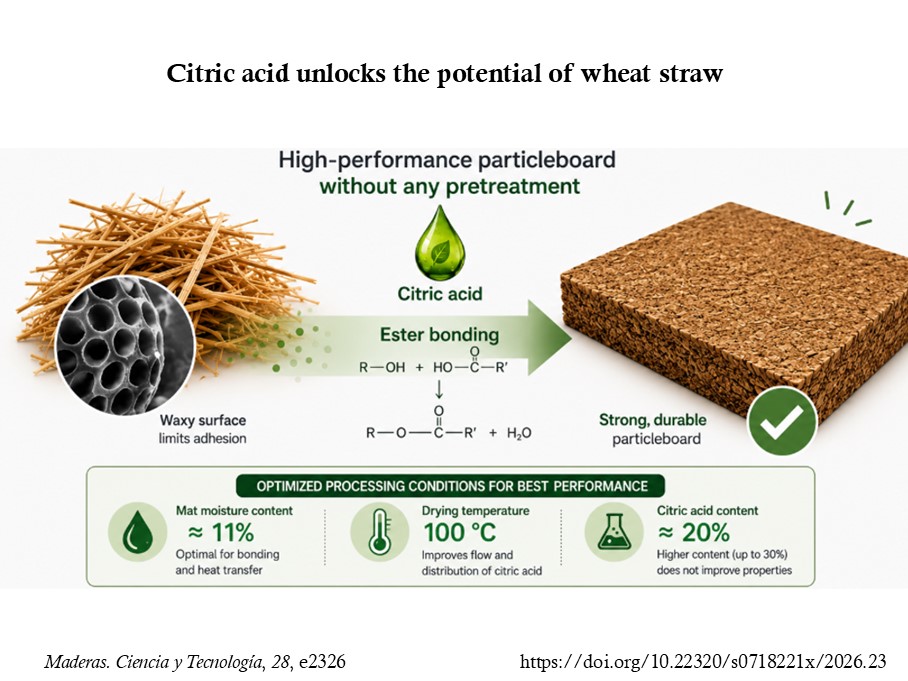
The intensive utilization of agricultural residues, particularly wheat straw (WS), in particleboard production as an environmentally sustainable alternative to wood-based panels remains limited due to their poor bonding performance with conventional adhesives. Citric acid (CA) has recently gained increasing attention as a bio-based adhesive and appears to be a promising solution to overcome the bonding challenges associated with wheat straw However, there is limited information available on the combined effects of the moisture content (MC) of the mat and the adhesive dosage on the behavior of WS particleboard bonded with citric acid. Therefore, the objective of this study was to determine the optimal moisture content (MC) and the optimal CA content required to achieve satisfactory physical and mechanical properties without pretreating the straw particles. To this end, the resinized straw particles were oven-dried at different times intervals (2 h to 14 h) and temperatures (80 °C and 100 °C) to obtain mat with various moisture content (0,5 % - 20 %). The effects of adhesive content of 15 %, 20 %, 25 %, and 30 % (based on the dry mass of the straw) on the properties of the panels were also studied. The optimum moisture content of the mat before hot pressing was about 11%, and the corresponding panel exhibited flexural strength, modulus of elasticity and internal bond of about 12 MPa, 3700 MPa and 0,26 MPa, respectively, while the thickness swelling and water absorption after 24-hour immersion were 6,5% and 46 %, respectively. Increasing the adhesive content from 15 % to 30 % led to an increase in flexural strength from 9 MPa to 13 MPa and 117% in internal bond. However, a further increase in the adhesive content above 20 % did not lead to any statistically significant differences in the physical properties. In general, the results showed that due to the acidic nature of citric acid, it is possible to produce particleboard from wheat straw without pretreating the straw particles before use.
Downloads
References
Adefris, L. A.; Desalegn, D.; Selvaraj, S. K.; Paramasivam, V.; Chadha, U. 2022. Experimental investigation of sorghum stalk and sugarcane bagasse hybrid composite for particleboard. Advances in Materials Science and Engineering 17 (1): 1844004. https://doi.org/10.1155/2022/1844004
Asghar, U.; Irfan, M.; Iram, M.; Huma, Z.; Nelofer, R.; Nadeem, M.; Syed, Q. 2015. Effect of alkaline pretreatment on delignification of wheat straw. Natural Product Research 29(2): 125–131. https://doi.org/10.1080/14786419.2014.964712
ASTM International. 2019. Standard test method for pH of aqueous solutions with the glass electrode. ASTM E70-19. ASTM International: West Conshohocken, PA, USA.
Ando, D.; Umemura, K. 2021. Bond structures between wood components and citric acid in wood-based molding. Polymers 13(1). e58. https://doi.org/10.3390/polym13010058
Azeredo, H.M.C.; Kontou-Vrettou, C.; Moates, G.K.; Wellner, N.; Cross, K.; Pereira, P.H.F.; Waldron, K.W. 2015. Wheat straw hemicellulose films as affected by citric acid. Food Hydrocolloids 50: 1–6. https://doi.org/10.1016/j.foodhyd.2015.04.005
Azizi, K.; Tabarsa, T.; Ashori, A. 2011. Performance characterizations of particleboards made with wheat straw and waste veneer splinters. Composites Part B: Engineering 42(7): 2085–2089. https://doi.org/10.1016/j.compositesb.2011.04.002
Beygi Heidarlou, H.; Banj Shafiei, A.; Nasiri, V.; Niţă, M.D.; Borz, S.A.; Lopez-Carr, D. 2023. Impact of Iran’s forest nationalization law on forest cover changes over six decades: A case study of a Zagros sparse coppice Oak Forest. Sensors 23(2). e871. https://doi.org/10.3390/s23020871
Böhm, M. 2009. The influence of moisture content on thickness swelling and modulus of elasticity in oriented strand board bending. Wood Research 54(4): 79–90. http://www.woodresearch.sk/wr/200904/08.pdf
Boquillon, N.; Elbez, G.; Schonfeld, U. 2004. Properties of wheat straw particle boards bonded with different types of resin. Journal of Wood Science 50: 230–235. https://doi.org/10.1007/s10086-003-0551-9
Bekhta, P.; Korkut, S.; Hiziroglu, S. 2013. Effect of pretreatment of raw material on properties of particleboard panels made from wheat straw. BioResources 8(3): 4766–4774. https://doi.org/10.15376/biores.8.3.4766-4774
Cao, Y.; Song, W.; Yang, Z.; Chen, Z.; Zhang, S. 2017. The properties of particleboard made from alkaline-treated wheat straw and methylene diphenyl diisocyanate binder. BioResources 12(2): 3265–3276. https://doi.org/10.15376/biores.12.2.3265-3276
De Melo, R.R.; Stangerlin, D.M.; Campomanes Santana, R.R.; Pedrosa, T.D. 2015. Decay and termite resistance of particleboard manufactured from wood, bamboo and rice husk. Maderas. Ciencia y Tecnología 17(1): 55–62. https://doi.org/10.4067/S0718-221X2015005000006
Deutsche Institute fur Normung – German Institute for Standardization. 1987. Determination of flow time using the DIN flow cup, DIN 53211 (Cup No. 4 mm). Lacke, Anstrichstoffe und ähnliche Beschichtungsstoffe; Bestimmung der Auslaufzeit mit dern DIN-Becher
European Committee for Standardization. 1993. Wood-based panels – Determination of moisture content. EN 322. European Committee for Standardization: Brussels, Belgium.
European Committee for Standardization. 1993. Wood-based panels – Determination of modulus of elasticity in bending and of bending strength. EN 310. European Committee for Standardization: Brussels, Belgium.
European Committee for Standardization. 1993. Particleboards and fibreboards – Determination of swelling in thickness after immersion in water. EN 317. European Committee for Standardization: Brussels, Belgium.
European Committee for Standardization. 1993. Particleboards and fibreboards – Determination of tensile strength perpendicular to the plane of the board. EN 319. European Committee for Standardization: Brussels, Belgium.
Food and Agriculture Organization. 2023. Data for forestry production and trade. FAOSTAT. United Nations. https://www.fao.org/faostat/en/#data/FO.
Goheen, S.M.; Wool, R.P. 1991. Degradation of polyethylene-starch blends in soil. Journal of Applied Polymer Science 42(10): 2691–2701. https://doi.org/10.1002/app.1991.070421007
Halligan, A.F.; Schniewind, A.P. 1974. Prediction of particleboard mechanical properties at various moisture contents. Wood Science and Technology 8(1): 68–78. https://doi.org/10.1007/BF00350644
Harlvarsson, S.; Edlund, H.; Norgren, M. 2009. Manufacture of non-resin wheat straw fiberboards. Industrial Crops and Products 29(2–3): 437–445. https://doi.org/10.1016/j.indcrop.2008.08.007
Han, G.; Zhang, C.; Zhang, D.; Umemura, K.; Kawai, S. 1998. Upgrading of urea formaldehyde-bonded reed and wheat straw particleboards using silane coupling agents. Journal of Wood Science 44: 282–286. https://doi.org/10.1007/BF00581308
Hafezi, S.M.; Enayati, A.; Hosseini, K.D.; Tarmian, A.; Mirshokraii, S.A. 2016. Use of amino silane coupling agent to improve physical and mechanical properties of UF-bonded wheat straw (Triticum aestivum L.) poplar wood particleboard. Journal of Forestry Research 27(2): 427–431. https://doi.org/10.1007/s11676-015-0135-8
Hematabadi, H.; Behrooz, R. 2012. The effect of urea pretreatment on the formaldehyde emission and properties of straw particleboard. Journal of Forestry Research 23: 497–502. https://doi.org/10.1007/s11676-012-0290-0
Hýsek, Š.; Podlena, M.; Böhm, M.; Bartsch, H.; Wenderdel, C. 2018. Effect of cold plasma surface pre-treatment of wheat straw particles on straw board properties. BioResources 13(3): 5065–5079. https://doi.org/10.15376/biores.13.3.5065-5079
Li, X.; Cai, Z.; Winandy, J. E.; Basta, A. H. 2010. Selected properties of particleboard panels manufactured from rice straws of different geometries. Bioresource Technology 101(12): 4662-4666. https://doi.org/10.1016/j.biortech.2010.01.053
International Organization for Standardization. 2023. Paints and varnishes – Determination of density – Part 1: Pycnometer method. ISO 2811-1. 2023. International Organization for Standardization: Geneva, Switzerland.
Khakzad, J.; Shalbafan, A.; Kazemi-Najafi, S. 2020. Lightweight tubular fiberboard: effect of hole diameters and number on panel properties. Maderas. Ciencia y Tecnología 22(3): 311–324. https://doi.org/10.4067/S0718-221X2020005000306
Kusumah, S.S.; Umemura, K.; Yoshioka, K.; Miyafuji, H.; Kanayama, K. 2016. Utilization of sweet sorghum bagasse and citric acid for manufacturing of particleboard I: Effects of pre-drying treatment and citric acid content on the board properties. Industrial Crops and Products 84: 34–42. https://doi.org/10.1016/j.indcrop.2016.01.042
Lee, C.J.; Na, J.H.; Park, J.Y.; Chang, P.S. 2019. Structural characteristics and in vitro digestibility of malic acid-treated corn starch with different pH conditions. Molecules 24(10). https://doi.org/10.3390/molecules24101900
Lee, S.H.; Md Tahir, P.; Lum, W.C.; Tan, L.P.; Bawon, P.; Park, B.D.; Osman Al Edrus, S.S.; Abdullah, U.H. 2020. A review on citric acid as green modifying agent and binder for wood. Polymers 12(8). e1692. https://doi.org/10.3390/polym12081692
Liao, R.; Xu, J.; Umemura, K. 2016. Low density sugarcane bagasse particleboard bonded with citric acid and sucrose: Effect of board density and additive content. BioResources 11(1): 2174–2185. https://doi.org/10.15376/biores.11.1.2174-2185
Menezzi, C.; Amirou, S.; Pizzi, A.; Xi, X.; Delmotte, L. 2018. Reactions with wood carbohydrates and lignin of citric acid as a bond promoter of wood veneer panels. Polymers 10(8). e833. https://doi.org/10.3390/polym10080833
Nazerian, M.; Beyki, Z.; Gargarii, R.M.; Kool, F. 2016. The effect of some technological production variables on mechanical and physical properties of particleboard manufactured from cotton (Gossypium hirsutum) stalks. Maderas. Ciencia y Tecnología 18(1): 167–178. https://doi.org/10.4067/S0718-221X2016005000017
Neitzel, N.; Hosseinpourpia, R.; Walther, T.; Adamopoulos, S. 2022. Alternative materials from agro-industry for wood panel manufacturing - A review. Materials 15(13). e4542. https://doi.org/10.3390/ma15134542
Shalbafan, A.; Rhême, M.; Thoemen, H. 2017. Ultra-light particleboard: characterization of foam core layer by digital image correlation. European Journal of Wood and Wood Products 75: 43–45. https://doi.org/10.1007/s00107-016-1088-0
Shalbafan, A.; Welling, J.; Hasch, J. 2017. Effect of aluminosilicate powders on the applicability of innovative geopolymer binders for wood-based composites. European Journal of Wood and Wood Products 75: 893–902. https://doi.org/10.1007/s00107-017-1172-0
Shalbafan, A.; Thoemen, H. 2022. Influence of pressing schedule and adhesive content on the rheological behavior of wood fiber-furnish mats. Materials 15(4). e1413. https://doi.org/10.3390/ma15041413
Sutiawan, J.; Hermawan, D.; Massijaya, M.Y.; Kusumah, S.S.; Lubis, M.A.R.; Marlina, R.; Purnomo, D.; Sulastiningsih, I.M. 2022. Influence of different hot-pressing conditions on the performance of eco-friendly jabon plywood bonded with citric acid adhesive. Wood Material Science and Engineering 17(6): 400–409. https://doi.org/10.1080/17480272.2021.1884898
Syamani, A.; Kusumah, S.; Astari, L.; Prasetiyo, W.; Wibowo, E.S.; Subyakto, E.S. 2018. Effect of pre-drying time and citric acid content on Imperata cylindrica particleboards properties. IOP Conference Series: Earth and Environmental Science 209(1). e012034. https://doi.org/10.1088/1755-1315/209/1/012034
Tabarsa, T.; Jahanshahi, S.; Ashori, A. 2011. Mechanical and physical properties of wheat straw boards bonded with a tannin modified phenol-formaldehyde adhesive. Composites Part B: Engineering 42(2): 176–180. https://doi.org/10.1016/j.compositesb.2010.09.012
Tasooji, M.; Tabarsa, T.; Khazaeian, A.; Wool, R.P. 2010. Acrylated epoxidized soy oil as an alternative to urea-formaldehyde in making wheat straw particleboards. Journal of Adhesion Science and Technology 24(8–10): 1717–1727. https://doi.org/10.1163/016942410X507786
Thoemen, H.; Irle, M.; Sernek, M. 2010. Wood-based Panels: An Introduction for Specialists. Brunel University Press: London, UK. ISBN 978-1-902316-82-6. 152 pp.
Maloney, T. M. 1977. Modern particleboard & dry-process fiberboard manufacturing. San Francisco: USA, Miller Freeman Publications. ISBN 0-87930-063-9. 672 pp.
Umemura, K.; Ueda, T.; Munawar, S.; Kawai, S. 2012. Application of citric acid as natural adhesive for wood. Journal of Applied Polymer Science 123(4): 1991–1996. https://doi.org/10.1002/app.34708
Widyorini, R.; Umemura, K.; Isnan, R.; Putra, D.R.; Awaludin, A.; Prayitno, T.A. 2016. Manufacture and properties of citric acid-bonded particleboard made from bamboo materials. European Journal of Wood and Wood Products 74(1): 57–65. https://doi.org/10.1007/s00107-015-0967-0
Zakaria, R.; Bawon, P.; Lee, S.H.; Salim, S.; Lum, W.C.; Al-Edrus, S.S.O.; Ibrahim, Z. 2021. Properties of particleboard from oil palm biomasses bonded with citric acid and tapioca starch. Polymers 13(20). e3494. https://doi.org/10.3390/polym13203494
Zhang, Y.; Lu, X.; Pizzi, A.; Delmotte, L. 2003. Wheat straw particleboard bonding improvements by enzyme pretreatment. European Journal of Wood and Wood Products 61(1): 49–54. https://doi.org/10.1007/s00107-002-0349-2
Downloads
Published
Issue
Section
License

This work is licensed under a Creative Commons Attribution 4.0 International License.
Los autores/as conservarán sus derechos de autor y garantizarán a la revista el derecho de primera publicación de su obra, el cuál estará simultáneamente sujeto a la Licencia de Reconocimiento de Creative Commons CC-BY que permite a terceros compartir la obra siempre que se indique su autor y su primera publicación esta revista.