
Effects of altitude and seasonal variation on stem moisture content and radial distribution in Scots pine and Oriental beech
DOI:
https://doi.org/10.22320/s0718221x/2026.24Keywords:
Altitudinal gradient, environmental factors, radial moisture distribution, soil moisture, wood moisture dynamicsAbstract
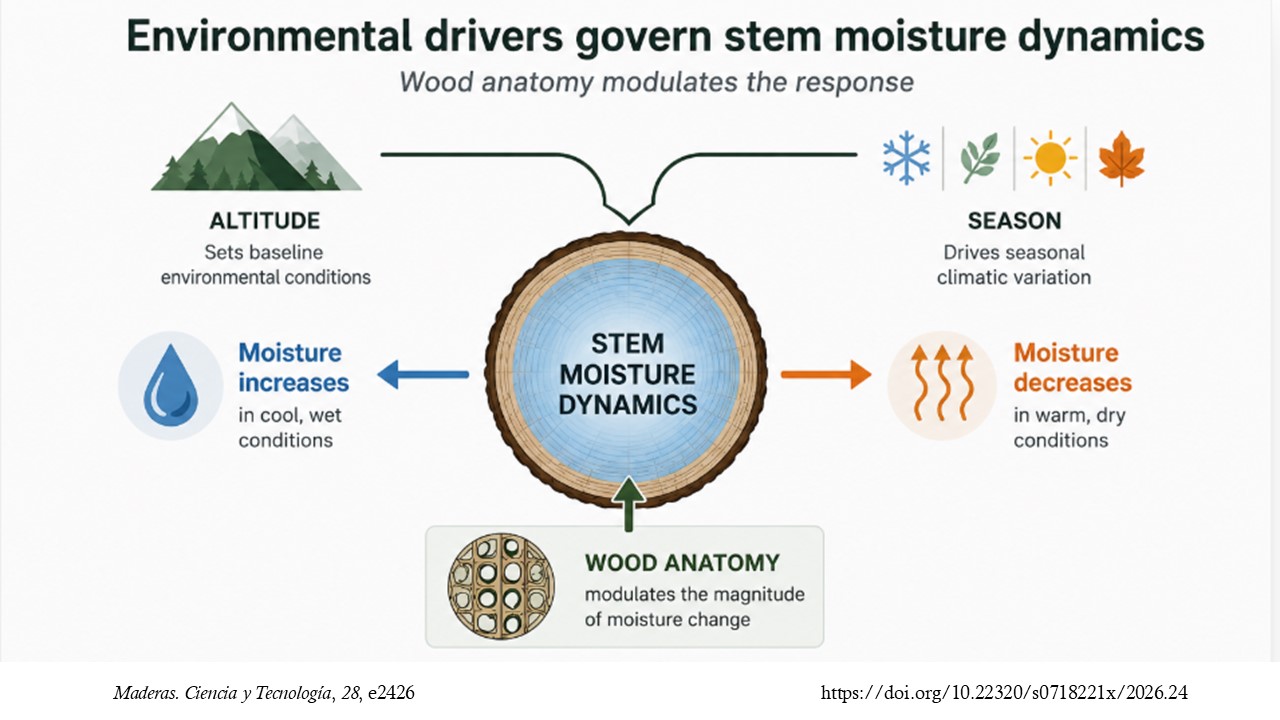
The stem moisture content (MC) of living trees governs log weight, drying behavior, preservative uptake, and the susceptibility of timber to checking and decay, while also reflecting the response of the tree to climate. This study aimed to evaluate monthly variations in the stem MC of scots pine (Pinus sylvestris L.) and oriental beech (Fagus orientalis Lipsky) at two altitudes and examine the relationships between stem MC and environmental factors such as air humidity, temperature, and soil moisture. Stems were sampled monthly over a full annual cycle at two contrasting altitudes in the Andes. The cross-sections were partitioned into radial zones, and the air temperature, relative humidity, and soil moisture were recorded in parallel. Altitude and sampling month significantly affected stem MC for both species. The annual mean reached 57% at high altitudes versus 50% at low altitudes in Scots pine (Pinus sylvestris L.) and 70% versus 58% in oriental beech (Fagus orientalis Lipsky). Stem MC peaked in October-December and February-March, and fell to its annual minimum during summer. Radially, MC in Scots pine (Pinus sylvestris L.) increased from the bark towards the inner sapwood (mean ≈ 85%) and then dropped sharply to ≈ 35% in the heartwood, with the sapwood-heartwood contrast widening at higher altitudes. Oriental beech (Fagus orientalis Lipsky) showed a more gradual gradient (sapwood ≈ 79%, heartwood ≈ 55%), and at lower altitudes, the two zones became virtually indistinguishable in some summer months. Stem MC was positively correlated with soil moisture in both species. Oriental beech (Fagus orientalis Lipsky) additionally showed a positive correlation with relative humidity and a strong negative correlation with air temperature, whereas scots pine (Pinus sylvestris L.) MC was not associated with atmospheric variables. Therefore, altitudinal origin and felling month carry a predictable signal of log moisture, with direct consequences for transport, drying, impregnation, and defect management. January felling emerged as the most favorable window, and the dataset supports fire risk modelling, biomass energy calculations, and drought stress assessments for two ecologically and economically important species.
Downloads
References
Bamber, R.; Fukazawa, K. 1985. Sapwood and heartwood: a review. Forest Products Abstracts 8(9): 265–278. https://www.cabidigitallibrary.org/doi/pdf/10.5555/19870616672
Brinkmann, N.; Eugster, W.; Buchmann, N.; Kahmen, A. 2019. Species-specific differences in water uptake depth of mature temperate trees vary with water availability in the soil. Plant Biology 21(1): 71-81. https://doi.org/10.1111/plb.12907
Bishop, K.; Dambrine, E. 1995. Localization of tree water uptake in Scots pine (Pinus sylvestris L.) and Norway spruce with hydrological tracers. Canadian Journal of Forest Research 25(2): 286–297. https://doi.org/10.1139/x95-033
Cao, J.; Chen, Y.; Jiang, Y.; Chen, J.; Zhang, Y.; Wu, J. 2023. Different responses of soil moisture to different artificial forest species on the Loess Plateau. Sustainability 15(19): 14275. https://doi.org/10.3390/su151914275
Carlquist, S. 2001. Comparative Wood Anatomy: Systematic, Ecological, and Evolutionary Aspects of Dicotyledon Wood. Springer Berlin Heidelberg. ISBN:3540411739, https://link.springer.com/book/10.1007/978-3-662-04578-7
Chalk, L.; Bigg, J.M. 1956. The distribution of moisture in the living stem in Sitka spruce and Douglas fir. Forestry 29(1): 5–21. https://doi.org/10.1093/forestry/29.1.5
Chan, A. M.; Bowling, D. R. 2017. Assessing the thermal dissipation sap flux density method for monitoring cold season water transport in seasonally snow-covered forests. Tree Physiology 37(7): 984-995. https://doi.org/10.1093/treephys/tpx049
Chen, Y.; Huang, Y.; Chen, S. 1998. A study on moisture distribution of green wood and variations of specific gravity in Cryptomeria japonica D. Don. Taiwan Journal of Forest Science 13(2): 91–100.
Chiu, C.M.; Lin, C.J. 2007. Radial distribution patterns of the green moisture content in trunks of 46-year-old red cypress (Chamaecyparis formosensis). Journal of Wood Science 53(5): 374–380. https://doi.org/10.1007/s10086-007-0885-9
Constant, T.; Nepveu, G.; Huber, F. 2002. Intra- and inter-tree variability of moisture content in standing sessile oak (Quercus petraea Liebl.). Holzforschung 56(2): 117–124. https://doi.org/10.1515/HF.2002.020
Çepel, N. 1995. Forest Ecology. 4th ed. IU Faculty of Forestry: Istanbul, Türkiye. 536 p. ISBN:975-404-398-1.
Finér, L.; Helmisaari, H. S.; Lõhmus, K.; Majdi, H.; Brunner, I.; Børja, I.; Eldhuset, T.; Godbold, D.; Grebenc, T.; Konôpka, B.; Kraigher, H.; Möttönen, M. R.; Ohashi, M.; Oleksyn, J.; Ostonen, I.; Uri, V.; Vanguelova, E. 2007. Variation in fine root biomass of three European tree species: Beech (Fagus sylvatica L.), Norway spruce (Picea abies L. Karst.), and Scots pine (Pinus sylvestris L.) (Pinus sylvestris L.). Plant Biosystems 141(3): 394-405. https://doi.org/10.1080/11263500701625897
Fromm, J.H.; Sautter, I.; Matthies, D.; Kremer, J.; Schumacher, P.; Ganter, C. 2001. Xylem water content and wood density in spruce and oak trees detected by high-resolution computed tomography. Plant Physiology 127(2): 416–425. https://doi.org/10.1104/pp.010194
Gartner, B.L.; Moore, J.R.; Gardiner, B.A. 2004. Gas in stems: abundance and potential consequences for tree biomechanics. Tree Physiology 24(11): 1239–1250. https://doi.org/10.1093/treephys/24.11.1239
Gebauer, T.; Horna, V.; Leuschner, C. 2008. Variability in radial sap flux density patterns and sapwood area among seven co-occurring temperate broad-leaved tree species. Tree Physiology 28(12): 1821–1830. https://doi.org/10.1093/treephys/28.12.1821
GDM. 2024. Provincial Statistics of the General Directorate of Meteorology. General Directorate of Meteorology: Ankara, Türkiye. https://mgm.gov.tr/veridegerlendirme/il-ve-ilceler-istatistik.aspx?k=A&m=DUZCE
GDF. 2024. Official Forestry Statistics. Ministry of Agriculture and Forestry, General Directorate of Forestry: Ankara, Türkiye. https://www.ogm.gov.tr/tr/e-kutuphane/resmi-istatistikler
Gessler, A.; Bächli, L.; Rouholahnejad Freund, E.; Treydte, K.; Schaub, M.; Haeni, M.; Weiler, M.; Seeger, S.; Marshall, J.; Hug, C.; Zweifel, R.; Hagedorn, F.; Rigling, A.; Saurer, M.; Meusburger, K. 2022. Drought reduces water uptake in beech from the drying topsoil, but no compensatory uptake occurs from deeper soil layers. New Phytologist 233(1): 194–206. https://doi.org/10.1111/nph.17767
Haygreen, J.; Bowyer, J. 1996. Forest Products and Wood Science: An Introduction. 3rd ed. Iowa State University Press: Ames, Iowa, USA. 484 p. ISBN:978-0-8138-2256-3
Kantarcı, M.D. 2000. Soil Science. 2nd ed. İstanbul University Forestry Faculty Press: İstanbul, Türkiye. 420 p. ISBN:975-404-588-7
Kayacık, H. 1980. The Special Systematic of Forestry and Park Trees. University of Istanbul, Faculty of Forestry Press: Istanbul, Türkiye.
Koch, P. 1972. Utilization of the Southern Pines. U.S. Southern Forest Experiment Station. Agriculture Handbook No.420. US Government Printing Office. Washington, USA. 1619 p.
Köcher, P.; Gebauer, T.; Horna, V.; Leuschner, C. 2009. Leaf water status and stem xylem flux in relation to soil drought in five temperate broad-leaved tree species with contrasting water use strategies. Annals of Forest Science 66: 101. https://doi.org/10.1051/forest/2008076
Körner, C. 2007. The use of ‘altitude’ in ecological research. Trends in Ecology & Evolution 22(11): 569–574. https://doi.org/10.1016/j.tree.2007.09.006
Kravka, M.; Krejzar, T.; Čermák, J. 1999. Water content in stem wood of large pine and spruce trees in natural forests in central Sweden. Agricultural and Forest Meteorology 98–99: 555–562. https://doi.org/10.1016/S0168-1923(99)00123-9
Knüver, T.; Bär, A.; Ganthaler, A.; Gebhardt, T.; Grams, T. E. E.; Häberle, K. H.; Hesse, B. D.; Losso, A.; Tomedi, I.; Mayr, S.; Beikircher, B. 2022. Recovery after long-term summer drought: Hydraulic measurements reveal legacy effects in trunks of Picea abies but not in Fagus sylvatica. Plant Biology 24(7): 1240-1253. https://doi.org/10.1111/plb.13444
Leuschner, C. 2020. Drought response of European beech (Fagus sylvatica L.)—A review. Perspectives in Plant Ecology, Evolution and Systematics 47: 125576. https://doi.org/10.1016/j.ppees.2020.125576
Longuetaud, F.; Mothe, F.; Santenoise, P.; Diop, N.; Dlouha, J.; Fournier, M.; Deleuze, C. 2017. Patterns of within-stem variations in wood specific gravity and water content for five temperate tree species. Annals of Forest Science 74(3). e64. https://doi.org/10.1007/s13595-017-0657-7
Lüttschwager, D.; Jochheim, H. 2020. Drought primarily reduces canopy transpiration of exposed beech trees and decreases the share of water uptake from deeper soil layers. Forests 11(5): 537. https://doi.org/10.3390/f11050537
Magh, R.K.; Eiferle, C.; Burzlaff, T.; Dannenmann, M.; Rennenberg, H.; Dubbert, M. 2020. Competition for water rather than facilitation in mixed beech-fir forests after drying-wetting cycle. Journal of Hydrology 587: 124944. https://doi.org/10.1016/j.jhydrol.2020.124944
Matheny, A.M.; Bohrer, G.; Garrity, S.R.; Morin, T.H.; Howard, C.J.; Vogel, C.S. 2015. Observations of stem water storage in trees of opposing hydraulic strategies. Ecosphere 6(9): 165. https://doi.org/10.1890/ES15-00170.1
Mátyás, C.; Ackzell, L.; Samuel, C. 2004. EUFORGEN Technical Guidelines for Genetic Conservation and Use for Scots pine (Pinus sylvestris L.) (Pinus sylvestris). International Plant Genetic Resources Institute: Rome, Italy. 6 p. ISBN: 92-9043-661-1
Nakada, R.; Fujisawa, Y.; Hirakawa, Y. 1999a. Soft X-ray observation of water distribution in the stem of Cryptomeria japonica D. Don II: Types found in wet-area distribution patterns in transverse sections of the stem. Journal of Wood Science 45(3): 194–199. https://doi.org/10.1007/BF01177725
Nakada, R.; Fujisawa, Y.; Hirakawa, Y. 1999b. Soft X-ray observation of water distribution in the stem of Cryptomeria japonica D. Don I: General description of water distribution. Journal of Wood Science 45(3): 188–193. https://doi.org/10.1007/BF01177724
Nehemy, M. F.; Maillet, J.; Perron, N.; Pappas, C.; Sonnentag, O.; Baltzer, J. L.; Laroque, C. P.; McDonnell, J. J. 2022. Snowmelt water use at transpiration onset: Phenology, isotope tracing, and tree water transit time. Water Resources Research 58(9): e2022WR032344. https://doi.org/10.1029/2022WR032344
Oberhuber, W.; Gruber, A.; Wieser, G. 2023. Seasonal and daily xylem radius variations in scots pine (Pinus sylvestris L.) are closely linked to environmental factors affecting transpiration. Biology 12(9): 1251. https://doi.org/10.3390/biology12091251
Pacheco, A.; Camarero, J.J.; Ribas, M.; Gazol, A.; Gutierrez, E.; Carrer, M. 2018. Disentangling the climate-driven bimodal growth pattern in coastal and continental Mediterranean pine stands. Science of the Total Environment 615: 1518–1526. https://doi.org/10.1016/j.scitotenv.2017.09.133
Panshin, A.J.; De Zeeuw, C. 1980. Textbook of Wood Technology: Structure, Identification, Properties, and Uses of the Commercial Woods of the United States and Canada. 4th ed. McGraw-Hill: New York, USA.772 p. ISBN: 978-0-07-048441-2
Pellet, C.; Hauck, C. 2017. Monitoring soil moisture from middle to high elevation in Switzerland: set-up and first results from the SOMOMOUNT network. Hydrology and Earth System Sciences 21(6): 3199–3220. https://doi.org/10.5194/hess-21-3199-2017
Ross, R. J. 2010. Wood handbook: Wood as an engineering material. General Technical Report FPL-GTR-190. USDA Forest Service: Madison, Wisconsin, USA. 509 p. http://dx.doi.org/10.2737/FPL-GTR-190
Sarıyıldız, T.; Savacı, G. 2023. Variation in soil properties and nutrient stocks under different forest tree species with altitude, aspect and soil depths. Journal of Bartin Faculty of Forestry 25(2): 279–294. https://doi.org/10.24011/barofd.1256500
Schweingruber, F.H. 1990. Anatomy of European Woods. Verlag Paul Haupt: Bern, Switzerland. 800 p. ISBN:978-3-258-04258-9
Song, X.; Li, J.; Zhang, W.; Tang, Y.; Sun, Z.; Cao, M. 2016. Variant responses of tree seedling to seasonal drought stress along an elevational transect in tropical montane forests. Scientific Reports 6(1): 36438. https://doi.org/10.1038/srep36438
Tsoumis, G. 1991. Science and Technology of Wood: Structure, Properties, Utilization. Van Nostrand Reinhold: New York, USA. 491 p. ISBN: 978-3-941300-22-4
Wagenführ, R. 1980. Wood anatomy with special reference to wood technology. 2nd ed. VEB Fachbuchverlag: Leipzig, Germany.328 p.
Ward, J.C. 1986. The effect of wetwood on lumber drying times and rates: an exploratory evaluation with longitudinal gas permeability. Wood and Fiber Science 18(2): 288–307. https://wfs.swst.org/index.php/wfs/article/view/1208
Ward, J.C.; Pong, W. 1980. Wetwood in Trees: A Timber Resource Problem. General Technical Report PNW‑GTR‑112. Portland, Oregon: U.S. Department of Agriculture, Forest Service, Pacific Northwest Forest and Range Experiment Station. 59 p. https://doi.org/10.2737/PNW-GTR-112
Waring, R.H.; Running, S.W. 1978. Sapwood water storage: its contribution to transpiration and effect upon water conductance through the stems of old-growth Douglas-fir. Plant, Cell and Environment 1(2): 131–140. https://doi.org/10.1111/j.1365-3040.1978.tb00754.x
Yaltırık, F. 1982. Fagus L. In: P.H. Davis (ed.), Flora of Turkey and the East Aegean Islands, Vol. 7, Edinburgh: Edinburgh University Press, pp. 657–658. 947 p. ISBN: 0‑85224‑396‑0.
Downloads
Published
Issue
Section
License

This work is licensed under a Creative Commons Attribution 4.0 International License.
Los autores/as conservarán sus derechos de autor y garantizarán a la revista el derecho de primera publicación de su obra, el cuál estará simultáneamente sujeto a la Licencia de Reconocimiento de Creative Commons CC-BY que permite a terceros compartir la obra siempre que se indique su autor y su primera publicación esta revista.