
Effect of wood veneer lamination on the bending performance of 3D printed wood-filled PLA composites
DOI:
https://doi.org/10.22320/s0718221x/2026.26Keywords:
Additive manufacturing, Wood-filled PLA, Wood veneer lamination, Hybrid composites, Bio-based composite, Flexural behaviorAbstract
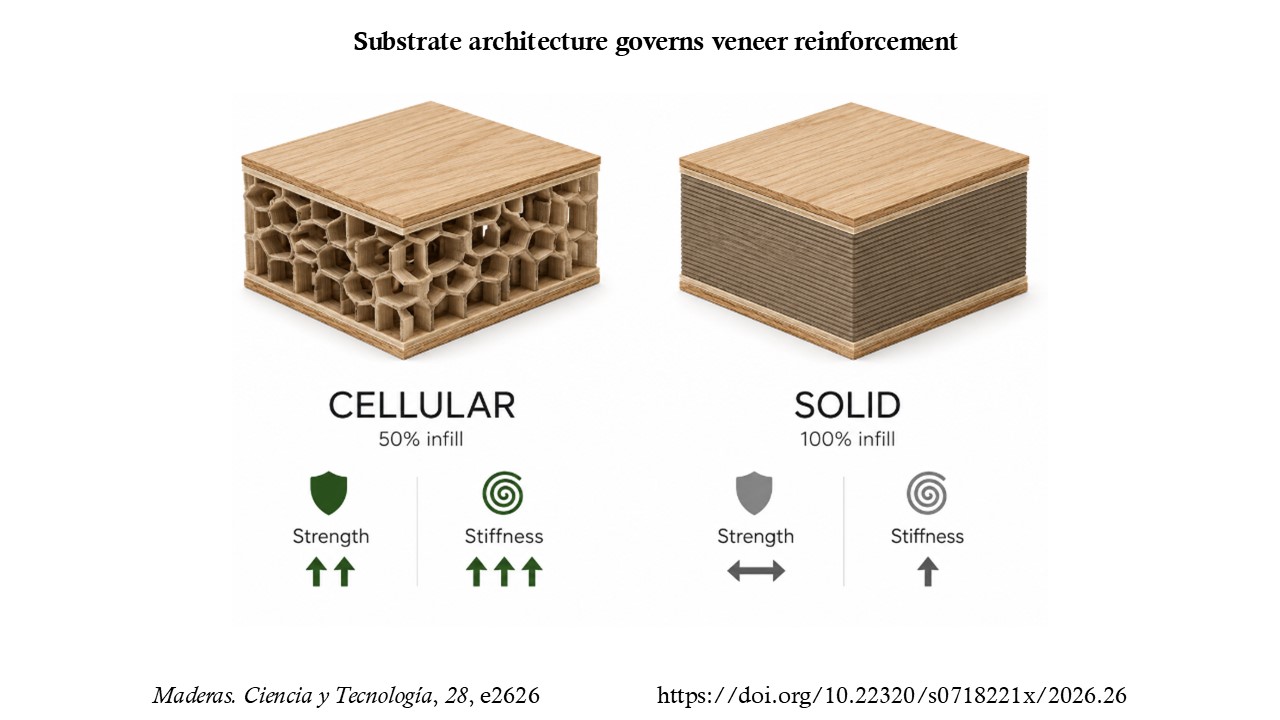
The integration of additive manufacturing and wood-based reinforcement systems has created new opportunities for the development of sustainable hybrid composite materials. This study investigated the effects of wood veneer lamination on the bending behavior of 3D-printed wood-filled PLA composites produced with different infill ratios. Specimens were manufactured using fused filament fabrication (FFF) with 50 % and 100 % infill configurations and subsequently laminated with 0,5 mm thick pine and oak veneers on both surfaces. For comparative evaluation, medium-density fiberboard (MDF) and particleboard specimens were also included in the study. A total of 120 specimens were subjected to three-point bending tests in order to determine bending strength and modulus of elasticity (MOE) values. In addition, representative load–extension behavior, fracture characteristics, and qualitative finite element method (FEM) observations were evaluated. The experimental results demonstrated that veneer lamination affected the mechanical performance of the tested materials differently depending on substrate structure and internal continuity characteristics. The highest bending strength values were obtained from the uncoated specimens printed at 100 % infill. In these groups, veneer lamination increased stiffness behavior but did not improve ultimate bending strength. In contrast, veneer application significantly improved both bending strength and stiffness performance in particleboard specimens and moderately enhanced the performance of MDF specimens. Fracture observations indicated that veneer lamination altered crack propagation behavior and interfacial response during bending, particularly in the laminated 3D-printed groups. Qualitative FEM observations supported the experimental findings by showing reduced displacement behavior and localized stress regions in veneer-laminated specimens, although the numerical simulations were interpreted qualitatively due to simplified modeling assumptions. These findings provide new insight into the reinforcing effect of wood veneer lamination on 3D-printed wood-filled PLA composites and demonstrate its potential as an effective strategy for improving the flexural performance of bio-based additively manufactured structures. The study contributes to the development of sustainable hybrid wood-polymer composites by clarifying the relationship between veneer reinforcement, infill density, and bending behavior.
Downloads
References
Acosta, A.P.; da Silva, A.A.X.; de Avila Delucis, R.; Amico, S.C. 2023. Wood and wood-jute laminates manufactured by vacuum infusion. Journal of Building Engineering 64. e105619. https://doi.org/10.1016/j.jobe.2022.105619
Ashter, S.A. 2013. Thermoforming of Single and Multilayer Laminates: Plastic Films Technologies, Testing, and Applications. Oxford, UK: William Andrew (Elsevier). ISBN 978-1-4557-3172-5. 352 p. https://doi.org/10.1016/C2012-0-02821-9
Çiğdem, E.; Perçin, O. 2023. Some physical and mechanical properties of thermally modified laminated veneer lumbers (LVL) reinforced with carbon fiber and glass fiber. Journal of the Faculty of Engineering and Architecture of Gazi University 38(2): 653–664. https://doi.org/10.17341/gazimmfd.984248
Gibson, I.; Rosen, D. W.; Stucker, B. (2015) Additive manufacturing technologies: 3D printing, rapid prototyping, and direct digital manufacturing. Johnson Matthey Technology Review 59(3): 193-198 https://doi.org/10.1595/205651315X688406
Estakhrianhaghighi, E.; Mirabolghasemi, A.; Zhang, Y.; Lessard, L.; Akbarzadeh, A. 2020. 3D‐printed wood‐fiber reinforced architected cellular composites. Advanced Engineering Materials 22(11). e2000565. https://doi.org/10.1002/adem.202000565
Falk, RH.; Colling, F. 1995. Laminating effects in glued-laminated timber beams. Journal of Structural Engineering 121(12): 1857–1863. https://doi.org/10.1061/(ASCE)0733-9445(1995)121:12(1857
Fico, D.; Rizzo, D.; De Carolis, V.; Montagna, F.; Palumbo, E.; Corcione, C.E. 2022. Development and characterization of sustainable PLA/Olive wood waste composites for rehabilitation applications using Fused Filament Fabrication (FFF). Journal of Building Engineering 56. e104673. https://doi.org/10.1016/j.jobe.2022.104673
Faizaan, M.; Shenoy, B.S.; Nunna, S.; Mallya, R.; Rao Udupi, S.; Ramanath, K.C.; Creighton, C. 2025. A study on the overall variance and void architecture on mex-pla tensile properties through printing parameter optimisation. Scientific Reports 15(1). e3103. https://doi.org/10.1038/s41598-025-87348-2
Huang, Y.; Löschke, S.; Proust, G. 2021. In the mix: The effect of wood composition on the 3D printability and mechanical performance of wood-plastic composites. Composites Part C: Open Access 5. e100140. https://doi.org/10.1016/j.jcomc.2021.100140
Krapež Tomec, D.; Kariž, M. 2022. Use of Wood in Additive Manufacturing: Review and Future Prospects. Polymers 14(6): 1174. https://doi.org/10.3390/polym14061174
Lohar, D.V.; Nikalje, A.M.; Damle, P.G. 2022. Development and testing of hybrid green polymer composite (HGPC) filaments of PLA reinforced with waste bio fillers. Materials Today: Proceedings 62: 818–824. https://doi.org/10.1016/j.matpr.2022.04.023
Novosel, A.; Sedlar, T.; Čizmar, D.; Turkulin, H.; Živković, V. 2023. Improvement of mechanical properties of oak-wood by bi-directional laminations–Efficacy of standard and pre-stressed glass fibre implants. Composite Structures 304. e116465. https://doi.org/10.1016/j.compstruct.2022.116465
Öztürk, Y.; Burdurlu, E. 2021. Effect of wood veneer lamination on the bending resistance of 3D-printed material. Bartın Journal of Forestry Faculty 23(3): 885–891. https://doi.org/10.24011/barofd.963190
Palaniyappan, S.; Annamalai, G.; Kumar, S.N.; Muthu, P. 2023. Development of functional gradient multi-material composites using Poly Lactic Acid and walnut shell reinforced Poly Lactic Acid filaments by fused filament fabrication technology. Journal of Building Engineering 65. e105746. https://doi.org/10.1016/j.jobe.2022.105746
Romani, A.; Suriano, R.; Levi, M. 2023. Biomass waste materials through extrusion-based additive manufacturing: A systematic literature review. Journal of Cleaner Production 386. e135779. https://doi.org/10.1016/j.jclepro.2022.135779
Sikora, A.; Gaff, M.; Sethy, A.K.; Fantuzzi, N.; Horáček, P. 2021. Bending work of laminated materials based on densified wood and reinforcing components. Composite Structures 274. e114319. https://doi.org/10.1016/j.compstruct.2021.114319
Sultana, J.; Rahman, M.M.; Wang, Y.; Ahmed, A.; Cao, X. 2024. Influences of 3D printing parameters on the mechanical properties of wood PLA filament: an experimental analysis by Taguchi method. Progress in Additive Manufacturing 9(4): 1239–1251 https://doi.org/10.1007/s40964-023-00516-6
Turkish Standards Institute 2021. Physical and mechanical properties of wood – Test methods for small clear wood specimens – Part 3: Determination of ultimate strength in static bending. TS ISO 13061-3. Turkish Standards Institute: Ankara, Türkiye.
Turkish Standards Institute 2021. Physical and mechanical properties of wood - Test methods for small clear wood specimens - Part 4: Determination of modulus of elasticity in static bending. TS ISO 13061-4. Turkish Standards Institute: Ankara, Türkiye.
Turkish Standards Institute 1999. Wood-Based panels- Determination of density. TS EN 323. Turkish Standards Institute: Ankara, Türkiye.
Ulaşan, H.; Söğütlü, C. 2024. The Effect of Support Layer Material and Adhesive Type on Compressive Dynamic Bending and Shear Strength in Laminated Wood. Wood Research 69(3): 402–416. https://doi.org/10.37763/wr.1336-4561/69.3.402416
Downloads
Published
Issue
Section
License

This work is licensed under a Creative Commons Attribution 4.0 International License.
Los autores/as conservarán sus derechos de autor y garantizarán a la revista el derecho de primera publicación de su obra, el cuál estará simultáneamente sujeto a la Licencia de Reconocimiento de Creative Commons CC-BY que permite a terceros compartir la obra siempre que se indique su autor y su primera publicación esta revista.