
What do the quality grades of rotary-cut veneers indicate about their internal structure in correlation to their mechanical properties?
DOI:
https://doi.org/10.22320/s0718221x/2026.29Keywords:
Fagus sylvatica, mechanical properties, rotary-cut veneer, structural features, tensile strength, veneer gradingAbstract
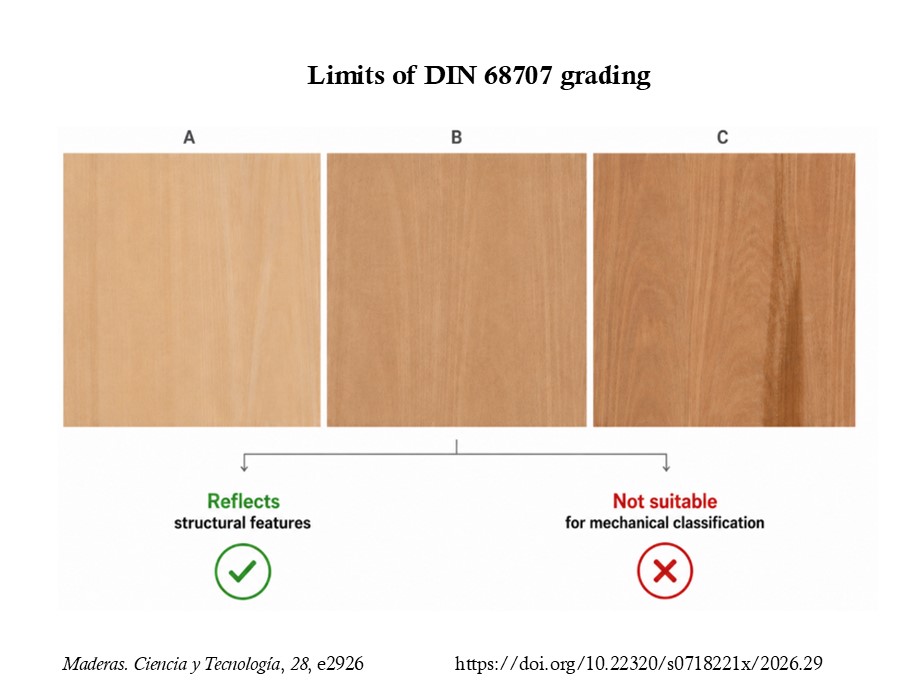
The quality grading of rotary-cut veneers, as defined by various standards, considers the quality features and surface appearance of plywood or molded plywood. This grading primarily focuses on visual surface characteristics, such as knots, cracks, and discoloration. However, the correlation between these quality grades and the internal structural features, such as fiber deviations, lathe check depth, and frequency, and their impact on mechanical properties remains unexplored. This study investigates the relationship between the quality grades (A, B, and C) of Fagus sylvatica (european beech veneers) and their mechanical performance, as represented by the modulus of elasticity and the tensile strength. Structural features were quantitatively analyzed. Tensile tests revealed that veneers of quality grade C exhibited significantly lower modulus of elasticity (10737 MPa) and tensile strength (78,2 MPa) than grades A and B. Grade B veneers showed comparable modulus of elasticity values of 13500 - 13800 MPa but differing tensile strengths of 88,3 MPa for grade A and 116,8 MPa for grade B on average. Structural analysis indicated that grade C veneers exhibited the highest fiber deviations in the thickness direction (up to 20 %) and the highest lathe check depths (46 %), suggesting a qualitative alignment between grading and structural integrity. However, the structural differences between grades A and B did not consistently reflect their mechanical performance.
Downloads
References
Bekhta, P.; Hiziroglu, S.; Shepelyuk, O. 2009. Properties of plywood manufactured from compressed veneer as building material. Materials and Design 30(4): 947–953. https://doi.org/10.1016/j.matdes.2008.07.001
Burawska-Kupniewska, I.; Mycka, P.; Beer, P. 2021. Influence of Scots Pine (Pinus sylvestris L.) veneers quality on selected properties of layered composite for flooring materials. Forests 12(8). e1017. https://doi.org/10.3390/f12081017
Clauß, S.; Pescatore, C.; Niemz, P. 2014. Anisotropic elastic properties of common ash (Fraxinus excelsior L.). Holzforschung 68(8): 941–949. https://doi.org/10.1515/hf-2013-0189
Çolak, S.; Çolakoğlu, G.; Aydin, I. 2007. Effects of logs steaming, veneer drying and aging on the mechanical properties of laminated veneer lumber (LVL). Building and Environment 42(1): 93–98. https://doi.org/10.1016/j.buildenv.2005.08.008
Daoui, A.; Descamps, C.; Marchal, R.; Zerizer, A. 2011. Influence of veneer quality on beech LVL mechanical properties. Maderas. Ciencia y Tecnología 13(1): 69–83. https://doi.org/10.4067/S0718-221X2011000100007
Duriot, R.; Pot, G.; Girardon, S.; Roux, B.; Marcon, B.; Viguier, J.; Denaud, L. 2021. New Perspectives for LVL Manufacturing from Wood of Heterogeneous Quality—Part 1: Veneer Mechanical Grading Based on Online Local Wood Fiber Orientation Measurement. Forests 12(9).1264. https://doi.org/10.3390/f12091264
German Institute for Standardization. 1995. Plywood—Classification by surface appearance—Part 2: Hardwood. DIN EN 635-2. DIN: Berlin, Germany.
German Institute for Standardization. 2016. Molded plywood and laminated wood for furniture—Requirements for dimensions and quality features. DIN 68707. DIN: Berlin, Germany.
Kamperidou, V.; Aidinidis, E.; Barboutis, I. 2020. Impact of structural defects on the surface quality of hardwood species sliced veneers. Applied Sciences 10(18). e6265. https://doi.org/10.3390/app10186265
Kamperidou, V.; Aidinidis, E.; Barboutis, I. 2022. Surface roughness of sliced veneers in terms of defects and wood structure variability—Impact of mild hydrothermal treatment. Drvna Industrija 73(2): 177–191. https://doi.org/10.5552/drvind.2022.2129
Kollmann, F. 1951. Technologie des Holzes und der Holzwerkstoffe. 1nd edition. vol. 1. Springer: Berlin, Germany. 1051p. ISBN 978-3-642-49474-1.
Krüger, R.; Buchelt, B.; Zauer, M.; Wagenführ, A. 2025. Veneer composites for structural applications—Mechanical parameters as basis for design. Forests 16(4). e617. https://doi.org/10.3390/f16040617
Krüger, R. 2022. Untersuchungen an Rotbuchenschälfurnier zur Anwendung furnierbasierter Werkstoffe im Maschinenbau (Investigations on beech rotary cut veneer for use in veneer-based materials in machine construction). PhD Thesis. Dresden University of Technology. 196 p. https://doi.org/10.25368/2024.324
Purba, C.Y.C.; Pot, G.; Viguier, J.; Ruelle, J.; Denaud, L. 2019. The influence of veneer thickness and knot proportion on the mechanical properties of laminated veneer lumber (LVL) made from secondary quality hardwood. European Journal of Wood and Wood Products 77(3): 393–404. https://doi.org/10.1007/s00107-019-01400-3
Pramreiter, M.; Stadlmann, A.; Linkeseder, F.; Keckes, J.; Müller, U. 2020a. Non-destructive testing of thin birch (Betula pendula Roth.) veneers. BioResources 15(1): 1265–1281. https://doi.org/10.15376/biores.15.1.1265-1281
Pramreiter, M.; Bodner, S.; Keckes, J.; Stadlmann, A.; Kumpenza, C.; Müller, U. 2020b. Influence of fiber deviation on strength of thin birch (Betula pendula Roth.) veneers. Materials 13(7). e1484. https://doi.org/10.3390/ma13071484
Rahayu-Sekartingsih, I. 2016. Characteristics of lathe check and surface roughness of fast growing wood veneers and their performance on laminated veneer lumber. PhD Thesis. École Nationale Supérieure des Arts et Métiers. 110 p. https://pastel.hal.science/tel-01399983/file/RAHAYU.pdf
Ramos-Maldonado, M.; Gutiérrez, F.; Gallardo-Venegas, R.; Bustos-Avila, C.; Contreras, E.; Lagos, L. 2025. Machine learning and industrial data for veneer quality optimization in plywood manufacturing. Processes 13(4). e1229. https://doi.org/10.3390/pr13041229
Rohumaa, A.; Hunt, H.G.; Hughes, M.; Frihart, C.R.; Kers, J. 2016. Lathe check formation and their impact on evaluations of veneer-based panel bond quality. In: Proceedings of the World Conference on Timber Engineering. Vienna, Austria, 22–25 August 2016.
Rohumaa, A.; Viguier, J.; Girardon, S.; Krebs, M.; Denaud, L. 2018. Lathe check development and properties: effect of log soaking temperature, compression rate, cutting radius and cutting speed during peeling process of European beech (Fagus sylvatica L.) veneer. European Journal of Wood and Wood Products 76(6): 1653–1661. https://doi.org/10.1007/s00107-018-1341-9
Wagenführ, A.; Buchelt, B.; Kairi, M.; Weber, A. 2023. Veneers and Veneer-Based Materials. In: Springer Handbook of Wood Science and Technology. Springer Handbooks. Springer: Cham, Switzerland. https://doi.org/10.1007/978-3-030-81315-4_26
Wang, J.; Biernacki, M.; Lam, F. 2001. Nondestructive evaluation of veneer quality using acoustic wave measurements. Wood Science and Technology 34(6): 505–516. https://doi.org/10.1007/s002260000069
Downloads
Published
Issue
Section
License

This work is licensed under a Creative Commons Attribution 4.0 International License.
Los autores/as conservarán sus derechos de autor y garantizarán a la revista el derecho de primera publicación de su obra, el cuál estará simultáneamente sujeto a la Licencia de Reconocimiento de Creative Commons CC-BY que permite a terceros compartir la obra siempre que se indique su autor y su primera publicación esta revista.