
Evaluation of the relationship between pilot hole dimensions and screw holding strength in softwood furniture elements
DOI:
https://doi.org/10.22320/s0718221x/2026.30Keywords:
Screw holding strength, pilot hole diameter, pilot hole depth, softwood, grain directionAbstract
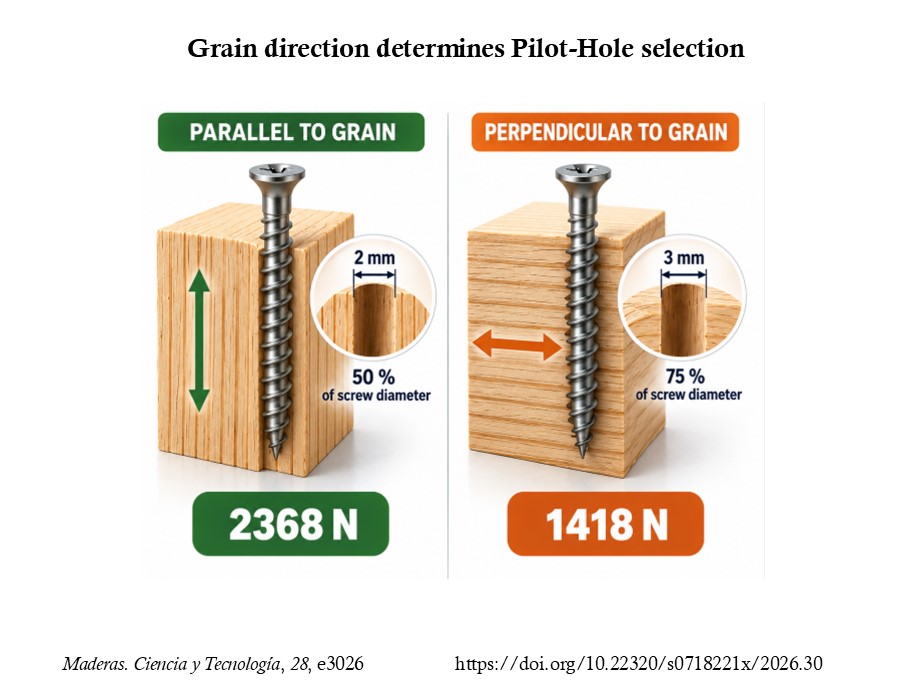
The influence of pilot-hole geometry on screw holding strength in solid softwood furniture elements remains insufficiently understood, particularly when wood species, pilot-hole dimensions, and grain direction are considered simultaneously. This study aimed to investigate the effects of pilot-hole diameter and depth on the screw holding strength of selected softwood species commonly used in furniture manufacturing and to identify the best-performing pilot-hole configurations among the tested levels for different grain directions. The materials examined were Larix decidua Mill. (larch), Pinus sylvestris L. (Scotch pine), Abies sp. (fir), Picea orientalis L. (spruce) and Cedrus libani A.Rich (cedar). A total of 900 specimens were prepared, comprising 5 wood species, 9 pilot hole configurations (3 diameter by 3 depth), and 10 replications for each condition. Screw withdrawal tests were conducted under static tensile loading, with 450 specimens tested parallel to the grain and 450 perpendicular to the grain. The results indicated that, for the withdrawal tests parallel to the grain, the highest mean screw holding strength was obtained with a pilot-hole diameter corresponding to 50 % of the screw diameter, while pilot-hole depth had no significant main effect. In case of the withdrawal tests perpendicular to the grain, highest mean screw holding strength was obtained with a pilot-hole diameter corresponding to 75 % of the screw diameter, whereas pilot-hole depth again showed no significant main effect. Wood species and pilot-hole diameter significantly affected screw holding strength, and all two-way and three-way interactions were significant. Cedar exhibited the highest mean screw holding strength in both loading orientations. These findings highlight the importance of considering pilot-hole diameter in relation to wood species and grain direction for screw connections in solid softwoods.
Downloads
References
American Society for Testing and Materials. 2001. Standard Test Methods for Evaluating Properties of Wood-Base Fiber and Particle Panel Materials. ASTM D1037-99. ASTM International: West Conshohocken, PA, USA. https://www.astm.org/search/result?q=ASTM%20D1037
Chen, Y.; Zhu, S.; Guo, Y.; Liu, S.; Tu, D.; Fan, H. 2016. Investigation on Withdrawal Resistance of Screws in Reconstituted Bamboo Lumber. Wood Research 61(5): 799–810. https://www.woodresearch.sk/cms/investigation-on-withdrawal-resistance-of-screws-in-reconstituted-bamboo-lumber/
Çelebi, G.; Kılıç, M. 2007. Nail and Screw Withdrawal Strength of Laminated Veneer Lumber Made up Hardwood and Softwood Layers. Construction and Building Materials 21(4): 894–900. https://doi.org/10.1016/j.conbuildmat.2005.12.015
Danacı, S. 2010. Effects of the Pilot Hole Diameter and Depth on Screw Holding Performance of Various Wood and Wood Composite Materials. M.Sc. Thesis. Muğla Sıtkı Koçman University, Institute of Science and Technology: Muğla, Turkey. P:63. Council of Higher Education Thesis No:274860. https://tez.yok.gov.tr/UlusalTezMerkezi/tezSorguSonucYeni.jsp
Doğanay, S. 1995. The Screw Holding Determination of Wood Materials to Option for Furniture Industry. Master's Thesis. Gazi University, Institute of Science: Ankara, Turkey. PP:69. Council of Higher Education Thesis No:38327. https://tez.yok.gov.tr/UlusalTezMerkezi/tezSorguSonucYeni.jsp
Eckelman, C.A. 1975. Screw Holding Performance in Hardwoods and Particleboard. Forest Products Journal 25(6): 30–35. https://ag.purdue.edu/department/fnr/lab-sites/woodresearch/extension-programs/publications-carl-eckelman.html
Eckelman, C.A. 1978. The Strength Design of Furniture. TimTech, Inc.: West Lafayette, IN, USA.
Kasal, A.; Şener, S.; Belgin, M.Ç.; Efe, H. 2006. Bending Strength of Screwed Corner Joints with Different Materials. Gazi University Journal of Science 19(3): 155–161. https://dergipark.org.tr/en/download/article-file/83097
Kasal, A. 2008. Effect of the Number of the Screws and Screw Size on Moment Capacity of Furniture Corner Joints in Case Construction. Forest Products Journal 58(6): 36–44. https://www.proquest.com/openview/c775c84137b487862fe960c15c602f03/1?pq-origsite=gscholar&cbl=25222
Minitab LLC. 2023. Minitab Statistical Software: Data analysis and process improvement software. Minitab LLC: State College, PA, USA. https://www.minitab.com/
Özcifci, A. 2009. The Effects of Pilot Hole, Screw Types and Layer Thickness on the Withdrawal Strength of Screws in Laminated Veneer Lumber. Materials & Design 30(7): 2355–2358. https://doi.org/10.1016/j.matdes.2008.11.001
Perçin, O.; Ayan, S. 2012. Determination of Screw Withdrawal Strength in Heat Treated Wood Material. Journal of Advanced Technology Sciences 1(1): 57–68. https://dergipark.org.tr/en/download/article-file/56464
Turkish Standards Institution. 2005. Screw Threads (Shapes and Dimensions). TS ISO 965-4. Turkish Standards Institution: Ankara, Turkey.
Turkish Standards Institution. 2005. Screw Threads (Shapes and Dimensions). TS ISO 965-5. Turkish Standards Institution: Ankara, Turkey.
Turkish Standards Institution. 2016. Timber Structures - Test Methods - Withdrawal Capacity of Timber Fasteners. TS EN 1382. Turkish Standards Institution: Ankara, Turkey.
Turkish Standards Institution. 2021. Wood - Determination of Moisture Content for Physical and Mechanical Tests. TS ISO 13061-1. Turkish Standards Institution: Ankara, Turkey.
Turkish Standards Institution. 2021. Wood - Determination of Density for Physical and Mechanical Tests. TS ISO 13061-2. Turkish Standards Institution: Ankara, Turkey.
Uysal, M.; Güntekin, E. 2024. Prediction of Screw Withdrawal Resistance for Plywood Laminated Panels and Sandwich Panels. Turkish Journal of Forestry 25(1): 81–88. https://doi.org/10.18182/tjf.1375273
Wilkinson, T.L.; Laatsch, T.R. 1970. Lateral and Withdrawal Resistance of Tapping Screws in Three Densities of Wood. Forest Products Journal 20(7): 34–41. https://www.cabidigitallibrary.org/doi/full/10.5555/19700603183
Yörür, H.; Tor, Ö.; Günay, N.M.; Birinci, E. 2017. The Effects of Different Variables on the Direct Screw Withdrawal Strength in Plywood. Kastamonu University Journal of Forestry Faculty 17(2): 325–333. https://doi.org/10.17475/kastorman.333858
Yörür, H.; Birinci, E.; Günay, N.M.; Tor, Ö. 2020. Effects of Factors on Direct Screw Withdrawal Resistance in Medium Density Fiberboard and Particleboard. Maderas. Ciencia y Tecnología 22(3): 375–384. https://doi.org/10.4067/S0718-221X2020005000311
Downloads
Published
Issue
Section
License

This work is licensed under a Creative Commons Attribution 4.0 International License.
Los autores/as conservarán sus derechos de autor y garantizarán a la revista el derecho de primera publicación de su obra, el cuál estará simultáneamente sujeto a la Licencia de Reconocimiento de Creative Commons CC-BY que permite a terceros compartir la obra siempre que se indique su autor y su primera publicación esta revista.