
Hacia la fabricación digital de estructuras laminares reticulares de madera deformadas elásticamente con mallados ortogonales
DOI:
https://doi.org/10.22320/s0718221x/2026.32Keywords:
Diseño computacional, estructuras laminares reticulares de madera, flexión activa, mecanizado CNC, prefabricación, uniones carpinterasAbstract
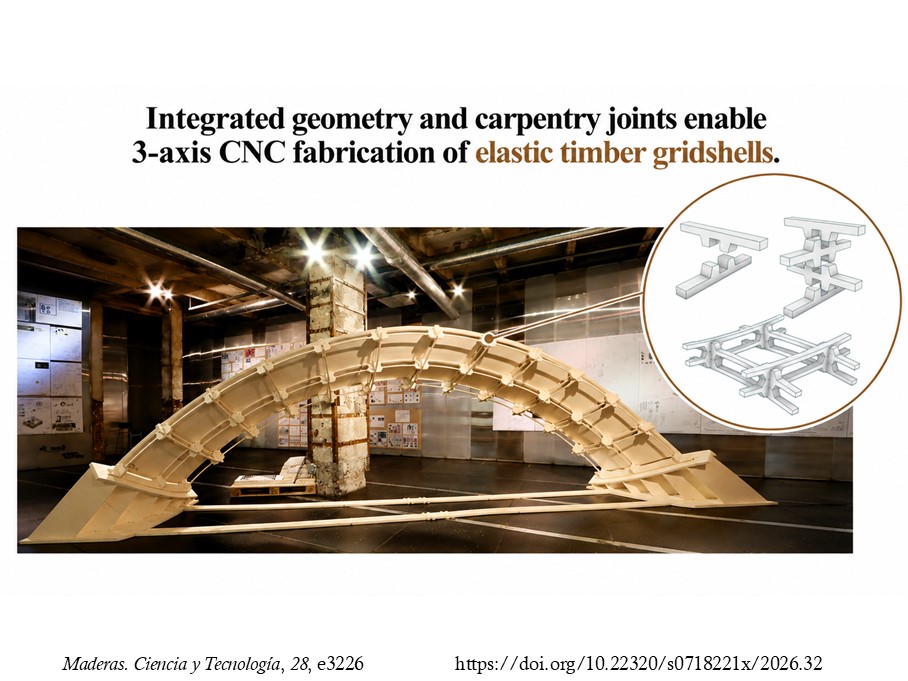
Las estructuras laminares reticulares de madera deformadas elásticamente (elastic timber gridshells) destacan por su eficiencia material y sostenibilidad al emplear tiras inicialmente rectas de madera de pequeña sección que se curvan en flexión activa. No obstante, su desarrollo ha estado condicionado por una laboriosa puesta en obra, dependiente de medios auxiliares y de un intensivo trabajo manual in situ. El presente trabajo plantea una nueva metodología de diseño y fabricación que integra la eficiencia propia de la flexión elástica con técnicas de fabricación digital mediante maquinaria por control numérico de tres ejes y el uso de uniones carpinteras para fomentar la prefabricación de este tipo de estructuras. Se explora la capacidad de patrones con trayectorias biaxiales para generar mallados perpendiculares, se analizan las ventajas constructivas derivadas y se propone un novedoso concepto de sistema de conexión nodal basado en uniones carpinteras ortogonales integradas en la geometría de las láminas. Esto permite el mecanizado de la estructura empleando tableros estructurales. Los principios del sistema se integran en un flujo de trabajo paramétrico que abarca desde el diseño hasta la fabricación, validado mediante diversos prototipos a escala y un demostrador a escala real de 7,5 m de luz. Los resultados muestran la viabilidad del enfoque propuesto para integrar procesos de fabricación digital y prefabricación off-site, favoreciendo la reducción de las operaciones manuales durante el ensamblaje. Finalmente, se identifican las limitaciones del sistema y los principales desarrollos necesarios para su escalabilidad.
Downloads
References
Boutillier, R.; Douthe, C.; Hauswirth, L.; Baverel, O. 2024. Topology generation of architectural meshes adapted to the support conditions. In: Proceedings of the Italian Workshop on Shell and Spatial Structures (IWSS 2023). Turin, Italy, pp. 31–40. https://doi.org/10.1007/978-3-031-44328-2_4
Chilton, J.; Tang, G. 2017. Timber gridshells: Architecture, structure and craft. Routledge: London, United Kingdom. https://doi.org/10.4324/9781315773872
Dellinger, F.; Li, X.; Wang, H. 2023. Discrete orthogonal structures. Computers & Graphics 114: 126–137. https://doi.org/10.1016/j.cag.2023.05.024
Glymph, J.; Shelden, D.; Ceccato, C.; Mussel, J.; Schober, H. 2004. A parametric strategy for free-form glass structures using quadrilateral planar facets. Automation in Construction 13(2): 187–202. https://doi.org/10.1016/j.autcon.2003.09.008
Gonzalez Quintial, F.; Martín Pastor, A. 2024. Monge Surfaces. Generation, Discretisation and Application in Architecture. Nexus Netw J 26, 811–828. https://doi.org/10.1007/s00004-024-00794-9
Harris, R.; Haskins, S.; Roynon, J. 2008. The Savill Garden gridshell: design and construction. The Structural Engineer 86(17): 27–34.
Harris, R.; Gusinde, B.; Roynon, J. 2012. Design and construction of The Pods Sports Academy, Scunthorpe, England. In: Quenneville, P. (ed.) Proceedings of the World Conference on Timber Engineering (WCTE 2012). Auckland, New Zealand, pp. 510–517. ISBN 978-1-62276-305-4.
Lara-Bocanegra, A.J. 2022. Láminas reticulares de madera deformadas elásticamente: Del material a la construcción. Tesis doctoral. Universidad Politécnica de Madrid, Madrid, España. https://doi.org/10.20868/UPM.thesis.70673
Lara-Bocanegra, A.J.; Roig, A.; Majano-Majano, A.; Guaita, M. (2020) Innovative design and construction of a permanent elastic timber gridshell. In: Proceedings of the Institution of Civil Engineers - Structures and Buildings, Vol. 173 No. 5 pp. 352–362. https://doi.org/10.1680/jstbu.19.00083
Lara-Bocanegra, A.J.; Majano-Majano, A.; Arriaga, F.; Guaita, M. 2018. Long-term bending stress relaxation in timber laths for the structural design of lattice shells. Construction and Building Materials 193: 565–575. https://doi.org/10.1016/j.conbuildmat.2018.10.224
Majano-Majano, A.; Lara-Bocanegra, A.J. 2025. Mechanical properties of high-performance LVL made from Eucalyptus globulus L. In: Proceedings of the 14th World Conference on Timber Engineering. Brisbane, Australia, pp. 1158–1165. https://doi.org/10.52202/080513-0142
Mesnil, R.; Douthe, C.; Baverel, O.; Léger, B.; Caron, J.F. 2015. Isogonal moulding surfaces: A family of shapes for high node congruence in free-form structures. Automation in Construction 59: 38–47. https://doi.org/10.1016/j.autcon.2015.07.009
Mesnil, R.; Santerre, Y.; Douthe, C.; Baverel, O.; Léger, B. 2015. Generating high node congruence in freeform structures with Monge’s Surfaces. In: Adriaenssens, S.; Gramazio, F.; Kohler, M.; Menges, A. (eds.) Proceedings of the IASS Symposium 2015. Amsterdam, The Netherlands. ISSN 2518-6582 https://hal.science/hal-01200521
Natterer, J.; Burger, N.; Müller A.; Natterer, J. (2000) Holzrippendächer in Brettstapelbauweise, Raumerlebnis durch filigrane Tragwerke. Bautechnik 77 (11) (2000) 783–792. https://doi.org/10.1002/bate.200006410
Niebler, M.; Usai, S.; Antemann, M.; Scheurer, F.; Slabbinck, E. (2023) Bent-on-Site Flat-Pack Delivery of a Timber Shell. In: Dörfler, K.; Knippers, J.; Menges, A.; Parascho, S.; Pottmann, H.; Wortmann, T. (eds.) Advances in Architectural Geometry 2023. Berlin, Boston: De Gruyter, 2023, pp. 69-82. https://doi.org/10.1515/9783111162683-006
Oberbichler, T.; Schling, E.; Bletzinger, K.U. 2023. Tracing curvature paths on trimmed multipatch surfaces. Applied Mathematical Modelling 118: 253–271. https://doi.org/10.1016/j.apm.2023.01.033
Ortiz-Sanz, J.; Gil-Docampo, M.; Bastos, G.; Lara-Bocanegra, A.J. 2024. Fotogrametría SfM de bajo costo para monitorización. Maderas. Ciencia y Tecnología 26: e0824. https://doi.org/10.22320/S0718221X/2024.08
Pottmann, H. 2013. Architectural Geometry and Fabrication-Aware Design. Nexus Network Journal 15(2): 195–208. https://doi.org/10.1007/s00004-013-0149-5
Pottmann, H.; Huang, Q.; Deng, B.; Schiftner, A.; Kilian, M.; Guibas, L.; Wallner, J. 2010. Geodesic patterns. ACM Transactions on Graphics 29(4). e43. https://doi.org/10.1145/1833349.1778780
Quinn, G.; Gengnagel, C. 2014. A review of elastic grid shells, their erection methods and the potential use of pneumatic formwork. In: Mobile and Rapidly Assembled Structures IV. WIT Transactions on the Built Environment, vol. 136, pp. 129–143. ISSN 1743-3509. https://doi.org/10.2495/MAR140111
Roig, A.; Lara-Bocanegra, A.J.; Xavier, J.; Majano-Majano, A. 2023. Design Framework for Selection of Grid Topology and Rectangular Cross-Section Size of Elastic Timber Gridshells Using Genetic Optimisation. Applied Sciences 13(1): 63. https://doi.org/10.3390/app13010063
Scheurer, F. 2010. Materialising Complexity. Architectural Design 80(4): 86–93. https://doi.org/10.1002/ad.1111
Schling, E.; Wan, Z. 2022. A geometry-based design approach. Journal of Building Engineering 52: 104432. https://doi.org/10.1016/j.jobe.2022.104432
Schling, E.; Wang, H.; Hoyer, S.; Pottmann, H. 2022. Designing Asymptotic Geodesic Hybrid Gridshells. Computer-Aided Design 152: 103378. https://doi.org/10.1016/j.cad.2022.103378
Stehling, H.; Scheurer, F.; Roulier, J.; Geglo, H.; Hofmann, M. 2017. From lamination to assembly: Modelling the Seine Musicale. In: Fabricate 2017. UCL Press: London, United Kingdom, pp. 258–263. https://doi.org/10.2307/j.ctt1n7qkg7.39
Stehling, H.; Scheurer, F.; Usai, S. 2020. Large-scale free-form timber grid shell. In: Fabricate 2020. Making Resilient Architecture. UCL Press: London, United Kingdom, pp. 210–217. EISBN 978-1-78735-811-9 https://doi.org/10.2307/j.ctv13xpsvw.32
Worsfold, T.; Bryant, M.; Crack, J. 2018. Design of Canary Wharf Elizabeth line station and Crossrail Place oversite development. The Structural Engineer 96(7): 78–83. https://doi.org/10.56330/GYNO2629
Downloads
Published
Issue
Section
License

This work is licensed under a Creative Commons Attribution 4.0 International License.
Los autores/as conservarán sus derechos de autor y garantizarán a la revista el derecho de primera publicación de su obra, el cuál estará simultáneamente sujeto a la Licencia de Reconocimiento de Creative Commons CC-BY que permite a terceros compartir la obra siempre que se indique su autor y su primera publicación esta revista.