
Well-being in post-disaster shelters: the perception of the indigenous community, Santa Catarina, Brazil
DOI:
https://doi.org/10.22320/07196466.2025.43.068.10Keywords:
environmental perception, post-disaster architecture, socio-environmental vulnerability, space appropriation, traditional communitiesAbstract
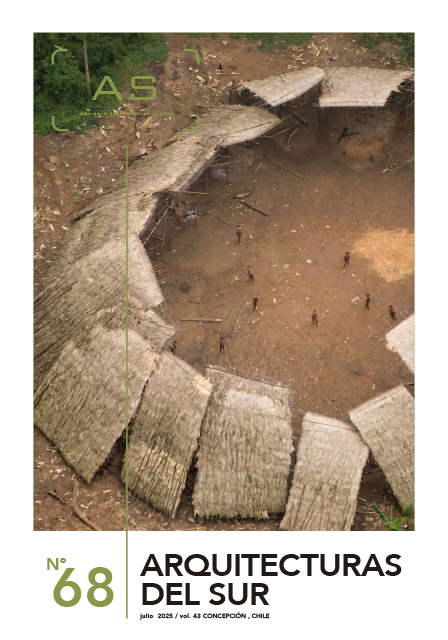
This study analyzes the impacts of natural disasters on vulnerable communities, with emphasis on temporary shelters as spaces for physical protection, psychosocial restoration, and identity reconstruction. The objective was to identify environmental attributes that influence well-being and to propose design recommendations based on environmental perception. The research was conducted with the Xokleng Indigenous community in José Boiteux, Santa Catarina, Brazil, which is affected by recurrent flooding and the North Dam, using a qualitative approach that included interviews with Indigenous leaders and photography as a model. The results indicate that comfort and safety/security extend beyond material aspects, integrating symbolic, cultural, and social dimensions. The use of wood as an identity-related material, forms that symbolize collectivity (stars and beehives), cross-ventilation, natural lighting, galleries, and a spatial organization that balances privacy and community life, stand out. The findings also highlight the value of extended family living arrangements and active participation in planning, in contrast to standardized solutions. It is concluded that post-disaster shelters should be conceived as restorative, culturally contextualized, and participatory spaces that strengthen community resilience and promote the comprehensive recovery of vulnerable Indigenous populations.
Downloads
References
ACSELRAD, H. (Org.). (2014). Conflitos ambientais no Brasil. Relume Dumará. https://conflitosambientais.org/wp-content/uploads/2023/06/Conflitos-Ambientais-no-Brasil-Acselrad-Henri.pdf
ArchDaily Brasil (2017). Casas Pemulung / IBUKU. ArchDaily. https://www.archdaily.com.br/br/884840/casas-pemulung-ibuku
CAIA, G., VENTIMIGLIA, F., & MAASS, A. (2010). Container vs. dacha: the psychological effects of temporary housing characteristics on earthquake survivors. Journal of Environmental Psychology, 30(1), 60–66. https://doi.org/10.1016/j.jenvp.2009.09.005
CARBONARI, L. T. (2021). Modelo multicritério de decisão para o projeto de acampamentos temporários planejados voltados a cenários de desastre [Tese Doutorado, Universidade Federal de Santa Catarina]. Repositório Institucional UFSC. https://repositorio.ufsc.br/handle/123456789/220514
COSTA, S. C., SILVA, V. N. V., MAGNAGO, R. F., & LIBRELOTTO, L. I. (07-09 de agosto de 2024). Análise global e regional do estado de Santa Catarina de desastres naturais. XII Encontro de Sustentabilidade em Projetos, Belo Horizonte, Brasil. https://repositorio.ufsc.br/bitstream/handle/123456789/256863/39.pdf?sequence=1&isAllowed=y
Centro de Estudos e Pesquisas em Engenharia e Defesa Civil - Banco Mundial. (2020). Relatório de danos materiais e prejuízos decorrentes de desastres naturais no Brasil (1995–2019). Secretaria de Estado da Proteção e Defesa Civil de Santa Catarina. https://www.gov.br/mdr/pt-br/centrais-de-conteudo/publicacoes/protecao-e-defesa-civil-sedec/danos_e_prejuizos_versao_em_revisao.pdf
DELGADO, M. (2022). Home is restoration: toward a health-based model of the importance of home for survivors of natural disasters. Social Sciences & Humanities Open, 6(1), 100351. https://doi.org/10.1016/j.ssaho.2022.100351
FÉLIX, D., BRANCO, J. M., & FEIO, A. (2013). Temporary housing after disasters: a state of the art survey. Habitat International, 40, 136–141. https://doi.org/10.1016/j.habitatint.2013.03.006
FLEURI, R. M., & OKAWATI, J. A. A. (Orgs.). (2021). Pedagogias e narrativas decoloniais. Editora CRV. https://doi.org/10.24824/978652511238.1
GIBBS, L., GALLAGHER, H. C., BLOCK, K., BAKER, E. BRYANT, R., HARMS, L., IRETON, G., KELLETT, C., SINNOTT, V., RICHARDSON, J.F., LUSHER, D., FORBES, D., MACDOUGALL, C., & WATERS E. (2017). Post-bushfire relocation decision-making and personal wellbeing: A case study of Victoria, Australia in A. Awotona (Ed.), Planning for Community-based disaster resilience planning worldwide (1st ed., pp. 333–356). Routledge.
GORDILLO BEDOYA, F. (2004). Habitat de transição e habitat de emergência. Tabula RASA, (2), 145-166. https://doi.org/10.25058/20112742.211
HEWITT, K. (1983). The idea of calamity in a technocratic age in K. Hewitt (Ed.), Interpretations of Calamity From the Viewpoint of Human Ecology (1st ed., pp. 3–32). Unwin-Hyman.
Instituto Nacional de Pesquisas Espaciais [INPE]. (2020). Desastres naturais e conceitos básicos. Ministério da Ciência e Tecnologia. http://www3.inpe.br/crs/crectealc/pdf/silvia_saito.pdf
Intergovernmental Panel on Climate Change [IPCC]. (2022). Climate change 2022: impacts, adaptation and vulnerability. Cambridge University Press. https://www.ipcc.ch/report/ar6/wg2/
Instituto Socioambiental [ISA]. (2023). Terras indígenas no Brasil. https://terrasindigenas.org.br/
KIENEN, A. (31 de outubro de 2023). Semanas após conflito na barragem, comunidade indígena de José Boiteux segue sem lar e com médica voluntária. O Município Blumenau. https://omunicipioblumenau.com.br/semanas-apos-conflito-na-barragem-comunidade-indigena-de-jose-boiteux-segue-sem-lar-ou-atendimento-medico/
MEEROW, S., & NEWELL, J. P. (2019). Urban resilience for whom, what, when, where, and why? Urban Geography, 40(3), 309-329. https://doi.org/10.1080/02723638.2016.1206395
NOGUEIRA, F. R. (2002). Gerenciamento de riscos ambientais associados a escorregamentos: contribuição às políticas públicas municipais para áreas de ocupação subnormal [Tese de doutorado, Universidade Estadual Paulista]. Acervo digital da Unesp. http://hdl.handle.net/11449/102945
Prefeitura Municipal de José Boiteux. (2022). Plano de contingência municipal de José Boiteux. https://www.pmjb.sc.gov.br/uploads/sites/474/2022/05/2356830_PLANO_DE_CONTINGENCIA_MUNICIPAL_JOSE_BOITEUX___OFICIAL_22022022.pdf
RUFAT, S. (2013). Spectroscopy of Urban Vulnerability. Annals of the Association of American Geographers, 103(3), 505–525. https://doi.org/10.1080/00045608.2012.702485
SAMPIERI, R. H., COLLADO, C. H., & LUCIO, M. P. B. (2013). Metodologia de pesquisa (5ª ed.). Penso.
Secretaria de Estado da Proteção e Defesa Civil [SEDEC]. (2017). Resposta: Gestão de Desastres, Decretação e Reconhecimento Federal e Gestão de Recursos Federais em Proteção em Defesa. Ministério de Integração Nacional. https://defesacivil.es.gov.br/Media/DefesaCivil/Material%20Did%C3%A1tico/M%C3%B3dulos%20SEDEC/M%C3%B3dulo%20III%20-%20RESPOSTA%20-%20Livro_Base.pdf
Secretaria de Estado da Proteção e Defesa Civil [SEDEC]. (2024). Red Integrada de Monitoreo de la Secretaría de Protección Civil y Defensa de Santa Catarina. https://monitoramento.defesacivil.sc.gov.br/mapa
SIMÕES, S. (Org.). (2006). Administração de Abrigos Temporários. Governo do Estado do Rio de Janeiro - Secretaria de Estado da Proteção e Defesa Civil [SEDEC]. https://www.defesacivil.rj.gov.br/images/sedec-arquivos/manual_abrigo_sedec_rj.pdf
SUKHWANI, V., NAPITUPULU, H., JINGNAN, D., YAMAJI, M., & SHAW, R. (2021). Enhancing cultural adequacy in post-disaster temporary housing. Progress in Disaster Science, 11, 100186. https://doi.org/10.1016/j.pdisas.2021.100186https://doi.org/10.1016/j.pdisas.2021.100186
United Nations Office for Disaster Risk Reduction. [UNDRR]. (2022). Global assessment report on disaster risk reduction (GAR) 2022: Our world at risk—Transforming governance for a resilient future. https://www.undrr.org/gar/gar2022-our-world-risk-gar
WISNER, B., BLAIKIE, P., CANNON, T., & DAVIS, I. (2004). At risk: natural hazards, people’s vulnerability and disasters (2nd ed.). Routledge. https://doi.org/10.4324/9780203714775
Downloads
Published
How to Cite
Issue
Section
License
Copyright (c) 2026 Andreia Grandi, Lisiane Ilha-Librelotto, Luana Toralles-Carbonari

This work is licensed under a Creative Commons Attribution-ShareAlike 4.0 International License.
The content of the articles published in each issue of Arquitecturas del Sur is the sole responsibility of the authors and does not necessarily represent the opinion of University of the Bío-Bío.
The authors will maintain their copyright; however, they will guarantee the journal the right to first publication and dissemination of their work. The publication of the article in Arquitecturas del Sur will be subject to the Creative Commons International license (CC BY-SA) that allows others to adapt: remix, transform and build on the material for any purpose, even commercially; share: copy and redistribute the material in any medium or format, as long as the authorship and first publication in this journal are acknowledged by citing them correctly, and their new contributions are under a license with the same terms.

















 Programa de Información Científica/Concurso Fondos de Publicación de Revistas Científicas 2018/ Proyecto Mejoramiento de Visibilidad de Revistas UBB (Código:FP180007)