
Vertical and radial variation in wood acoustical and physical properties of Ailanthus altissima
DOI:
https://doi.org/10.22320/s0718221x/2025.31Keywords:
Ailanthus altissima, wood acoustics, vibration damping, acoustic properties, mechanical properties of wood, radial and axial variation, musical instrument woodAbstract
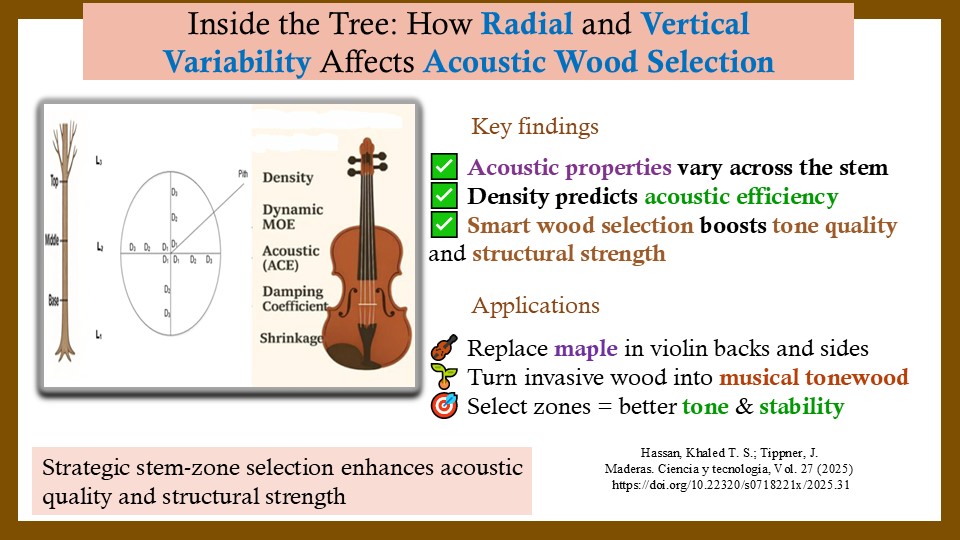
This study investigated the vertical and radial variability of wood acoustical and physical properties in Ailanthus altissima (ailanthus tree), a species with potential applications in musical instrument construction. However, there is limited information about the variation within the stem in these properties, which is essential for assessing its suitability in acoustically demanding applications. In this context, wood density, dynamic modulus of elasticity, damping coefficient, acoustic conversion efficiency, and tangential and radial shrinkage were analyzed across three stem heights and three radial positions. Results revealed significant variation within the stem, with density and dynamic modulus of elasticity increasing from the base to the middle before declining at the top, while acoustic conversion efficiency showed an inverse trend. Radially, acoustic conversion efficiency was highest near the pith and decreased significantly toward the middle and outer parts of the stem, with no significant difference between these outer zones. The damping coefficient was lowest at the bottom logs, increased significantly at the middle, and slightly decreased at the top. Radially, the damping coefficient was lowest near the pith, increased toward the middle, and reached the highest values near the bark. Shrinkage increased significantly from pith to bark but showed minor axial variation, with similar values at the base and middle, and a significant decrease at the top of the stem. Importantly, density could be used as an indicator for acoustic conversion efficiency, enabling indirect assessment of acoustic performance. These variations highlight the potential of selecting specific stem regions to balance sound transmission and structural support, suggesting that Ailanthus altissima (ailanthus tree) could replace traditional woods for the backs and sides of stringed instruments.
Downloads
References
Arriaga, F.; Wang, X.; Íñiguez-González, G.; Llana, D.F.; Esteban, M.; Niemz, P. 2023. Mechanical properties of wood: a review. Forests 14(6): e1202. https://doi.org/10.3390/f14061202 DOI: https://doi.org/10.3390/f14061202
Barnett, J.; Jeronimidis, G. 2009. Wood quality and its biological basis. John Wiley & Sons, New York, USA. https://www.wiley.com/en-us/Wood+Quality+and+its+Biological+Basis-p-9781405147811
Bosman, M.T.; de Kort, I.; van Genderen, M.K.; Baas, P. 1994. Radial variation in wood properties of naturally and plantation grown light red meranti (Shorea, Dipterocarpaceae). IAWA Journal 15(2): 111-120. https://doi.org/10.1163/22941932-90001350 DOI: https://doi.org/10.1163/22941932-90001350
Brémaud, I. 2012. Acoustical properties of wood in string instruments soundboards and tuned idiophones: biological and cultural diversity. The Journal of the Acoustical Society of America 131(1): 807-818. https://doi.org/10.1121/1.3651233 DOI: https://doi.org/10.1121/1.3651233
Brémaud, I.; El Kaïm, Y.; Guibal, D.; Minato, K.; Thibaut, B.; Gril, J. 2012. Characterisation and categorisation of the diversity in viscoelastic vibrational properties between 98 wood types. Annals of Forest Science 69(3): 373-386. https://doi.org/10.1007/s13595-011-0166-z DOI: https://doi.org/10.1007/s13595-011-0166-z
Butterfield, R.P.; Crook, R.P.; Adams, R.; Morris, R. 1993. Radial variation in wood specific gravity, fibre length and vessel area for two Central American hardwoods: Hyeronima alchorneoides and Vochysia guatemalensis: natural and plantation-grown trees. IAWA Journal 14(2): 153-161. https://doi.org/10.1163/22941932-90001310 DOI: https://doi.org/10.1163/22941932-90001310
Carlier, C.; Alkadri, A.; Gril, J.; Brémaud, I. 2018. Revisiting the notion of “resonance wood” choice: a decompartmentalized approach from violin makers’ opinion and perception to characterization of material properties’ variability. En: Pérez, M.A.; Marconi, E. (Eds.) Wooden musical instruments: different forms of knowledge (Book of End of WoodMusICK COST Action FP1302). Philarmonie, Paris, pp. 119-141. https://hal.archives-ouvertes.fr/hal-02051004
Chowdhury, Q.; Rashid, A.M.; Newaz, S.; Alam, M. 2007. Effects of height on physical properties of wood of jhau (Camarina equisetifolia). Australian Forestry 70(1): 33-36. https://doi.org/10.1080/00049158.2007.10676260 DOI: https://doi.org/10.1080/00049158.2007.10676260
Cristini, V.; Tippner, J.; Vojáčková, B.; Paulić, V. 2021. Comparison of variability in results of acoustic tomographs in pedunculate oak (Quercus robur L.). BioResources 16(2): 3046-3058. https://doi.org/10.15376/biores.16.2.3046-3058 DOI: https://doi.org/10.15376/biores.16.2.3046-3058
Cruz, G.K.D.A.; Pio, N.D.S.; Iwakiri, S. 2019. Longitudinal and transverse variation in the physical properties of wood red tauari. Floresta e Ambiente 26(3). e20170336. https://doi.org/10.1590/2179-8087.033617 DOI: https://doi.org/10.1590/2179-8087.033617
Enescu, C.M.; Houston, D.T.; Caudullo, G. 2016. Ailanthus altissima in Europe: distribution, habitat, usage and threats. En: San-Miguel-Ayanz, J.; de Rigo, D.; Caudullo, G.; Houston, D.T.; Mauri, A. (Eds.).European Atlas of Forest Tree Species. Publ. Off. EU, Luxembourg. https://forest.jrc.ec.europa.eu/en/european-atlas/atlas-download-page/
Ferreira, P.J.; Gamelas, J.A.; Carvalho, M.G.; Duarte, G.V.; Canhoto, J.M.; Passas, R. 2013. Evaluation of the papermaking potential of Ailanthus altissima. Industrial Crops and Products 42: 538-542. https://doi.org/10.1016/j.indcrop.2012.06.030 DOI: https://doi.org/10.1016/j.indcrop.2012.06.030
Githiomi, J.K.; Kariuki, J.G. 2010. Wood basic density of Eucalyptus grandis from plantations in Central Rift Valley, Kenya: variation with age, height level and between sapwood and heartwood. Journal of Tropical Forest Science 22(3): 281-286. https://www.frim.gov.my/v1/JTFSOnline/jtfs/v22n3/281-286.pdf
Haines, D.W. 1979. On musical instrument wood. Catgut Acoustical Society Newsletter 31(1): 23-32. https://cir.nii.ac.jp/crid/1571698600481139328
Hassan, K.T.S.; Kandeel, E.A.E.; Kherallah, I.E.A.; Abou-Gazia, H.A.; Hassan, F.M.M. 2020. Pinus halepensis and Eucalyptus camaldulensis grown in Egypt: a comparison between stem and branch properties for pulp and paper making. BioResources 15(4): 7598-7614. https://doi.org/10.15376/biores.15.4.7598-7614 DOI: https://doi.org/10.15376/biores.15.4.7598-7614
Hassan, K.T.S. 2020. Vertical variation of wood chemical constituents in (Albizia lebbeck L. Benth.) trees grown in Egypt. Journal of Plant Production 11(4): 363-367. https://doi.org/10.21608/jpp.2020.95638 DOI: https://doi.org/10.21608/jpp.2020.95638
Hassan, K.T.S.; Horáček, P.; Tippner, J. 2013. Evaluation of stiffness and strength of Scots pine wood using resonance frequency and ultrasonic techniques. BioResources 8(2): 1634-1645. https://doi.org/10.15376/biores.8.2.1634-1645 DOI: https://doi.org/10.15376/biores.8.2.1634-1645
Hassan, K.T.S.; Tippner, J. 2019. Acoustic properties assessment of neem (Azadirachta indica A. Juss.) wood from trees irrigated with secondarily treated wastewater. BioResources 14(2): 2919-2930. https://doi.org/10.15376/biores.14.2.2919-2930 DOI: https://doi.org/10.15376/biores.14.2.2919-2930
Heisey, R.M. 1997. Allelopathy and the secret life of Ailanthus altissima. Arnoldia 57(3): 28-36. https://doi.org/10.5962/p.251181 DOI: https://doi.org/10.5962/p.251181
Horáček, P.; Tippner, J.; Hassan, K.T. 2012. Nondestructive evaluation of static bending properties of Scots pine wood using stress wave technique. Wood Research 57(3): 359-366. http://www.woodresearch.sk/wr/201203/02.pdf
Hu, S.Y. 1979. Ailanthus. Arnoldia 39(2): 29-50. http://www.jstor.org/stable/42954660 DOI: https://doi.org/10.5962/p.250166
Hudson, I.; Wilson, L.; Van Beveren, K. 1998. Vessel and fibre property variation in Eucalyptus globulus and Eucalyptus nitens: some preliminary results. IAWA Journal 19(2): 111-130. https://doi.org/10.1163/22941932-90001514 DOI: https://doi.org/10.1163/22941932-90001514
ISO. 2014. Physical and mechanical properties of wood – Test methods for small clear wood specimens – Part 2: Determination of density for physical and mechanical tests. ISO 13061-2. Geneva, Switzerland.
ISO. 2016. Physical and mechanical properties of wood – Test methods for small clear wood specimens – Part 13: Determination of radial and tangential shrinkage. ISO 13061-13. Geneva, Switzerland.
Izekor, D.N.; Fuwape, J.A. 2011. Performance of teak (Tectona grandis L.F.) wood on exposure to outdoor weather conditions. Journal of Applied Sciences and Environmental Management 15(1): 217-222. https://doi.org/10.4314/jasem.v15i1.65702 DOI: https://doi.org/10.4314/jasem.v15i1.65702
Kiaei, M.; Farsi, M. 2016. Vertical variation of density, flexural strength and stiffness of Persian silk wood. Madera y Bosques 22(1): 169-175. https://doi.org/10.21829/myb.2016.221484 DOI: https://doi.org/10.21829/myb.2016.221484
Kloiber, M.; Tippner, J.; Hrivnák, J. 2014. Mechanical properties of wood examined by semi-destructive devices. Materials and Structures 47(1): 199-212. https://doi.org/10.1617/s11527-013-0055-z DOI: https://doi.org/10.1617/s11527-013-0055-z
Koponen, S.; Toratti, T.; Kanerva, P. 1989. Modelling longitudinal elastic and shrinkage properties of wood. Wood Science and Technology 23(1): 55-63. https://doi.org/10.1007/bf00350607 DOI: https://doi.org/10.1007/BF00350607
Kord, B.; Kialashaki, A.; Kord, B. 2010. The within-tree variation in wood density and shrinkage, and their relationship in Populus euramericana. Turkish Journal of Agriculture and Forestry 34(2): 121-126. https://dx.doi.org/10.3906/tar-0903-14 DOI: https://doi.org/10.3906/tar-0903-14
Lachenbruch, B.; Moore, J.R.; Evans, R. 2011. Radial variation in wood structure and function in woody plants, and hypotheses for its occurrence. En: Meinzer, F.C.; Lachenbruch, B.; Dawson, T.E. (Eds.). Size- and age-related changes in tree structure and function. Tree Physiology, Springer 4: 121-164. https://doi.org/10.1007/978-94-007-1242-3_5 DOI: https://doi.org/10.1007/978-94-007-1242-3_5
Machado, J.S.; Louzada, J.L.; Santos, A.J.; Nunes, L.; Anjos, O.; Rodrigues, J.; Simões, R.M.; Pereira, H. 2014. Variation of wood density and mechanical properties of blackwood (Acacia melanoxylon R. Br.). Materials & Design 56: 975-980. https://doi.org/10.1016/j.matdes.2013.12.016 DOI: https://doi.org/10.1016/j.matdes.2013.12.016
Mahmud, S.Z.; Hashim, R.; Saleh, A.H.; Sulaiman, O.; Saharudin, N.I.; Ngah, M.L.; Masseat, K.; Husain, H. 2017. Physical and mechanical properties of juvenile wood from Neolamarckia cadamba planted in west Malaysia. Maderas. Ciencia y Tecnología 19(2): 225-238. https://doi.org/10.4067/s0718-221x2017005000020 DOI: https://doi.org/10.4067/S0718-221X2017005000020
McLean, J.P.; Zhang, T.; Bardet, S.; Beauchêne, J.; Thibaut, A.; Clair, B.; Thibaut, B. 2011. The decreasing radial wood stiffness pattern of some tropical trees growing in the primary forest is reversed and increases when they are grown in a plantation. Annals of Forest Science 68(4): 681-688. https://doi.org/10.1007/s13595-011-0085-z DOI: https://doi.org/10.1007/s13595-011-0085-z
Miller, J.H. 1990. Ailanthus altissima (Mill.) Swingle ailanthus. En: Burns, R.M.; Honkala, B.H. (Eds.). Silvics of North America, Volume 2. U.S. Department of Agriculture, Forest Service: Washington, DC, USA. https://www.srs.fs.usda.gov/pubs/misc/ag_654/volume_2/vol2_table_of_contents.htm
Miranda, I.; Gominho, J.; Pereira, H. 2015. Heartwood, sapwood and bark variation in coppiced Eucalyptus globulus trees in 2nd rotation and comparison with the single-stem 1st rotation. Silva Fennica 49(1): e1141. https://doi.org/10.14214/sf.1141 DOI: https://doi.org/10.14214/sf.1141
Mohammed, W.S.A.; Nasroun, T.H. 2012. Variations in the anatomical structure of Ailanthus excelsa wood with height on the tree and radial distance from the pith. Journal of Agricultural and Veterinary Sciences (JAVS) 13(2): 11-19. http://repository.sustech.edu/handle/123456789/16852
Panayotov, P.; Kalmukov, K.; Panayotov, M. 2011. Biological and wood properties of Ailanthus altissima (Mill.) Swingle. Forestry Ideas 17(2): 122-130. http://forestry-ideas.info/files/issue/Forestry_Ideas_BG_2011_17_2_2.pdf
Panshin, A.J.; De Zeeuw, C. 1980. Textbook of wood technology. Part 1. Formation, anatomy, and properties of wood. McGraw-Hill: New York, USA.
Repola, J. 2006. Models for vertical wood density of Scots pine, Norway spruce and birch stems, and their application to determine average wood density. Silva Fennica 40(4): 673-685. https://doi.org/10.14214/sf.322 DOI: https://doi.org/10.14214/sf.322
Roohnia, M.; Alavi-Tabar, S.E.; Hossein, M.A.; Tajdini, A.; Jahan-Latibari, A.; Manouchehri, N. 2011. Acoustic properties in Arizona cypress logs: a tool to select wood for sounding board. BioResources 6(1): 386-399. https://doi.org/10.15376/biores.6.1.386-399 DOI: https://doi.org/10.15376/biores.6.1.386-399
Shi, J.; Yin, S.; Huang, W.; Na, B. 2025. Application of vibrational methods in wood performance testing: a short review. BioResources 20(2): 4861-4876. https://doi.org/10.15376/biores.20.2.Shi DOI: https://doi.org/10.15376/biores.20.2.Shi
Sidan, L.; Liu, Z.; Liu, Y.; Yu, H.; Yinglai, H. 2010. Acoustic vibration properties of wood for musical instrument based on FFT of adding windows. En: Proceedings of the International Conference on Mechanical and Electrical Technology, Singapore, pp. 370-373. https://doi.org/10.1109/icmet.2010.5598383 DOI: https://doi.org/10.1109/ICMET.2010.5598383
Sladonja, B.; Sušek, M.; Guillermic, J. 2015. Review on invasive tree of heaven (Ailanthus altissima (Mill.) Swingle) conflicting values: assessment of its ecosystem services and potential biological threat. Environmental Management 56(4): 1009-1034. https://doi.org/10.1007/s00267-015-0546-5 DOI: https://doi.org/10.1007/s00267-015-0546-5
Tenorio, C.; Moya, R.; Salas, C.; Berrocal, A. 2016. Evaluation of wood properties from six native species of forest plantations in Costa Rica. Bosque 37(1): 71-84. https://doi.org/10.4067/s0717-92002016000100008 DOI: https://doi.org/10.4067/S0717-92002016000100008
Topaloglu, E.; Erisir, E. 2018. Longitudinal variation in selected wood properties of oriental beech and caucasian fir. Maderas. Ciencia y Tecnología 20(3): 403-416. https://doi.org/10.4067/s0718-221x2018005031101 DOI: https://doi.org/10.4067/S0718-221X2018005031101
Traoré, B.; Brancheriau, L.; Perré, P.; Stevanovic, T.; Diouf, P. 2010. Acoustic quality of vène wood (Pterocarpus erinaceus Poir.) for xylophone instrument manufacture in Mali. Annals of Forest Science 67(8): 815-815. https://doi.org/10.1051/forest/2010054 DOI: https://doi.org/10.1051/forest/2010054
Vojáčková, B.; Tippner, J.; Horáček, P.; Sebera, V.; Praus, L.; Mařík, R.; Brabec, M. 2021. The effect of stem and root-plate defects on the tree response during static loading—numerical analysis. Urban Forestry & Urban Greening 59: 127002. https://doi.org/10.1016/j.ufug.2021.127002 DOI: https://doi.org/10.1016/j.ufug.2021.127002
Wegst, U.G. 2006. Wood for sound. American Journal of Botany 93(10): 1439-1448. https://doi.org/10.3732/ajb.93.10.1439 DOI: https://doi.org/10.3732/ajb.93.10.1439
Yamashita, K.; Hirakawa, Y.; Nakatani, H.; Ikeda, M. 2009. Tangential and radial shrinkage variation within trees in sugi (Cryptomeria japonica) cultivars. Journal of Wood Science 55(3): 161-168. https://doi.org/10.1007/s10086-008-1012-2 DOI: https://doi.org/10.1007/s10086-008-1012-2
Zobel, B.J.; Buitjeenen, J.P. 1989. Wood variation: its causes and control. Springer-Verlag: New York, USA. https://doi.org/10.1007/978-3-642-74069-5 DOI: https://doi.org/10.1007/978-3-642-74069-5
Downloads
Published
How to Cite
Issue
Section
License

This work is licensed under a Creative Commons Attribution 4.0 International License.
Los autores/as conservarán sus derechos de autor y garantizarán a la revista el derecho de primera publicación de su obra, el cuál estará simultáneamente sujeto a la Licencia de Reconocimiento de Creative Commons CC-BY que permite a terceros compartir la obra siempre que se indique su autor y su primera publicación esta revista.