
Experimental characterization of briquettes produced from Eucalyptus bark with cassava starch binder
DOI:
https://doi.org/10.22320/s0718221x/2026.09Keywords:
Biomass briquettes, biomass densification, cassava starch binder, Eucalyptus bark, energy density, forest residuesAbstract
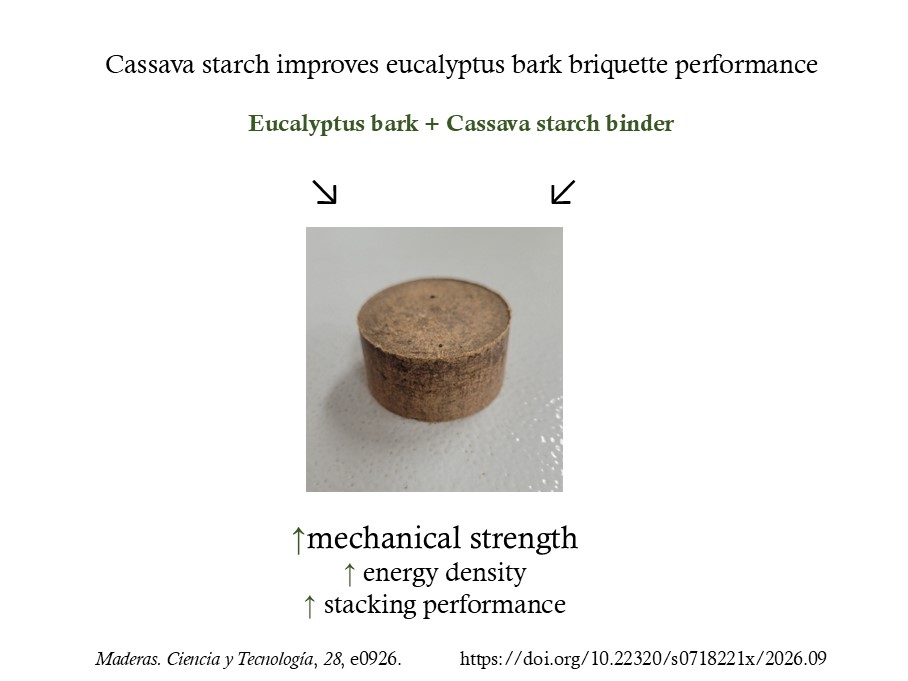
Brazil has a vast area of planted forests, which makes it the second largest producer of bark as a by-product. Several alternatives have been studied for the reuse of this residue; however, little attention has been given to the use of forest residues, such as bark, in the energy sector for briquette production and to the main variables involved in this process. The aim of this work was to evaluate the viability of producing briquettes from Eucalyptus bark. The briquettes were produced and characterized according to American and Brazilian standards, evaluating two different particle sizes and the addition of cassava starch. The briquettes produced from Eucalyptus bark show potential for use, although attention should be paid to their ash content. In particular, the treatment produced with a 12-mesh granulometry and the addition of cassava starch showed the best chemical, energetic, physical, and mechanical properties. The production of briquettes from Eucalyptus bark demonstrates the feasibility of reusing forest residues for bioenergy production.
Downloads
References
Amari, M.; Khimeche, K.; Hima, A.; Chebout, R.; Mezroua, A. 2021. Synthesis of green adhesive with tannin extracted from Eucalyptus bark for potential use in wood composites. Journal of Renewable Materials 9(3): 463-475. https://doi.org/10.32604/jrm.2021.013680
American Society for Testing and Materials. 2021. Standard Test Method for Ash in Wood. ASTM D1102-84. ASTM International, West Conshohocken, PA, USA.
American Society for Testing and Materials. 2023. Standard Test Method for Gross Calorific Value of Refuse-Derived Fuel by the Bomb Calorimeter. ASTM E711-87. ASTM International, West Conshohocken, PA, USA.
American Society for Testing and Materials. 2019. Standard Test Method for Moisture Analysis of Particulate Wood Fuels. ASTM E871-82. ASTM International, West Conshohocken, PA, USA.
American Society for Testing and Materials. 2019. Standard Test Method for Volatile Matter in the Analysis of Particulate Wood Fuels. ASTM E872-82. ASTM International, West Conshohocken, PA, USA.
Arachchige, U.S.P.R. 2021. Briquettes production as an alternative fuel. Nature Environment and Pollution Technology 20(4): 1661-1668. https://doi.org/10.46488/NEPT.2021.v20i04.029
Associação Brasileira de Normas Técnicas. 2011. Concreto e argamassa - Determinação da resistência à tração por compressão diametral de corpos de prova cilíndricos. ABNT NBR 7222. ABNT, Rio de Janeiro, Brasil.
Food and Agriculture Organization of the United Nations. 2020. The state of the world’s forests. FAO, Rome, Italy. https://openknowledge.fao.org/items/d0f20c1c-7760-4d94-86c3-d1e770a17db0
Fernandez, B.O.; Róz, A.L.; Gonçalves, B.F.; Nakashima, G.T.; Yamaji, F.M. 2018. The quality of sugarcane briquettes produced with cornstarch binder. Revista Virtual de Química 10(1): 142-154. https://doi.org/10.21577/1984-6835.20180013
Ferronato, N.; Calle Mendoza, I.J.; Gorritty Portillo, M.A.; Conti, F.; Torretta, V. 2022. Are waste-based briquettes alternative fuels in developing countries? A critical review. Energy for Sustainable Development 68: 220-241. https://doi.org/10.1016/j.esd.2022.03.013
Foelkel, C. 2006. Casca da árvore do eucalipto. Grau Celsius. Porto Alegre, Brasil. https://www.eucalyptus.com.br/capitulos/capitulo_casca.pdf
García, R.; Pizarro, C.; Lavín, A.G.; Bueno, J.L. 2014. Spanish biofuels heating value estimation. Part II: proximate analysis data. Fuel 117(1): 1139-1147. https://doi.org/10.1016/j.fuel.2013.08.049
Indústria Brasileira de Árvores. 2023. Relatório Anual. IBA, Brasil. https://iba.org/datafiles/publicacoes/relatorios/relatorio-anual-iba2023-r.pdf
Kumar, J.A.; Kumar, K.V.; Petchimuthu, M.; Iyahraja, S.; Kumar, D.V. 2021. Comparative analysis of briquettes obtained from biomass and charcoal. Materials Today: Proceedings 45(1): 857-861. https://doi.org/10.1016/j.matpr.2020.02.918
Križan, P. 2022. Biomass Compaction: The Effects of Pressing Chamber Design Parameters on Extrusion Quality. 1st ed. Springer. https://doi.org/10.1007/978-3-030-89956-1
Litefti, K.; Freire, M.S.; Stitou, M.; Gonzáles-Álvarez, J. 2024. Biosorption of methylene blue and malachite green from single and binary solutions by Pinus pinaster bark. Maderas. Ciencia y Tecnología 26: 1-12. https://doi.org/10.22320/s0718221x/2024.14
Lykidis, C.; Kamperidou, V.; Mantanis, G.I. 2023. The use of black pine bark for improving the properties of wood pellets. Forests 14(6): 1-12. https://doi.org/10.3390/f14061069
Miola, B.; Frota, M.M.M.; Oliveira, A.G.; Uchôa, K.M.; Leandro Filho, F.A. 2020. Aproveitamento energético dos resíduos de cascas de coco verde para produção de briquetes. Engenharia Sanitária e Ambiental 25(4): 627-634. https://doi.org/10.1590/s1413-4152202020180029
Mugabi, P.; Kisakye, D.B. 2021. Status of production, distribution and determinants of biomass briquette acceptability in Kampala city, Uganda. Maderas. Ciencia y Tecnología 23: 1-8. https://doi.org/10.4067/s0718-221x2021000100413
Nakashima, G.T.; Adhman, I.C.S.; Hansted, A.L.S.; Belini, G.B.; Waldman, W.R.; Yamaji, F.M. 2017. Lignocellulosic materials: characterization and production of briquettes. Revista Virtual de Química 9(1): 150-162. https://doi.org/10.21577/1984-6835.20170012
Oladeji, J.T.; Enweremadu, C.C. 2012. The effects of some processing parameters on physical and densification characteristics of corncob briquettes. International Journal of Energy Engineering 2(1): 22-27. https://doi.org/10.5923/j.ijee.20120201.04
Prayitno, T.A.; Widyorini, R.; Lukmandaru, G. 2021. Chemical variation of five natural extracts by non-polar solvent. Maderas. Ciencia y Tecnología 23: 1-12. https://doi.org/10.4067/s0718-221x2021000100401
R Core Team. 2023. R: A language and environment for statistical computing. Version 4.2.2. R Foundation for Statistical Computing, Vienna, Austria. https://www.r-project.org/
Ribeiro, R.M.; Bahia, M.A.M.; Caetano, M.Z.G.; Sousa, P.H.C.V.; Fernandes, R.L.O.; Franco, M.P.; Sette Júnior, C.R. 2021. Briquette production with wood residues from Hymenolobium petraeum Ducke. Revista Virtual de Química 14(1): 31-34. https://doi.org/10.21577/1984-6835.20210094
Sabatti, M.; Fabbrini, F.; Harfouche, A.; Beritognolo, I.; Mareschi, L.; Carlini, M.; Paris, P.; Scarascia-Mugnozza, G. 2014. Evaluation of biomass production potential and heating value of hybrid poplar genotypes in a short-rotation culture in Italy. Industrial Crops and Products 61: 62-73. https://doi.org/10.1016/j.indcrop.2014.06.043
Sen, R.; Wiwatpanyaporn, S.; Annachhatre, A.P. 2016. Influence of binders on physical properties of fuel briquettes produced from cassava rhizome waste. International Journal of Environment and Waste Management 17(2): 158-174. https://doi.org/10.1504/IJEWM.2016.076750
Souza, C.O.; Arantes, M.D.C.; Pinto, J.A.; Silva, J.G.M.; Carneiro, M.F.; Lima, A.C.B.; Passos, R.R. 2022. Qualidade dos resíduos madeireiros de mogno-africano e eucalipto para briquetagem. Ciência Florestal 32(2): 637-652. https://doi.org/10.5902/1980509843299
Tumuluru, J.S.; Wright, C.T.; Hess, J.R.; Kenney, K.L. 2011. A review of biomass densification systems to develop uniform feedstock commodities for bioenergy application. Biofuels, Bioproducts and Biorefining 5(1): 683-707. https://doi.org/10.1002/bbb.324
Wilczynski, D.; Berdychowski, M.; Talaśka, K.; Wojtkowiak, D. 2021. Experimental and numerical analysis of the effect of compaction conditions on briquette properties. Fuel 288: 1-19. https://doi.org/10.1016/j.fuel.2020.119613
Downloads
Published
Issue
Section
License

This work is licensed under a Creative Commons Attribution 4.0 International License.
Los autores/as conservarán sus derechos de autor y garantizarán a la revista el derecho de primera publicación de su obra, el cuál estará simultáneamente sujeto a la Licencia de Reconocimiento de Creative Commons CC-BY que permite a terceros compartir la obra siempre que se indique su autor y su primera publicación esta revista.