
Mechanical and bonding performance of cross-laminated timber manufactured from heat-treated wood
DOI:
https://doi.org/10.22320/s0718221x/2026.25Keywords:
Cross-laminated timber, thermal modification, silane coupling agents, bonding performance, mechanical propertiesAbstract
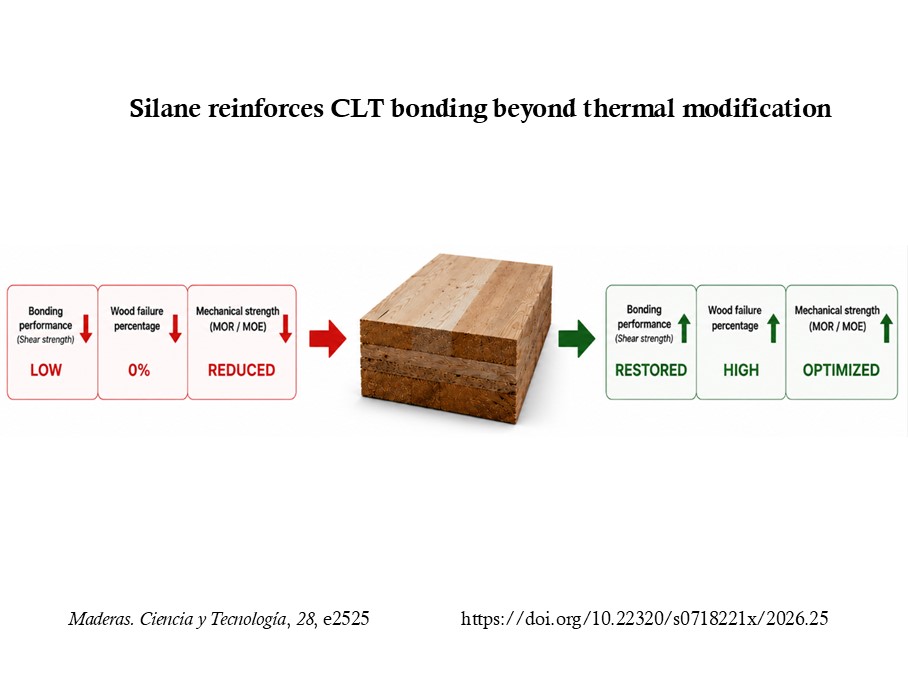
The chemical and surface changes induced by heat treatment can affect wood-adhesive interactions; however, limited attention has been given to the role of silane-based surface modification in enhancing the bonding and mechanical performance of heat-treated cross-laminated timber (CLT). Heat-treated Pinus sylvestris (Scots pine) and Abies bornmülleriana (Uludağ fir) were used as outer layers in the manufacture of three-layer CLT panels, and their mechanical properties were evaluated in this study. Heat treatment (HT) was carried out at 200 °C for 4 hours according to the Thermo-wood method. Layers were joined using one-component polyurethane-based adhesive. Some samples were treated with a silane-based coupling agent before bonding to improve bonding performance, and the effects of silane on bonding and mechanical properties were studied. Within this frame, tensile shear strength (TSS), bending shear strength (BSS), modulus of elasticity in bending (MOE), and tensile strength perpendicular to the surface (PTS) were measured. According to the results, silane modification generally improved mechanical performance, leading to a significant 74 % increase in PTS in Scots pine, while also affecting BSS (13 %) and MOE (7 %) in fir. In contrast, HT mainly altered bending-related behavior, most notably in Uludağ fir (BSS ≈ 10 %). Uludağ fir samples showed a higher BSS performance when compared to Scots pine ones. Overall, this study emphasizes that HT and silane modification can improve the mechanical performance of CLT, with effects varying by wood species and mechanical properties, providing valuable insights for the enhancement of low-durability wood.
Downloads
References
Ahn, K.S.; Pang, S.J.; Oh, J.K. 2021. Prediction of withdrawal resistance of single screw on Korean wood products. Journal of the Korean Wood Science and Technology 49(1): 93–102. https://doi.org/10.5658/WOOD.2021.49.1.93
Ajdinaj, D.; Cota, H.; Lato, E.; Quku, D. 2025. Surface quality of planed tangential and radial sections of thermally modified silver fir wood. Maderas. Ciencia y Tecnología 27(17): 1–9. http://dx.doi.org/10.22320/s0718221x/2025.17
Ali, M.R.; Abdullah, U.H.; Ashaari, Z.; Hamid, N.H.; Hua, L.S. 2021. Hydrothermal modification of wood: A review. Polymers 13(16). e2612. https://doi.org/10.3390/polym13162612
Altaher Omer Ahmed, A.; Garab, J.; Horváth-Szováti, E.; Kozelka, J.; Bejó, L. 2023. The bending properties of hybrid cross-laminated timber (CLT) using various species combinations. Materials 16(22), 7153. https://doi.org/10.3390/ma16227153
Altinok, M.; Ozalp, M.; Korkut, S. 2010. The effects of heat treatment on some mechanical properties of laminated beech (Fagus orientalis L.) wood. Wood Research 55(3): 131–142. https://www.woodresearch.sk/articles/5-17-143124_WR201003_13ozalp.pdf
Augustina, S.; Marbun, S.D.; Trisatya, D.R.; Santoso, E.B.; Pramadani, D.; Afni, N.N.; Fariha, T.A.; Cahyono, T.D.; Novriyanti, E.; Bula, M.; Bahanawan, A.; Sejati, P.S.; Kim, N.H.; Dwianto, W.; Gérardin, P. 2023. Dimensional stability and mechanical properties of citric acid impregnated samama wood (Anthocephalus macrophyllus (Roxb.) Havil.) at high curing temperatures. Journal of the Korean Wood Science and Technology 51(6): 431–446. https://doi.org/10.5658/WOOD.2023.51.6.431
Barbhuiya, S.; Das, B.B.; Kapoor, K.; Das, A.; Katare, V. 2025. Mechanical performance of bio-based materials in structural applications: A comprehensive review. Structures 75. e108726. https://doi.org/10.1016/j.istruc.2025.108726
Bi, W.; Li, H.; Hui, D.; Gaff, M.; Lorenzo, R.; Corbi, I.; Corbi, O.; Ashraf, M. 2021. Effects of chemical modification and nanotechnology on wood properties. Nanotechnology Reviews 10(1): 978–1008. https://doi.org/10.1515/ntrev-2021-0065
Bondsman, B.; Peplow, A. 2025. Experimental modal analysis and variability assessment in cross-laminated timber. Mechanical Systems and Signal Processing 228. e112466. https://doi.org/10.1016/j.ymssp.2025.112466
Bošanský, M.; Trcala, M. 2025. Numerical analysis of cross-laminated timber panels under three-point bending using laminate theory. Materials 18(22), 5232. https://doi.org/10.3390/ma18225232
BSI. 2013. Adhesives for load-bearing timber structures—Test methods—Part 1: Determination of longitudinal tensile shear strength. EN 302-1. British Standards Institution: London, UK.
BSI. 2016. Adhesives—Wood adhesives for non-structural applications—Determination of tensile shear strength of lap joints. BS EN 205. British Standards Institution: London, UK.
Broushakian, V.; Mohebby, B. 2025. Moisture distribution in cross laminated timber (CLT) made from heat-treated wood. European Journal of Wood and Wood Products 83(53): 1–9. https://doi.org/10.1007/s00107-025-02212-4
Chen, G.; Gupta, A.; Mekonnen, T.H. 2023. Effects of wood fiber loading, silane modification and crosslinking on the thermomechanical properties and thermal conductivity of EPDM biocomposite foams. Industrial Crops and Products 200. e116911. https://doi.org/10.1016/j.indcrop.2023.116911
Chen, C.C.; Mo, J.; Haviarova, E. 2025a. Adding value to hardwoods—Thin hardwood cross-laminated timber (HCLT). Wood Material Science and Engineering 20(3): 741–743. https://doi.org/10.1080/17480272.2025.2457558
Chen, H.; Ma, W.; Kasal, B.; Wei, Y.; Yan, L. 2025b. Flexural behavior of adhesively bonded cross-laminated timber-concrete composite (TCC) panel with glass-fiber textile mesh as reinforcement in concrete: Experimental studying and numerical simulation. Engineering Structures 330. 119916. https://doi.org/10.1016/j.engstruct.2025.119916
Song, D.B.; Kim, K.H. 2023. Influence of composition of layer layout on bending and compression strength performance of larix cross-laminated timber (CLT). Journal of the Korean Wood Science and Technology 51(4): 239–252. https://doi.org/10.5658/WOOD.2023.51.4.239
Dunky, M. 2017. Adhesives in the Wood Industry. In: Pizzi, A.; Mittal, K.L. (Eds.), Handbook of Adhesive Technology. 3rd ed. CRC Press, Boca Raton, FL, USA, pp. 511–574. ISBN: 9781498736473. https://doi.org/10.1201/9781315120942-20
Fariha, T.A.; Marbun, S.D.; Sudarmanto; Narto; Bahanawan, A.; Sejati, P.S.; Darmawan, T.; Triwibowo, D.; Adi, D.S.; Amin, Y.; Augustina, S.; Dwianto, W.; Sari, R.K.; Alipraja, I.; Wahyudi, I.; Kusuma, E.L.R. 2025. The surface characteristics and physical properties of sengon wood at high-temperature heating treatments. Indonesian Journal of Forestry Research 12(1): 135–149. https://doi.org/10.59465/ijfr.2025.12.1.135-149
Gurleyen, L.; Ayata, U.; Esteves, B.; Cakicier, N. 2017. Effects of heat treatment on the adhesion strength, pendulum hardness, surface roughness, color and glossiness of Scots pine laminated parquet with two different types of UV varnish application. Maderas. Ciencia y Tecnología 19(2): 213–224. https://doi.org/10.4067/S0718-221X2017005000019
Heräjärvi, H.; Kunttu, J.; Hurmekoski, E.; Hujala, T. 2020. Outlook for modified wood use and regulations in circular economy. Holzforschung 74(4): 334–343. https://doi.org/10.1515/hf-2019-0053
Hill, C.; Altgen, M.; Rautkari, L. 2021. Thermal modification of wood—A review: Chemical changes and hygroscopicity. Journal of Materials Science 56(11): 6581–6614. https://doi.org/10.1007/s10853-020-05722-z
Jeleč, M.; Varevac, D.; Rajčić, V. 2018. Cross-laminated timber (CLT)—A state of the art report. Građevinar 70(2): 75–95. https://doi.org/10.14256/JCE.2071.2017
Jerves, R.A. 2021. Thermally modified composite wood-strand panels for building construction applications. Master's Thesis. Washington State University, Pullman, WA, USA, p. 140. https://doi.org/10.7273/000000059
Kim, K.H.; Lee, H.M.; Lee, M. 2024. Evaluation of adhesive characteristics of mixed cross laminated timber (CLT) using yellow poplar and softwood structural lumbers. Journal of the Korean Wood Science and Technology 52(1): 58–69. https://doi.org/10.5658/WOOD.2024.52.1.58
Li, M.; Ren, H. 2022. Study on the interlaminar shear properties of hybrid cross-laminated timber (HCLT) prepared with larch, poplar and OSB. Industrial Crops and Products 189. e115756. https://doi.org/10.1016/j.indcrop.2022.115756
Liao, Y.; Tu, D.; Zhou, J.; Zhou, H.; Yun, H.; Gu, J.; Hu, C. 2017. Feasibility of manufacturing cross-laminated timber using fast-grown small diameter eucalyptus lumbers. Construction and Building Materials 132: 508–515. https://doi.org/10.1016/j.conbuildmat.2016.12.027
Lu, W.; Gu, J.; Wang, B. 2019. Study on flexural behavior of cross‐laminated timber based on different tree species. Advances in Materials Science and Engineering 2019(1), 1728258. https://doi.org/10.1155/2019/1728258
Mamoňová, M.; Ciglian, D.; Reinprecht, L. 2022. SEM analysis of glued joints of thermally modified wood bonded with PUR and PVAc glues. Materials 15(18). e6440. https://doi.org/10.3390/ma15186440
Özan, Z.E. 2017. Isıl işlem görmüş ahşap malzemenin çapraz lamine kereste üretiminde kullanım olanaklarının araştırılması. Master's Thesis. Bartın University, Graduate School of Natural and Applied Sciences: Bartın, Türkiye. 61 pp. http://hdl.handle.net/11772/405
Özan, Z.E.; Onat, S.M.; Aydemir, D. 2017. The effects of thermal treatment on some properties of Scots pine and Uludağ fir woods. Journal of Bartin Faculty of Forestry 19(1): 187–193.
Papadopoulos, A.N. 2019. Advances in wood composites. Polymers 12(1). e48. https://doi.org/10.3390/polym12010048
Priadi, T.; Sholihah, M.; Karlinasari, L. 2019. Water absorption and dimensional stability of heat-treated fast-growing hardwoods. Journal of the Korean Wood Science and Technology 47(5): 567–578. https://doi.org/10.5658/WOOD.2019.47.5.567
Sandberg, D.; Kutnar, A.; Mantanis, G. 2017. Wood modification technologies—A review. iForest – Biogeosciences and Forestry 10(6): 895–908. https://doi.org/10.3832/ifor2380-010
Sikora, K.S.; McPolin, D.O.; Harte, A.M. 2016. Effects of the thickness of cross-laminated timber (CLT) panels made from Irish Sitka spruce on mechanical performance in bending and shear. Construction and Building Materials 116: 141–150. https://doi.org/10.1016/j.conbuildmat.2016.04.145
Statgraphics Technologies Inc. 2016. Statgraphics Centurion XVI (Version 16). Statistical analysis software. Statgraphics Technologies, Inc., Warrenton, VA, USA. https://www.statgraphics.com/centurion-xvi
Suleimana, A.; Sena, C.S.; Branco, J.M.; Camões, A. 2020. Ability to glue Portuguese eucalyptus elements. Buildings 10(7). e133. https://doi.org/10.3390/buildings10070133
TS. 1976a. Wood—Determination of moisture content for physical and mechanical tests. TS 2471. Turkish Standards Institution: Ankara, Türkiye.
TS. 1976b. Wood—Determination of density for physical and mechanical tests. TS 2472. Turkish Standards Institution: Ankara, Türkiye.
TS. 1999. Wood-based panels—Determination of modulus of elasticity in bending and of bending strength. TS EN 310. Turkish Standards Institution: Ankara, Türkiye.
Vidholdová, Z.; Ciglian, D.; Reinprecht, L. 2021. Bonding of the thermally modified Norway spruce wood with the PUR and PVAc adhesives. Acta Facultatis Xylologiae Zvolen 63(1): 63–73. https://doi.org/10.17423/AFX.2021.63.1.06
Wang, Q.; Xiao, Z.; Wang, W.; Xie, Y. 2015. Coupling pattern and efficacy of organofunctional silanes in wood flour-filled polypropylene or polyethylene composites. Journal of Composite Materials 49(6): 677–684. https://doi.org/10.1177/0021998314525065
Downloads
Published
Issue
Section
License

This work is licensed under a Creative Commons Attribution 4.0 International License.
Los autores/as conservarán sus derechos de autor y garantizarán a la revista el derecho de primera publicación de su obra, el cuál estará simultáneamente sujeto a la Licencia de Reconocimiento de Creative Commons CC-BY que permite a terceros compartir la obra siempre que se indique su autor y su primera publicación esta revista.