
Comparing the effects of anatomical structural differences in different wood species on the industrial processing capabilities of computer controlled lasers
DOI:
https://doi.org/10.22320/s0718221x/2026.27Keywords:
Laser wood processing, laser wood carving, CNC laser, industrial production, anatomical differences in woodAbstract
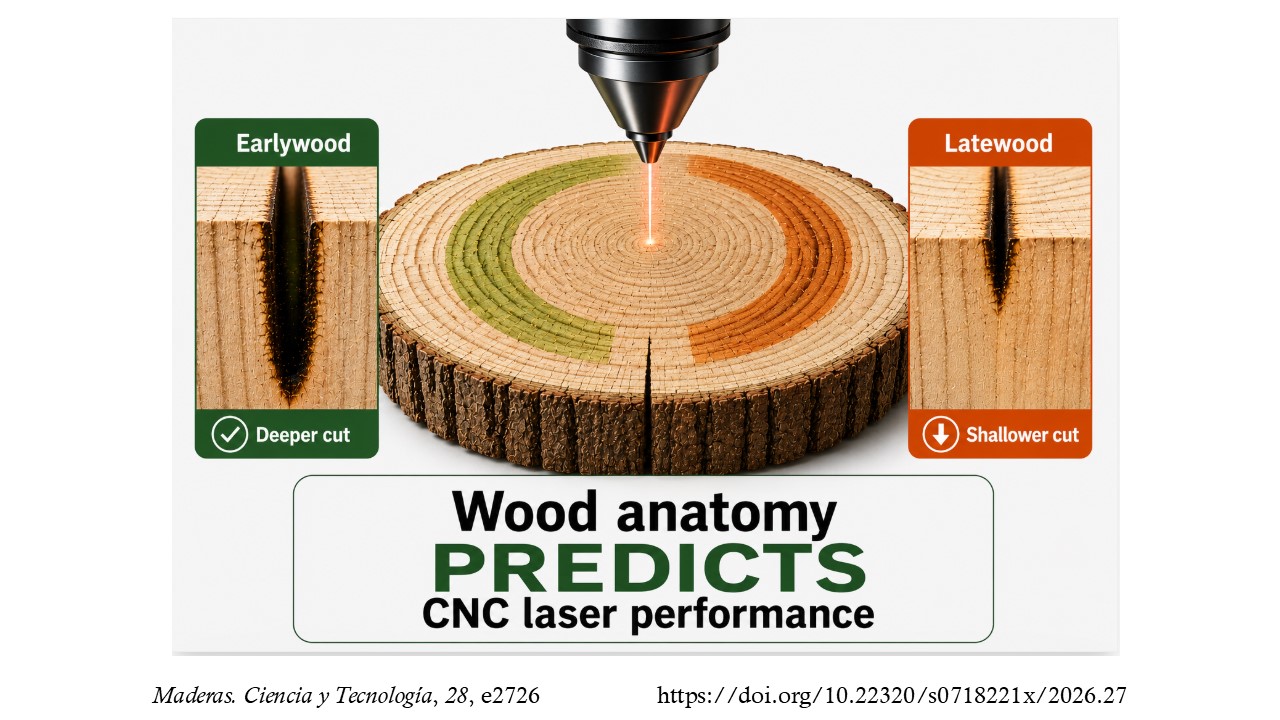
This study aims to compare the effects of anatomical structural differences in different tree species on the industrial processing capabilities of CNC lasers. For this purpose, solid wood materials were laser-cut at a speed of 10 mm/s and laser-engraved at a feed rate of 200 mm/s using a 130-watt carbon dioxide-filled glass tube CNC laser machine. The effects of the anatomical structures of six different solid wood materials (heartwood, sapwood, early wood, and late wood) on laser cutting and laser engraving were investigated. The macroscopic anatomical structure of the wood was examined in terms of ease of direct application in production. As a result, for all six different solid wood materials, it was found that early wood sections were easier to process than late wood sections in both laser cutting and laser engraving. The differences in laser processing performance between early and late wood were found to be statistically significant. The positive or negative effects of heart, sapwood, and heartwood anatomical sections on both laser cutting and laser engraving were not found to be statistically significant for all tree species. However, these effects were evaluated proportionally among all tree species. Overall, the heartwood and sapwood of solid wood species showed approximately the same laser cutting performance, with heart exhibiting lower laser cutting performance. On the other hand, the sapwood of solid wood species generally showed better laser engraving performance than both heart and heartwood, while heart and heartwood showed approximately the same laser engraving performance. Consequently, it was concluded that laser operators would be more accurate to separately evaluate the positive or negative effects of anatomical cross-sections of heartwood and sapwood on both laser cutting and laser engraving for each wood species, based on numerical data.
Downloads
References
Açık, C. 2022. Investigation and application of CNC laser production parameters in industrial wood product design. Ph.D. Thesis. Kahramanmaraş Sütçü İmam University, Institute of Science and Technology, Department of Forestry Industrial Engineering. Kahramanmaraş, Turkey. 250 p. https://tez.yok.gov.tr/UlusalTezMerkezi/tezSorguSonucYeni.jsp
Açık, C.; Tutuş, A. 2023. Investigation of CNC laser processing performance of some wood species used in industrial product manufacturing. Journal of the Faculty of Engineering and Architecture of Gazi University 38(1): 461–470. https://doi.org/10.17341/gazimmfd.986215
Barnekov, V.G.; McMillin, C.W.; Huber, H.A. 1986. Factors influencing laser cutting of wood. Forest Products Journal 36(1): 55–58. https://research.fs.usda.gov/treesearch/7972
Bozkurt, Y.; Erdin, N. 2011. Wood Technology. Istanbul University Faculty of Forestry Textbook. 372 p. Istanbul University Publication No: 5029 Faculty of Forestry Publication No: 445 ISBN No: 978-975-404-900-8. Istanbul, Türkiye.
Cherif, M. 1990. Precision cutting of hardwooden by using a high energy carbon dioxide laser. Master’s Thesis. Michigan State University, Institute of Science, Metallurgy Mechanics and Materials Science. 81 p.
Gurau, L.; Petru, A.; Varodi, A.; Timar, M.C. 2017. The influence of CO₂ laser beam power output and scanning speed on surface roughness and colour changes of beech (Fagus sylvatica). BioResources 12(4): 7395–7412. https://doi.org/10.15376/biores.12.4.7395-7412
Guo, X.; Deng, M.; Hu, Y.; Wang, Y.; Ye, T. 2021. Morphology, mechanism and kerf variation during CO₂ laser cutting pine wood. Journal of Manufacturing Processes 68: 13–22. https://doi.org/10.1016/j.jmapro.2021.05.036
Katik, F.; Kubovsky, I. 2011. Chemical changes of beech wood due to CO₂ laser irradiation. Journal of Photochemistry and Photobiology A: Chemistry 222: 105–110. https://doi.org/10.1016/j.jphotochem.2011.05.008
Kubovsky, I.; Kristak, L.; Suja, J.; Gajtanska, M.; Igaz, R.; Ruziak, I.; Reh, R. 2020. Optimization of parameters for the cutting of wood-based materials by a CO₂ laser. Applied Sciences 10 (22), 8113; DOI: 10.3390/app10228113
Li, R.; Xu, W.; Wang, X.; Wang, C. 2018. Modeling and predicting of the color changes of wood surface during CO₂ laser modification. Journal of Cleaner Production 183: 818–823. DOI: https://doi.org/10.1016/j.jclepro.2018.02.194
Merchant, V.E. 1995. The influence of cutting assist gas and pressure on the laser cutting of lumber products. ICALEO '95 Proceedings: Laser Materials Processing Conference Proceedings. San Diego, California, USA. (pp. 128-137). ASME. https://doi.org/10.2351/1.5058897
Petru, A.; Lunguleasa, A. 2017. Colour influence of the laser raster speed on wood pyrography. Pro Ligno 13: 508–515. https://www.proligno.ro/ro/articles/2017/4/PETRU.pdf
Downloads
Published
Issue
Section
License

This work is licensed under a Creative Commons Attribution 4.0 International License.
Los autores/as conservarán sus derechos de autor y garantizarán a la revista el derecho de primera publicación de su obra, el cuál estará simultáneamente sujeto a la Licencia de Reconocimiento de Creative Commons CC-BY que permite a terceros compartir la obra siempre que se indique su autor y su primera publicación esta revista.