
Pre-Treatment condition and preservative treatment quality of Eucalypt electricity distribution poles in Uganda
DOI:
https://doi.org/10.22320/s0718221x/2026.33Keywords:
Eucalyptus, moisture content, preservative penetration, preservative retention, utility poles, wood preservationAbstract
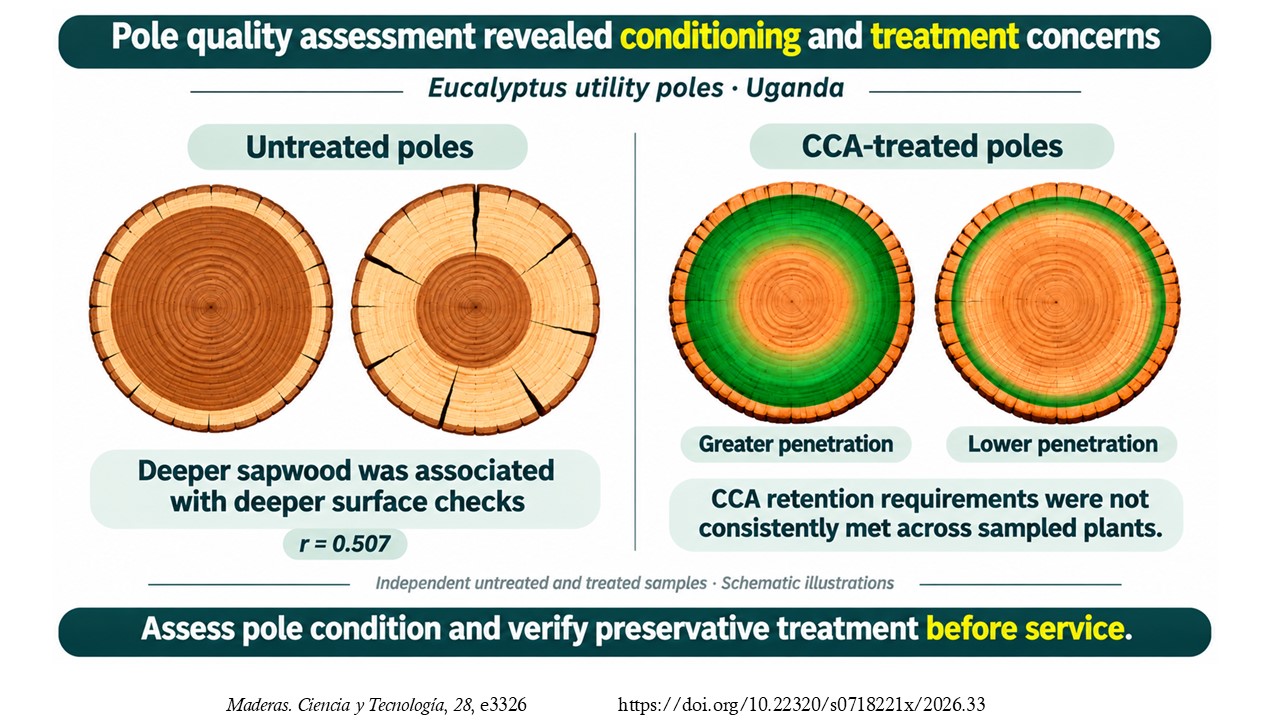
The durability of wooden poles is important for reliable electricity distribution. In Uganda, premature failure of treated poles has caused substantial replacement costs, yet the condition of poles presented for treatment and the consistency of preservative treatment achieved by treatment plants have not been sufficiently characterized as potential quality-control concerns. This study assessed moisture content, sapwood depth and drying defects in seasoned Eucalyptus poles before preservation, and preservative penetration and retention after treatment. Two separate and independent sets of poles were assessed. The first comprised 338 untreated, air-seasoned poles awaiting preservative treatment, while the second comprised 338 treated poles, consisting of 278 CCA-treated and 60 creosote-treated poles. Thus, a total of 676 poles were assessed. The poles, obtained from six treatment companies in Uganda, were 9 m, 10 m, 12 m and 14 m in length. Among the untreated poles, mean moisture content was 28,5% at the theoretical ground line (TGL) and 30 % at the midpoint, while mean sapwood depth was 23,75 mm. Sapwood depth was moderately positively correlated with surface-check depth. Among the treated poles, mean CCA penetration was 23 mm at TGL and 21 mm at midpoint, while mean CCA retention was 21,8 kg/m³ and 18,3 kg/m³, respectively. For creosote-treated poles, mean penetration was 27 mm at TGL and 21 mm at midpoint, while mean retention was 254,7 kg/m³ and 173,3 kg/m³, respectively. The results demonstrate variability in pole conditioning, drying defects and preservative-treatment quality among the sampled plants. These conditions may be relevant to subsequent durability, but the study did not follow the sampled poles in service and therefore does not establish them as direct causes of premature failure. The findings support stronger quality control of pole conditioning, drying defects, and preservative penetration and retention before poles enter service.
Downloads
References
Arisandi, R.; Marsoem, S.N.; Sutapa, J.P.G.; Lukmandaru, G. 2023. The methods for measuring the area of heartwood and sapwood. Reviews in Agricultural Science 11: 76–92. https://doi.org/10.7831/ras.11.0_76
Boreman, R. 2020. Reliability and sustainability of wood poles in the electrical power distribution network. MPhil Dissertation. University of Johannesburg: Johannesburg, South Africa. https://hdl.handle.net/10210/453069
Butler, B.J.; Sass, E.M. 2023. Wood supply from family forests of the United States: Biophysical, social, and economic factors. Forest Science 69(6): 629–642. https://doi.org/10.1093/forsci/fxad034
East African Community. EAC. 2023a. DEAS 322:2023. Wood poles, cross-arms and blocks for power and telecommunication lines — Specification. Second Edition. East African Community: Arusha, Tanzania. 38 pp.
East African Community. EAC. 2023b. DEAS 324:2023. Copper/chromium/arsenic compositions for the preservation of timber — Method for timber treatment. Second Edition. East African Community: Arusha, Tanzania. 22 pp.
Gezer, E.D.; Temiz, A.; Yüksek, T. 2015. Inspection of wooden poles in electrical power distribution networks in Artvin, Turkey. Advances in Materials Science and Engineering 2015: e659818. https://doi.org/10.1155/2015/659818
Kirker, G.T.; Lebow, S.T. 2021. Wood preservatives. In: Ross, R.J. (ed.). Wood handbook—Wood as an engineering material. General Technical Report FPL-GTR-282. U.S. Department of Agriculture, Forest Service, Forest Products Laboratory: Madison, WI, USA, Chapter 15, 26 pp. https://research.fs.usda.gov/treesearch/62259
Mugabi, P. 2007. Moisture content and drying defects in kiln-dried Eucalyptus grandis poles. PhD Dissertation (Forest and Wood Science). Stellenbosch University: Stellenbosch, South Africa. https://hdl.handle.net/10019.1/4575
Mugabi, P.; Otuko, E. 2019. Effectiveness of copper chrome arsenate and used engine oil in protecting fencing posts of Ugandan grown eucalypt clone GC550 and Phoenix reclinata against termite attack. Maderas. Ciencia y Tecnología 21(1): 97–104. https://doi.org/10.4067/S0718-221X2019005000109
Mugabi, P.; Rypstra, T.; Vermaas, H.F.; Nel, D.G. 2010. Relationships between drying defect parameters and some growth characteristics in kiln-dried South African grown Eucalyptus grandis poles. European Journal of Wood and Wood Products 68(3): 329–340. https://doi.org/10.1007/s00107-009-0375-4
Mugabi, P.; Thembo, J. 2018. Effect of pole size on preservative penetration and retention in air-dried Ugandan grown eucalypt utility poles. Maderas. Ciencia y Tecnología 20(1): 85–90. https://doi.org/10.4067/S0718-221X2018005001701
Otuko, E.; Mugabi, P.; Nabatanzi, T.; Kityo, P.; Kakeeto, P.; Kinhonhi, I.; Kansiime, F. 2024. Performance of treated wooden electricity distribution poles in service in Uganda. European Journal of Wood and Wood Products 82(6): 1755–1765. https://doi.org/10.1007/s00107-024-02104-z
Poonia, P.K.; Tripathi, S.; Sihag, K.; Kumar, S. 2015. Effect of microwave treatment on air permeability and preservative impregnation of Eucalyptus tereticornis wood. Journal of the Indian Academy of Wood Science 12(2): 89–93. https://doi.org/10.1007/s13196-015-0148-0
Ribera, J.; Schubert, M.; Fink, S.; Cartabia, M.; Schwarze, F.W.M.R. 2017. Premature failure of utility poles in Switzerland and Germany related to wood decay basidiomycetes. Holzforschung 71(3): 241–247. https://doi.org/10.1515/hf-2016-0134
Ryan, P.C.; Stewart, M.G.; Spencer, N. 2015. Cost-effective design and maintenance of timber power distribution poles in a changing climate. In: Proceedings of the 12th International Conference on Applications of Statistics and Probability in Civil Engineering (ICASP12). Vancouver, Canada, 12–15 July 2015, pp. 1–8. https://open.library.ubc.ca/media/stream/pdf/53032/1.0076028/1
Salman, A.M.; Li, Y. 2016. Age-dependent fragility and life-cycle cost analysis of wood and steel power distribution poles subjected to hurricanes. Structure and Infrastructure Engineering 12(8): 890–903. https://doi.org/10.1080/15732479.2015.1053949
Sargent, R.; Gaunt, D.; Riley, S.; Stovold, T.; Suontama, M.; Emms, G. 2017. Drying Eucalyptus nitens: Screening for checking and collapse. Specialty Wood Products Research Partnership, Technical Report SWP-T022. New Zealand Forest Owners Association: Wellington, New Zealand. https://www.nzffa.org.nz/system/assets/5161/SWP-T022.pdf
South African Bureau of Standards. SABS. 2017. SANS 673:2017. Mixtures of copper-chromium-arsenic compounds for timber preservation. Edition 3.04. South African Bureau of Standards: Pretoria, South Africa.
Ssemaganda, I.E.; Mugabi, P.; Tumwebaze, S.B. 2011. Effectiveness of selected preservatives in protecting Ugandan grown Eucalyptus grandis wood against termite attack. Maderas. Ciencia y Tecnología 13(2): 135–142. https://doi.org/10.4067/S0718-221X2011000200001
Wood, K.C.; Morrell, J.J.; Leggate, W. 2020. Enhancing the durability of low durability Eucalyptus plantation species: A review of strategies. In: Proceedings of the IRG51 Annual Meeting/Webinar. IRG/WP 20-40910. The International Research Group on Wood Protection: Stockholm, Sweden. 19 pp. https://era.daf.qld.gov.au/8056/1/IRG20-40910.pdf
Downloads
Published
Issue
Section
License

This work is licensed under a Creative Commons Attribution 4.0 International License.
Los autores/as conservarán sus derechos de autor y garantizarán a la revista el derecho de primera publicación de su obra, el cuál estará simultáneamente sujeto a la Licencia de Reconocimiento de Creative Commons CC-BY que permite a terceros compartir la obra siempre que se indique su autor y su primera publicación esta revista.