Bonding performance of Pinus caribaea varieties under different adhesives systems for edge glued panels production
DOI:
https://doi.org/10.22320/s0718221x/2026.20Keywords:
Pinus caribaea varieties, shear strength, wood bonding, wood adhesivesAbstract
The performance of bonded wood products depends on wood properties and adhesive systems, resulting in variability in bonding. Although Pinus caribaea has been introduced in Brazil since the mid-20th century and presents potential for commercial use, there is still a lack of studies evaluating the bonding performance of its different varieties. In particular, comparative analyses of bonding behavior among varieties under different adhesive systems remain limited, especially for industrial applications such as edge glued panels.
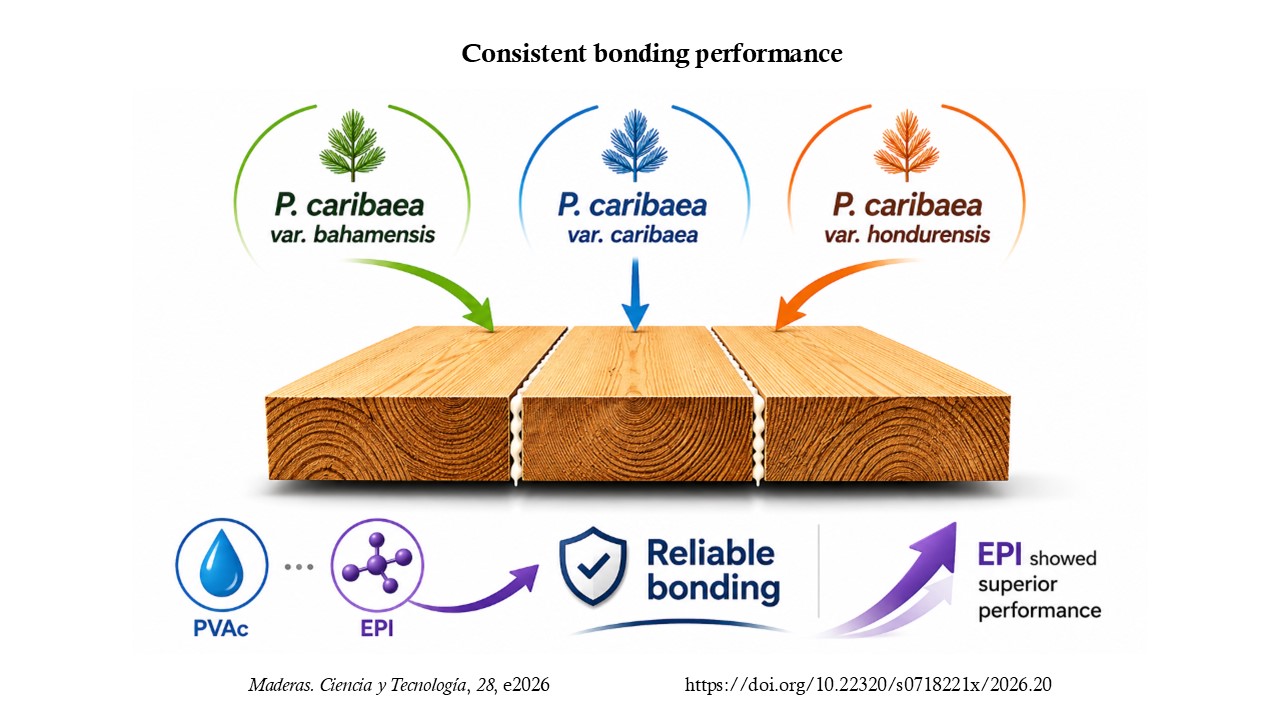
In the context, this study evaluated the bonding performance of three Pinus caribaea varieties affects using different adhesive systems (PVAc and EPI), for the production of edge glued panels using Pinus taeda as a reference. Wood samples from three varieties originating from 17- and 18-year-old experimental plantations were characterized in terms of physical and chemical properties according to COPANT and TAPPI standards. Bonding performance was assessed through finger joint (bending and tension) and edge bonding (shear strength) tests using PVAc and EPI adhesives, following ASTM and EN standards, with statistical analysis based on a factorial design.
The results indicated that all varieties of Pinus caribaea exhibited low density, similar to Pinus taeda, although with higher extractive contents. All varieties achieved satisfactory performance in finger joint tests, meeting or exceeding ASTM requirements and showing results comparable to the reference species. In edge bonding, the varieties performed similarly or superiorly to Pinus taeda, with emphasis on the bahamensis variety. The EPI adhesive showed superior performance compared to PVAc.
These findings demonstrate that intra-species variability does not limit bonding performance and confirm the technical feasibility of using Pinus caribaea varieties in the production of edge glued panels. The results contribute to expanding the industrial applicability of this species, supporting its use as an alternative raw material in the wood products sector.
Downloads
References
Albuquerque, C.C.; Iwakiri, S.; Keinert, S.; Trianoski, R. 2020. Adesão e adesivos. In: Iwakiri, S.; Trianoski, R. (eds.). Painéis de madeira reconstituída. Fundação de Pesquisas Florestais do Paraná (FUPEF): Curitiba, PR, Brasil, 260 p. ISBN 978-85-86617-00-9.
Almeida, N.F.; Bortoletto Junior, G.; Mendes, R.F.; Surdi, P.G. 2014. Produção e avaliação da qualidade de lâminas de madeira de um híbrido de Pinus elliottii var. elliottii × Pinus caribaea var. hondurensis. Floresta e Ambiente 21(2): 261–268. https://doi.org/10.4322/floram.2014.022
ASTM International. 2005. Standard specification for adhesives used for finger joints in nonstructural lumber products. ASTM D5572-95(2005). ASTM International: West Conshohocken, PA, USA.
Barboutis, I.; Kamperidou, V. 2021. Shear strength of beech wood joints bonded with commercially produced PVAc D3 adhesives. International Journal of Adhesion and Adhesives 105. e102774. https://doi.org/10.1016/j.ijadhadh.2020.102774
Belleville, B.; Lancelot, K.; Galore, E.; Fehrmann, J.; Ozarska, B. 2024. Gluing characteristics of Papua New Guinea timber species for various non-structural applications. Maderas. Ciencia y Tecnología 26. e1024. https://doi.org/10.22320/s0718221x/2024.10
Bajaluk Bilik, A.C.; Trianoski, R.; Iwakiri, S.; Camargo Angelo, A. 2025. Technological potential of Eucalyptus dunnii wood from different fertilization and genetic sources for the production of edge glued panels. Maderas. Ciencia y Tecnología 27. e2725. https://doi.org/10.22320/s0718221x/2025.27
Businský, R. 2016. New insight into the morphology of the long shoots of Pinus (Pinaceae). Flora 223: 167–190. https://doi.org/10.1016/j.flora.2016.05.010
Chudnoff, M. 1984. Tropical timbers of the world. USDA Forest Service: Washington, DC, USA.
Clauß, S.; Joscak, M.; Niemz, P. 2011. Thermal stability of glued wood joints measured by shear tests. European Journal of Wood and Wood Products 69: 101–111. https://doi.org/10.1007/s00107-010-0411-4
Comisión Panamericana de Normas Técnicas. 1972. Maderas: método de determinación del peso específico aparente. COPANT 461. COPANT: Caracas, Venezuela.
Comisión Panamericana de Normas Técnicas. 1972. Maderas: método de determinación de la contracción. COPANT 462. COPANT: Caracas, Venezuela.
European Committee for Standardization. 2008. Solid wood panels (SWP) – Requirements. EN 13353:2008. CEN: Brussels, Belgium.
European Committee for Standardization. 2009. Solid wood panels – Bonding quality – Test method. EN 13354:2009. CEN: Brussels, Belgium.
European Committee for Standardization. 2002. Wood-based panels – Determination of density. EN 323:2002. CEN: Brussels, Belgium.
Foelkel, C. 2008. Os pinus no Brasil: Pinus caribaea e suas três variedades. PinusLetter 8. https://www.celso-foelkel.com.br/pinus_08.html
Freitas, M.M.; Sebbenn, A.M.; Marais, E.; Zanatto, A.C.S.; Sousa, C.M.R.; Lemos, S.V. 2005. Parâmetros genéticos em progênies de polinização aberta de Pinus caribaea var. bahamensis. Revista do Instituto Florestal 17(1): 103–111. https://doi.org/10.24278/2178-5031.2005171475
Frihart, C.R.; Hunt, C.G. 2021. Wood adhesives: bond formation and performance. In: Wood handbook: Wood as an engineering material. USDA Forest Service: Madison, WI, USA.
Ghofrani, M.; Mirkhandouzi, F.Z.; Ashori, A. 2016. Effects of extractives removal on the performance of clear varnish coatings on boards. Journal of Composite Materials 50(21): 3019–3024. https://doi.org/10.1177/0021998315615205
Gibson, G. 1987. A review of provenance testing of commercially important tropical pines. In: Silvicultura y mejoramiento genético de especies forestales. CIEF: Buenos Aires, Argentina.
Gomes, N.B.; Jardim, P.I.L.G.; Christoforo, A.L.; Souza, A.J.D.; Molina, J.C. 2025. Análise dos parâmetros de fabricação de elementos de madeira lamelada colada. Ambiente Construído 25. e136707. https://doi.org/10.1590/s1678-86212025000100786
Gonçalez, J.C.; Vieira, F.S.; Camargos, J.A.A.; Zerbini, N.J. 2009. Influência do sítio nas propriedades da madeira de Pinus caribaea var. hondurensis. Cerne 15(2): 251–255.
Klitzke, R.J. 2007. Secagem da madeira. In: Tecnologias aplicadas ao setor florestal brasileiro. UFES: Brasil.
Pereira Lima, C.K.; Akira Mori, F.; Marin Mendes, L.; Oliveira Carneiro, A.C. 2007. Características anatômicas e química da madeira de clones de Eucalyptus e sua influência na colagem. Cerne 13(2): 123–129.
Pizzi, A.; Papadopoulos, A.N.; Policardi, F. 2020. Wood composites and their polymer binders. Polymers 12(5). e1115. https://doi.org/10.3390/polym12051115
Sebbenn, A.M.; Vilas Boas, O.; Max, J.C.M.; Freitas, M.L.M. 2010. Estimativa de parâmetros genéticos e ganhos na seleção para caracteres de crescimento em teste de progênies de Pinus caribaea var. hondurensis e var. bahamensis, em Assis–SP. Revista do Instituto Florestal 22(2): 279–288. https://doi.org/10.24278/2178-5031.2010222267
Sellers, T. 1994. Adhesive in the wood industry. In: Handbook of adhesive technology. Marcel Dekker: USA.
Shimizu, J.Y. 2008. Pinus na silvicultura brasileira. Embrapa Florestas: Brasil.
Statgraphics Technologies, Inc. 2018. Statgraphics Centurion XVII: statistical software. Statgraphics Technologies, Inc.: The Plains, VA, USA. https://www.statgraphics.com/centurion-xvii
Technical Association of the Pulp and Paper Industry. 1997. Solvent extractives of wood and pulp. TAPPI T 204 cm-97. TAPPI: Atlanta, GA, USA.
Technical Association of the Pulp and Paper Industry. 2002. Ash in wood. TAPPI T 211 om-02. TAPPI: Atlanta, GA, USA.
Technical Association of the Pulp and Paper Industry. 2002. pH and electrical conductivity. TAPPI T 252 om-02. TAPPI: Atlanta, GA, USA.
Trianoski, R.; Iwakiri, S. 2020. Painéis colados lateralmente. In: Iwakiri, S.; Trianoski, R. (eds.). Painéis de madeira reconstituída. Fundação de Pesquisas Florestais do Paraná (FUPEF): Curitiba, PR, Brasil. ISBN 978-85-86617-00-9.
Vick, C.B. 1999. Adhesive bonding of wood materials. In: Wood handbook: Wood as an engineering material. General Technical Report FPL-GTR-113. USDA Forest Service, Forest Products Laboratory: Madison, WI, USA. https://doi.org/10.2737/FPL-GTR-113
Downloads
Published
Issue
Section
License

This work is licensed under a Creative Commons Attribution 4.0 International License.
Los autores/as conservarán sus derechos de autor y garantizarán a la revista el derecho de primera publicación de su obra, el cuál estará simultáneamente sujeto a la Licencia de Reconocimiento de Creative Commons CC-BY que permite a terceros compartir la obra siempre que se indique su autor y su primera publicación esta revista.